Is Vaping Legal in Pakistan?
Yes for adults. No law bans owning or using a vape, but sales to under-18s, indoor public use and some local orders are restricted. See what applies.
Short answer: Legal for adults, with limits
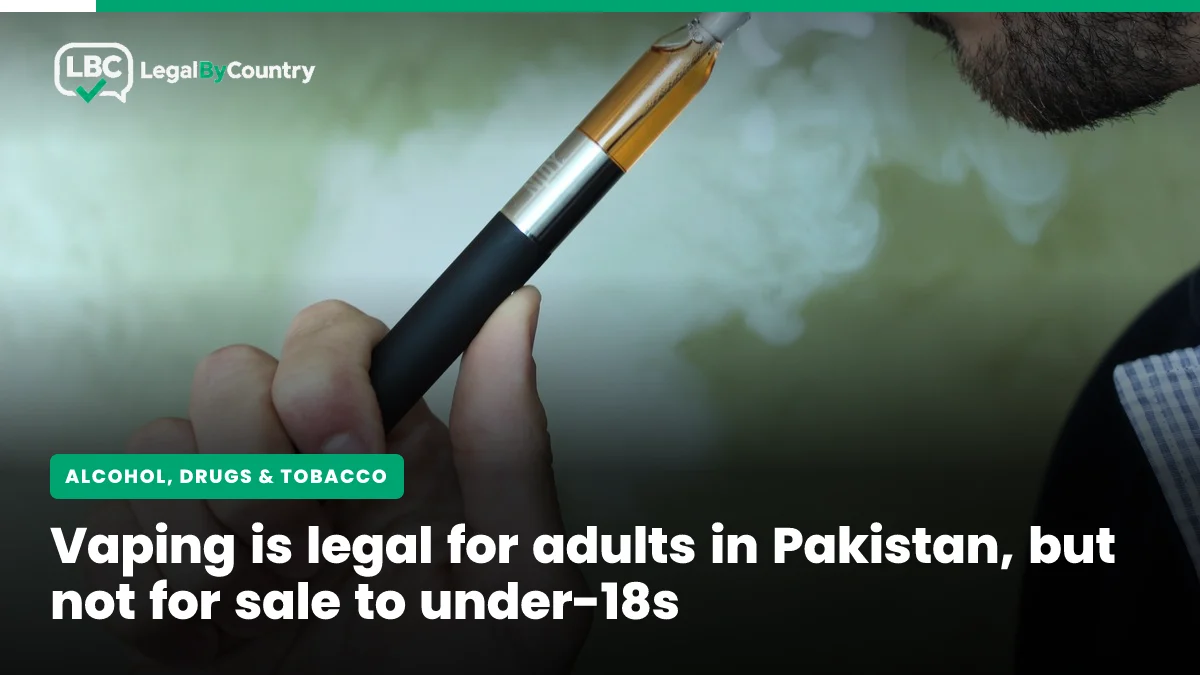
Yes, for adults. No federal or provincial law bans buying or using a vape. The Prohibition of Smoking and Protection of Non-smokers Health Ordinance, 2002 still bars sales to under-18s and use in indoor public places, and some provinces add local restrictions.
- The law
Prohibition of Smoking and Protection of Non-smokers Health Ordinance, 2002 (Ordinance No. LXXIV of 2002), ss. 2(g), 5, 6, 8, 9, 11, 12, 14
Federal Excise Act, 2005, First Schedule, Table I, serial 8a
Code of Criminal Procedure, 1898 (provincial and district orders), s. 144
- Penalty
- Selling a vape to anyone under 18 carries a fine of up to Rs 5,000, and for a repeat offence up to three months in prison or a fine of at least Rs 100,000, or both, under section 11(b) of the 2002 Ordinance.
General information only, not legal advice. For help with your own matter, consult a qualified lawyer or legal consultant. Read the disclaimer
Vaping is legal for adults in Pakistan, but the rules around it are thin
Walk through a market in Lahore or Karachi and you will pass a vape shop glowing with pods and e-liquids. In June 2025 Punjab police sealed many of them, and a court then ordered them reopened. So is vaping legal in Pakistan? For adults, yes.
No federal or provincial statute bans an adult from buying, owning or using an e-cigarette, as of 16 November 2026. The devices are imported, taxed by the Federal Board of Revenue and sold openly. What Pakistan lacks is a law written for vapes. Most of the rules that touch them come from a 2002 tobacco law drafted before e-cigarettes were common, from short-term district orders, and from provincial notifications.
That gap cuts both ways. Adults face very little legal risk for private use. Sellers, though, face crackdowns that can arrive with a cabinet decision, and several bills to regulate vaping are moving through the system. This guide sets out what is in force today, what was announced but not made law, and what is still only a proposal.
The 2002 smoking law was written for tobacco, not e-cigarettes
The main federal law is the Prohibition of Smoking and Protection of Non-smokers Health Ordinance, 2002. Its definition of "smoking" covers tobacco only, and it never mentions e-cigarettes, so how far it reaches vapes depends on wording that courts have not yet settled.
The Ordinance (No. LXXIV of 2002) extends to the whole of Pakistan. Section 2(g) defines "smoking" as "smoking of tobacco in any form whether in the form of cigarettes, cigar or otherwise with the aid of a pipe, wrapper or any other instrument." A typical vape heats a liquid containing nicotine, glycerine and flavouring. Nicotine comes from tobacco, but the liquid is not tobacco leaf, and nothing burns.
Some sections use wider words, and those matter more for vapes:
- Section 5 bans anyone from smoking "or use tobacco in any other form" in a place of public work or use.
- Section 8 bans selling "cigarettes or any other smoking substance" to anyone under 18.
- Section 9 bans storing, selling or distributing "any other smoking substance or any other tobacco product" within 50 metres of a school, college or other educational institution.
A nicotine e-liquid fits comfortably within "any other smoking substance" in ordinary speech, and Punjab has already applied the Ordinance to vapes in parks (see below). We found no superior court judgment that decides the point either way. The safe reading for a shopkeeper or a user is that these sections apply.
No amendment has added e-cigarettes to the Ordinance
We checked for an amending act or ordinance that brings e-cigarettes into the 2002 law and found none in force. The Senate bill described further down would create a separate law for Islamabad, but as of 16 November 2026 it has not passed both houses of Parliament.
Selling vapes to anyone under 18 breaks the law
Section 8 of the 2002 Ordinance bans selling cigarettes "or any other smoking substance" to a person under 18. Applied to vapes, a shop that sells a pod or e-liquid to a teenager commits an offence, with a fine that rises for a repeat offence.
The law punishes the seller, not the young buyer. Section 11(b) sets the penalty for breaking sections 7, 8 or 9. Section 14 makes those offences cognizable, meaning police can arrest without a warrant, and bailable, meaning the accused has a right to bail.
| Breach of the 2002 Ordinance | First offence | Second or later offence |
|---|---|---|
| Using in a place of public work or use, or in a public service vehicle (ss. 5, 6) | Fine up to Rs 1,000 | Fine from Rs 1,000 up to Rs 100,000 |
| Owner not displaying "No Smoking Zone" boards (s. 10) | Fine up to Rs 1,000 | Fine from Rs 1,000 up to Rs 100,000 |
| Selling to a person under 18 (s. 8) | Fine up to Rs 5,000 | Up to 3 months in prison, or a fine of at least Rs 100,000, or both |
| Storing or selling within 50 metres of an educational institution (s. 9) | Fine up to Rs 5,000 | Up to 3 months in prison, or a fine of at least Rs 100,000, or both |
| Advertising outside the official guidelines (s. 7) | Fine up to Rs 5,000 | Up to 3 months in prison, or a fine of at least Rs 100,000, or both |
Figures are from section 11 of the Ordinance as published, checked on 16 November 2026. We found no later federal amendment to these amounts.
Many retailers already refuse sales to under-18s as a store policy. Under section 8, that refusal is not a courtesy: it keeps the shop on the right side of the law.
Punjab announced a full ban in June 2025, and a court put it on hold
On 3 June 2025 the Punjab cabinet ordered a province-wide ban on the sale and purchase of vapes. Shops were sealed. The Lahore High Court then stayed the crackdown because no law backed it, and as of November 2026 no Punjab statute bans vaping.
The sequence, from dated reports:
- 3 June 2025: Chief Minister Maryam Nawaz Sharif announced at a cabinet meeting that the sale and purchase of vapes was banned across Punjab, and district administrations were told to close vaping outlets, ProPakistani reported. No act, ordinance or gazette notification was named.
- 16 June 2025: Justice Anwaar Hussain of the Lahore High Court issued notices to the chief secretary, home secretary and Lahore police chief on a petition by 74 vape dealers, but refused to unseal the shops at once, Dawn reported.
- Late June 2025: the court granted interim relief, ordered the shops de-sealed and restrained coercive action, after the government's law officer could not show a legal basis for the sealing, Daily Pakistan reported on 25 June 2025.
- 6 June 2026: a Daily Pakistan fact check found no Punjab or federal law that explicitly bans selling, owning or using vaping products.
- 27 October 2026: the Punjab government was preparing legislation on the sale, use and marketing of vapes, still at the consultation stage, Daily Pakistan reported.
A cabinet decision is a policy, not a law. Without an act of the Punjab Assembly, or a rule or notification made under one, the police have little to charge a seller with. That is the point the High Court picked up. We could not find a final judgment in the dealers' case, so the interim order is the latest ruling we can point to.
What Punjab has made binding
Two narrower Punjab measures do touch vapes:
- Parks (July 2025): the Housing, Urban Development and Public Health Engineering Department issued a notification under the 2002 Ordinance declaring public parks no-smoking areas. It covers e-cigarettes and vapes and bans their sale at tuck shops, cafes and vending points in or around parks, Dawn reported on 30 July 2025.
- School canteens (October 2026): amended food regulations published in the Punjab Gazette reportedly ban selling vapes and tobacco in canteens of schools, colleges and universities, and at food businesses within 100 metres of them. We have seen news reports of this, not the gazette text.
Khyber Pakhtunkhwa has used short emergency orders instead of a law
Khyber Pakhtunkhwa has restricted vapes through section 144 orders under the Code of Criminal Procedure, temporary orders that lapse after a set period. Each order we found ran for 60 days, and we could not confirm that any is in force today.
- January 2024: the KP Home and Tribal Affairs Department told deputy commissioners to ban the sale of e-cigarettes and vapes to people under 21, and their sale and storage within 50 metres of educational institutions, for 60 days, Business Recorder reported on 17 January 2024.
- June 2024: the Deputy Commissioner of Peshawar banned the use, sale, distribution, storage, promotion and sponsorship of e-cigarettes, vapes and nicotine pouches in District Peshawar for 60 days, The Nation reported on 21 June 2024.
Breaking a section 144 order is an offence under section 188 of the Pakistan Penal Code. Because these orders can be renewed at short notice, a person in KP should check with the local deputy commissioner's office before assuming no order applies.
For Sindh, Balochistan and Gilgit-Baltistan we found no vape-specific ban or notification. The 2002 Ordinance still applies there as it does elsewhere.
Islamabad's vape bill has cleared a Senate committee but is not law
The Electronic Nicotine Delivery Systems (Regulation) Bill, 2025 would set an 18-plus age limit, a schools buffer, an advertising ban and nicotine limits for vapes in Islamabad. A Senate committee recommended it in August 2026. Until both houses pass it, none of it binds anyone.
Senator Sarmad Ali introduced it as a private member's bill in December 2025. Reports from January 2026 described the draft: a minimum buying age of 18, no sales within 50 metres of schools and colleges, no vaping on public transport, in government offices or in parks, no advertising, a 40 mg/ml nicotine cap, and first-offence fines starting at Rs 50,000 (ProPakistani, 8 January 2026). On 20 August 2026 the Senate Standing Committee on Health unanimously recommended the bill, Dawn reported.
A bill recommended by a committee still has to pass the Senate, then the National Assembly, and receive the President's assent. Treat the figures above as a preview of likely rules for Islamabad, not as current fines.
Vapes are imported and taxed openly, which shows they are lawful goods
The federal government treats e-liquids as a taxable product. The Federal Excise Act, 2005 charges duty on "E-liquids by whatsoever name called, for electric cigarette kits" at Rs 16,500 per kilogram, as substituted by the Finance Act, 2026.
| Item | What applies | Source and as-of date |
|---|---|---|
| E-liquids for electric cigarette kits | Federal excise duty of Rs 16,500 per kg | Federal Excise Act, 2005, First Schedule, Table I, serial 8a, consolidated to 30 June 2026 |
| Importing devices and e-liquids | Allowed through Customs, with customs duty and sales tax | Petitioners told the Lahore High Court in June 2025 that federal policy allows import; we could not verify the current tariff rate |
| Undeclared or smuggled stock | Liable to seizure by Customs | Customs Act, 1969, general rules on undeclared goods |
The FBR's consolidated Federal Excise Act notes that serial 8a was first inserted by the Finance Act, 2020, and that the Finance Act, 2026 substituted the current rate. A product the state taxes by the kilogram is not a banned product. The excise duty is paid by the manufacturer or importer; the retail buyer pays it inside the price.
We did not find a confirmed current customs duty rate for e-cigarette devices, so we do not state one. If you are importing stock commercially, ask the Customs collectorate or a licensed customs agent for the current tariff heading and rate.
Vaping in public places can break the 2002 Ordinance
Section 5 bans smoking or using tobacco "in any other form" in places of public work or use, and section 6 does the same for buses, trains and planes. Vaping indoors in an office, hospital, restaurant or bus station risks a fine and removal.
The Ordinance lists places of public work or use: auditoriums, buildings, health institutions, restaurants, public offices, courts, cinemas, hotel lounges, libraries, bus stations, stadiums and educational institutions, among others. It expressly excludes open places. Under section 12, an authorised officer or a police officer of sub-inspector rank or above may eject anyone who breaks the Ordinance from such a place.
Two practical points follow:
- A building owner can always ban vaping on private premises as a house rule, whatever the law says.
- In Punjab, vaping in public parks is covered by the July 2025 parks notification.
Our guide on smoking in public places covers the no-smoking rules in full, and the shisha guide covers hookah lounges, which have their own provincial bans.
Adult users can stay on the right side of the law with a few steps
An adult who buys from a proper shop, vapes in private or in the open, and stays out of places the Ordinance covers is at very low legal risk. The steps below follow the law as it stands on 16 November 2026.
- Be 18 or older. Shops cannot lawfully sell to you otherwise, and in KP older orders used 21.
- Buy from an established shop with a fixed address and receipts, so the stock has come through Customs and paid excise duty.
- Do not vape indoors in offices, hospitals, restaurants, schools, courts, cinemas, stations or public transport.
- In Punjab, do not vape in public parks. In KP, check with the deputy commissioner's office whether a section 144 order is in force in your district.
- If you run a shop, refuse sales to under-18s, stay more than 50 metres from any school or college, and keep vapes out of school canteens in Punjab.
- Follow news of the Islamabad bill and the Punjab draft law, because either could change the rules within months.
None of this covers putting anything other than nicotine e-liquid in a vape. Cannabis or other drug oils in a device fall under the Control of Narcotic Substances Act, 1997, which is a different and far more serious matter. Our alcohol, drugs and tobacco guides cover those laws.
Frequently asked questions
Is vaping banned in Pakistan?
+
No. As of 16 November 2026 no federal or provincial statute bans an adult from buying, owning or using a vape. Punjab announced a ban in June 2025, but the Lahore High Court stayed the crackdown because no law supported it.
What is the legal age to buy a vape in Pakistan?
+
Eighteen. Section 8 of the 2002 smoking Ordinance bars selling cigarettes or any other smoking substance to anyone under 18, which covers nicotine e-liquids on its ordinary wording. Temporary orders in Khyber Pakhtunkhwa in 2024 used 21 as the limit.
Is vaping banned in Punjab?
+
Not by law. The Punjab cabinet ordered a ban on 3 June 2025, but the Lahore High Court ordered sealed shops reopened later that month. Vaping is banned in Punjab's public parks, and the government was drafting a vape law in October 2026.
Can I vape in public in Pakistan?
+
Outdoors in open places, generally yes. Section 5 of the 2002 Ordinance bans smoking or using tobacco in any other form in places of public work or use, such as offices, hospitals and restaurants, and section 6 covers public transport. Punjab also bans vaping in parks.
Is there tax on vapes in Pakistan?
+
Yes. E-liquids for electric cigarette kits carry federal excise duty of Rs 16,500 per kilogram under the Federal Excise Act, 2005, as amended by the Finance Act, 2026. Imported devices also pay customs duty and sales tax.
Can I bring a vape into Pakistan?
+
Yes, vapes are lawful imports. We could not confirm an official personal allowance, so declare devices and e-liquid to Customs if you carry more than obvious personal use. Undeclared commercial stock can be seized.
Does Islamabad have a vape law?
+
Not yet. The Electronic Nicotine Delivery Systems (Regulation) Bill, 2025 would set an 18-plus age limit and fines from Rs 50,000 in Islamabad. A Senate committee recommended it on 20 August 2026, but it has not been enacted.
Can a shop sell vapes near a school?
+
No. Section 9 of the 2002 Ordinance bans storing or selling any smoking substance or tobacco product within 50 metres of a school, college or educational institution. Punjab's October 2026 food rules reportedly add a 100-metre limit for food businesses.
Sources
We compiled this guide from official sources: the law itself, government notifications and court records, checked against reporting of recent changes. It is for information only.
- Prohibition of Smoking and Protection of Non-Smokers Health Ordinance, 2002 (Ordinance No. LXXIV of 2002), gazette text · WIPO Lex (official text as published by the Government of Pakistan)
- Federal Excise Act, 2005 (updated up to 30 June 2026) · Federal Board of Revenue
- LHC issues notices on petition against Punjab vape ban (17 June 2025) · Dawn
- Vape shop owners get relief as Lahore High Court halts crackdown (25 June 2025) · Daily Pakistan
- Vape shops to reopen in Lahore as court stops action against e-cigarette vaping (25 June 2025) · Pakistan Observer
- Punjab bans sale of vapes and e-cigarettes (3 June 2025) · ProPakistani
- Punjab bans smoking in public parks (30 July 2025) · Dawn
- Fact Check: No vape ban in Punjab despite viral posts' claims (6 June 2026) · Daily Pakistan
- Punjab government prepares law to curb vaping among youth (27 October 2026) · Daily Pakistan
- KP imposes ban on e-cigarettes to minors, in vicinity of educational institutions (17 January 2024) · Business Recorder
- District government bans e-cigarettes and vapes in Peshawar (21 June 2024) · The Nation
- Senate bill proposes minimum age limit for vape purchases (8 January 2026) · ProPakistani
- Senate panel moves to curb youth vaping (January 2026) · The Express Tribune
- Senate health committee approves e-cigarette regulation bill (21 August 2026) · Dawn
Advocate, Supreme Court of Pakistan
Advocate of the Supreme Court of Pakistan and the Lahore High Court, former Assistant Advocate General Punjab and Assistant Attorney General for Pakistan, and adjunct professor of law in Lahore.
Full profile and credentials →
Is Shisha Legal in Pakistan?
Only in private. Serving shisha in cafes, restaurants and hotels is banned under the Prohibition of Smoking Ordinance, 2002, Supreme Court orders and provincial bans, and Islamabad has shut every shisha cafe. An adult smoking a hookah at home commits no offence.
Is Naswar Legal in Pakistan?
Yes. No law in force bans adults from buying or using naswar. The Prohibition of Smoking Ordinance, 2002 still bars using it in public buildings and transport and selling it within 50 metres of schools, and provincial laws bar selling tobacco to children.
Is It Legal to Buy Medicines Without a Prescription in Pakistan?
Only for ordinary medicines. The Drugs Act, 1976 and provincial drug rules let licensed shops sell prescription-only medicines, such as antibiotics, steroids and sedatives, only on a doctor's prescription. Buying psychotropic medicines without one can also breach narcotics law.
Is Cannabis Legal in Pakistan?
No. The Control of Narcotic Substances Act, 1997 bans growing, possessing, selling and transporting cannabis, including charas and bhang. Only businesses licensed by the Cannabis Control and Regulatory Authority may handle it, for industrial hemp or medical use, never for personal consumption.