Is Cannabis Legal in Pakistan?
No. Charas, bhang and ganja are banned under the CNSA 1997. See penalties by weight, the 2024 hemp authority, medical cannabis and the only lawful route.
Short answer: Illegal except licensed hemp and medical use
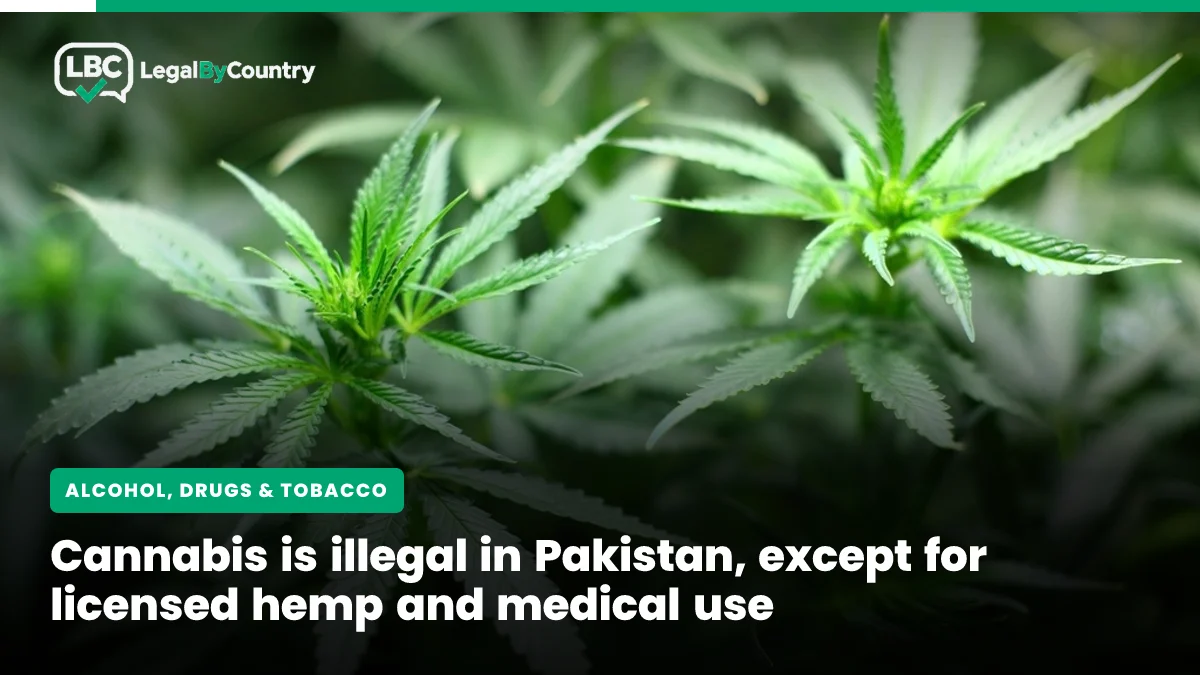
No. The Control of Narcotic Substances Act, 1997 bans growing, possessing, selling and transporting cannabis, including charas and bhang. Only businesses licensed by the Cannabis Control and Regulatory Authority may handle it, for industrial hemp or medical use, never for personal consumption.
- The law
Control of Narcotic Substances Act, 1997 (as amended by Act XX of 2022 and Act XXXVIII of 2023), ss. 2(d), 4, 5, 6, 7, 8, 9(1), 46, 51
Cannabis Control and Regulatory Authority Act, 2024 (Act XXIV of 2024), ss. 3, 4, 20, 22, 24, 25, 26, 30, 34
Prohibition (Enforcement of Hadd) Order, 1979, Arts. 4, 6, 11, 12 and Schedule
Anti-Narcotics Force Act, 1997, Constitution of the ANF
- Penalty
- Possessing or dealing in 10 kilograms or more of charas carries 20 years to life imprisonment and a fine of at least Rs 800,000 under the table in section 9(1) of the Control of Narcotic Substances Act, 1997, as amended in 2022.
General information only, not legal advice. For help with your own matter, consult a qualified lawyer or legal consultant. Read the disclaimer
Cannabis is illegal in Pakistan unless the state has licensed the activity
Every summer, wild cannabis grows waist high along roadsides in Khyber Pakhtunkhwa, and in Tirah Valley whole terraced fields are planted with it. Is cannabis legal in Pakistan? No. Growing, keeping, selling or using it is a crime, unless a government licence covers the activity.
The main law is the Control of Narcotic Substances Act, 1997 (CNSA), Act XXV of 1997. Parliament rewrote its punishment tables in 2022 and removed the death penalty from them in 2023. Since 2024 a second law, the Cannabis Control and Regulatory Authority Act, 2024, has opened a licensed channel for industrial hemp and medical cannabis businesses.
That new channel is easy to misread. The government's own National Cannabis Control and Regulatory Policy, 2025 says in its first section that use of cannabis "for entertainment purpose will continue to be illegal and shall be dealt with by existing laws of the Country." Nothing in the 2024 Act lets a private person grow, buy or smoke cannabis for themselves.
The Control of Narcotic Substances Act, 1997 sets the main offences
The CNSA bans cultivating cannabis, and bans possessing, buying, selling, transporting, importing or exporting it, except for medical, scientific or industrial purposes under a licence. Charas, bhang and ganja all fall inside its definition, so a local name changes nothing.
What the law counts as cannabis
Section 2(d) defines "cannabis (hemp)" in three parts:
- cannabis resin, or charas, including hashish oil and liquid hashish;
- the flowering or fruiting tops of the plant, which the 2022 amendment says "include all forms known as bhang, siddhi or ganja"; and
- any mixture of these, or any drink prepared from them.
Section 2(e) adds that "cannabis plant" means any plant of the genus cannabis. Seeds and leaves are left out of the definition of cannabis itself only when they are not accompanied by the tops, and the plant they grow into is covered whatever its strength.
Growing cannabis
Section 4 says no one shall cultivate any cannabis plant, let land for its cultivation, or gather any part of it. The only exception is a licence from the Federal Government, or a Provincial Government it has authorised, "exclusively for medical, scientific or industrial purposes." Under section 5, as amended in 2022, breaking section 4 carries up to seven years in prison and a fine, with a minimum of one year.
Possessing, selling and moving it
Section 6 bans producing, manufacturing, extracting, possessing, selling, buying, distributing, transporting or dispatching any narcotic drug except for medical, scientific or industrial purposes as the law permits. Section 7 bans import, export and transport within Pakistan without a licence, and section 8 bans trafficking and financing it. The CNSA has no small personal-use allowance: possessing a few grams is still an offence under section 6.
Penalties rise with weight, and charas is punished harder than bhang
Under the table in section 9(1), the punishment depends on the type of cannabis and its weight. Small amounts of bhang carry six months to three years. Ten kilograms or more of charas carries at least twenty years, up to life imprisonment.
The table below comes from the consolidated text on Pakistan Code, updated to 4 August 2023, which includes the Control of Narcotic Substances (Amendment) Act, 2022 (Act XX of 2022) and the 2023 amendment (Act XXXVIII of 2023). It applies to cases under the federal Act, which covers the whole country except where Sindh's own law now applies (see below).
| Type and weight (CNSA s. 9(1), as of 4 August 2023) | Prison term | Fine |
|---|---|---|
| Bhang, up to 999 g | 6 months to 3 years | Up to Rs 10,000 |
| Bhang, 1,000 g to 9,999 g | 3 to 7 years | Rs 10,000 to Rs 100,000 |
| Bhang, 10,000 g to 19,999 g | 7 to 14 years | Rs 100,000 to Rs 200,000 |
| Bhang, 20,000 g or more | 14 years to life | At least Rs 200,000 |
| Charas, up to 499 g | 10 months to 5 years | Up to Rs 40,000 |
| Charas, 500 g to 999 g | 5 to 9 years | Rs 40,000 to Rs 80,000 |
| Charas, 1,000 g to 4,999 g | 9 to 14 years | Rs 80,000 to Rs 400,000 |
| Charas, 5,000 g to 9,999 g | 14 to 20 years | Rs 400,000 to Rs 800,000 |
| Charas, 10,000 g or more | 20 years to life | At least Rs 800,000 |
| Hashish oil or liquid hashish, up to 499 g | 14 months to 7 years | Up to Rs 40,000 |
| Hashish oil or liquid hashish, 5,000 g or more | 20 years to life | At least Rs 400,000 |
Two provisos to section 9(1) push sentences to the top of each band. If the offence is committed "inside or near a school, college, university" or any other educational institution, the court must give the maximum punishment. A person with a previous CNSA conviction must also get the maximum for a later offence.
No death penalty for cannabis
Cannabis offences never carried the death penalty under the 2022 table: it appeared only for the largest amounts of heroin, morphine and cocaine. The Control of Narcotics Substances (Amendment) Act, 2023 then struck the words "punishment for death or" from every row of the section 9(1) table.
Special Courts and bail
CNSA cases are tried by Special Courts set up under section 46. Section 51(2) says bail in non-capital cases "shall not be normally granted" unless the court thinks it a fit case, and then only against substantial security. In practice, an arrest can mean a long wait in custody before trial.
Sindh now runs its own narcotics law
Sindh replaced the federal Act with the Sindh Control of Narcotic Substances Act, 2024 (Sindh Act VIII of 2024). Cases brought by Sindh police are prosecuted under that law, while the Anti-Narcotics Force and Customs still act under the federal CNSA across Pakistan.
The path to that point was uneven. Sindh first amended the federal Act in its own application through the Control of Narcotics Substance (Sindh Amendment) Act, 2021, with a different, simpler penalty scale that groups cannabis with coca leaf and poppy straw. The province then passed its own Act in 2024. The Sindh Control of Narcotic Substances (Amendment) Act, 2025 (Sindh Act XVII of 2025) makes every Sindh police station a Narcotics Control Police Station, with effect from 28 October 2024.
We could not open an official copy of the 2024 Sindh Act itself, so we do not reproduce its penalty table here. If a case is registered in Sindh, the court will decide which law and which sentencing scale apply, depending on the date and the agency involved.
Using cannabis can also be an offence under the Hadd Order
The Prohibition (Enforcement of Hadd) Order, 1979 lists bhang, siddhi, ganja, charas and hashish as intoxicants. Taking any intoxicant "by any means whatsoever" counts as drinking under Article 6, so a Muslim who consumes cannabis can face up to three years under Article 11.
The same Order punishes owning or possessing an intoxicant with up to two years under Article 4. Article 12 says police may not arrest someone on suspicion of having taken an intoxicant unless that person refuses a medical examination or is certified by a medical officer to have taken it. Whipping in tazir cases was abolished by the Abolition of the Punishment of Whipping Act, 1996. Our guide to whether alcohol is legal in Pakistan explains the Order in more detail.
The Cannabis Control and Regulatory Authority licenses hemp and medical cannabis businesses
The Cannabis Control and Regulatory Authority (CCRA), set up by Act XXIV of 2024, is the only body that can license cannabis cultivation, processing, manufacturing and sale. Its licences are for industrial hemp and medical products, not for personal use.
How the Authority came about
- 1 September 2020: the federal cabinet approved the first licence for industrial and medical use of hemp, issued to the Ministry of Science and Technology and the Pakistan Council of Scientific and Industrial Research (PCSIR), Arab News reported that day.
- 16 February 2024: the Cannabis Control and Regulatory Authority Ordinance, 2024 (Ordinance IV of 2024) was published in the Gazette of Pakistan.
- 24 September 2024: the President assented to the Cannabis Control and Regulatory Authority Act, 2024, published in the Gazette on 26 September 2024. It came into force at once.
- January 2026: the federal cabinet approved the National Cannabis Control and Regulatory Policy, 2025, Profit reported on 20 January 2026.
- October 2026: the CCRA and the Securities and Exchange Commission of Pakistan signed a memorandum of understanding. A company that lists cannabis activities in its memorandum of association now needs a CCRA no objection certificate before incorporation, ProPakistani reported on 8 October 2026.
What the 2024 Act requires
Section 20 says no person shall cultivate, produce, manufacture, or develop and sell products from cannabis plant derivatives except under a CCRA licence. A cultivation-only licence can go to any person. A production or manufacturing licence goes only to a company registered under the Companies Act, 2017. Each licence lasts five years and cannot be transferred.
The Authority sits in Islamabad. Its Board of Governors is chaired by the Secretary of the Defence Division, with members from the Cabinet Division, Law, National Food Security and each province. The policy separates industrial cannabis, or hemp, with less than 0.3% THC (the compound that causes the high), from medicinal cannabis with more than 0.3% THC, which it says must be grown indoors under security.
Breaking the Act, its rules or a licence condition is punished under section 26 with a fine of Rs 10 million to Rs 200 million for a company, or Rs 1 million to Rs 10 million for an individual, plus daily fines for continuing breaches. Obstructing a CCRA inspection carries up to three years or a fine of up to Rs 200 million under section 24(3). Section 25 says criminal offences under the Act are tried under the CNSA, and section 34 keeps the Anti-Narcotics Force's powers intact.
Licence classes listed by the CCRA
The CCRA's licence list shows 16 classes, from industrial hemp cultivation to export. The figures below are as listed on 16 November 2026. The page does not state the currency, which is presumably rupees.
| Licence (Standard class) | Application | Issuance | Annual renewal |
|---|---|---|---|
| A-1 Industrial Hemp Cultivation | 100,000 | 300,000 | 200,000 |
| A-4 Group Farming (Industrial Hemp) | 50,000 | 150,000 | 100,000 |
| A-2 Medicinal Cannabis Cultivation (Controlled) | 250,000 | 1,200,000 | 600,000 |
| B-1 Hemp Processing | 300,000 | 1,200,000 | 700,000 |
| C-1 Research and Development | 50,000 | 300,000 | 150,000 |
Khyber Pakhtunkhwa has moved on hemp first
Khyber Pakhtunkhwa approved provincial rules for medicinal and industrial cannabis in April 2025, Dawn reported on 15 April 2025. On 22 December 2025, the province's Cannabis Regulatory Authority approved pilot hemp cultivation licences for established industries working with farmers, but postponed cannabis cultivation and processing for now, Dawn reported on 29 December 2025.
The CCRA has also briefed tribal elders from Tirah Valley on bringing traditional growing into the licensed system, according to a Dawn report of 9 May 2026. Plans like these do not legalise any existing field. Until a farmer holds a licence, growing cannabis remains an offence under section 4 of the CNSA.
Medical cannabis is planned, but patients cannot supply themselves
The 2025 policy allows cannabis medicines only on a doctor's prescription, made by licensed pharmaceutical companies and sold through pharmacies. A patient who grows, buys or carries cannabis for their own treatment is still breaking the CNSA.
Section 10.4 of the policy says cannabis medicines "can only be provided to the end user/ patient on medical prescription," and that medicinal cannabis with more than 0.3% THC must be sold through outlets on prescriptions "from registered health professionals and doctors for specific medical conditions." Every medicine still needs registration with the Drug Regulatory Authority of Pakistan (DRAP). We could not find a cannabis-based medicine on an official DRAP list, so ask DRAP or your doctor before assuming one is available.
CBD oil, which comes from hemp and has little or no THC, raises separate questions about import, labelling and DRAP rules. Our guide to whether CBD oil is legal in Pakistan covers them.
The Anti-Narcotics Force and police enforce the law
The Anti-Narcotics Force (ANF) is the federal agency for narcotics cases, alongside Customs, provincial police and excise departments. All of them can arrest, search and seize under the CNSA, and cases go to the Special Courts.
The ANF is constituted under the Anti-Narcotics Force Act, 1997. Under section 30 of the 2024 Act, the CCRA must refer suspected CNSA offences by its own licensees to the ANF. A licence protects only the activity it names, on the land or premises it names. Anything outside its terms is treated as an ordinary narcotics offence.
Two more consequences follow a conviction. Sections 12, 13 and 19 of the CNSA allow assets gained from narcotics offences to be frozen and forfeited, and vehicles used to carry drugs can be confiscated. A conviction also stays on your record and can affect jobs, travel and visa applications.
The lawful route is a licensed hemp or medical cannabis business
The only way to deal in cannabis lawfully in Pakistan is to hold a CCRA licence for a specific commercial, medical or research activity and follow its conditions. No licence exists for growing or using cannabis for personal consumption.
For a farmer, company or researcher, the steps published by the CCRA are:
- Decide which licence class fits your activity, using the CCRA's list of licence types.
- Check the eligibility criteria: Pakistani citizenship or a company incorporated in Pakistan, FBR registration with an NTN, no loan default or blacklisting, and police clearance for all directors and partners.
- If you are forming a company, get a CCRA no objection certificate before SECP incorporation.
- Register and apply on the CCRA e-licence portal, paying the fees for your class.
- Show land rights, facility details and the financial and technical capacity the Act and rules require.
- Once licensed, keep to the THC limits, record your land use, allow inspections, and pay 2% of annual revenue to the Authority's fund under section 22(5).
The CCRA warns that anyone offering licences or approvals outside its official channels may be a fraud, and asks people not to pay such intermediaries. For the wider picture on narcotics, alcohol and tobacco, see our drugs and alcohol guides.
Frequently asked questions
Is it legal to smoke charas in Pakistan?
+
No. Possessing charas is an offence under section 6 of the Control of Narcotic Substances Act, 1997, with penalties set by weight in section 9(1). A Muslim who takes it can also be prosecuted for drinking under Article 11 of the Hadd Order, 1979.
Is bhang legal in Pakistan?
+
No. Since the 2022 amendment, the CNSA's definition of cannabis expressly includes all forms known as bhang, siddhi or ganja. Up to 999 grams of bhang carries six months to three years in prison and a fine of up to Rs 10,000.
What is the punishment for a small amount of charas?
+
Under the federal CNSA table, up to 499 grams of charas carries ten months to five years in prison and a fine of up to Rs 40,000. The court must give the maximum if the offence happened near a school or college, or if you have a previous conviction.
Did Pakistan legalise cannabis in 2024?
+
No. The Cannabis Control and Regulatory Authority Act, 2024 created a licensing body for industrial hemp and medical cannabis businesses. The 2025 national policy states that use of cannabis for entertainment will continue to be illegal under existing laws.
Can I grow cannabis at home in Pakistan?
+
No. Section 4 of the CNSA bans cultivating any cannabis plant without a government licence, and section 5 punishes it with one to seven years in prison and a fine. CCRA licences cover commercial, medical and research activities, not home growing for personal use.
Is medical marijuana legal in Pakistan?
+
Not for patients acting on their own. The 2025 policy allows cannabis medicines only from licensed pharmaceutical companies, sold on a doctor's prescription, and every medicine needs DRAP registration. Growing, buying or carrying cannabis yourself for treatment remains an offence under the CNSA.
Who can get a hemp licence in Pakistan?
+
A Pakistani citizen or a company incorporated in Pakistan with an NTN, no loan default and police clearance for its directors. Any person can hold a cultivation-only licence, but production and manufacturing licences go only to companies registered under the Companies Act, 2017.
Is there still a death penalty for cannabis in Pakistan?
+
No. The 2022 table never set death for cannabis, charas or hashish oil, and the Control of Narcotics Substances (Amendment) Act, 2023 removed the death penalty from every row of the section 9(1) table. The highest cannabis penalty is life imprisonment.
Sources
We compiled this guide from official sources: the law itself, government notifications and court records, checked against reporting of recent changes. It is for information only.
- Control of Narcotic Substances Act, 1997 (updated till 04.08.2023) · Ministry of Law and Justice (Pakistan Code)
- Control of Narcotic Substances Act, 1997 with Rules, amendments up to date (Federal Act No. XXXVIII of 2023) · Sindh Judicial Academy Library
- Control of Narcotics Substances (Amendment) Act, 2023, as passed by Parliament · National Assembly of Pakistan
- Cannabis Control and Regulatory Authority Act, 2024 (Act No. XXIV of 2024) · Ministry of Law and Justice (Pakistan Code)
- Cannabis Control and Regulatory Authority Act, 2024, Gazette of Pakistan Extraordinary, 26 September 2024 · National Assembly of Pakistan
- Cannabis Control and Regulatory Authority Ordinance, 2024, Gazette of Pakistan Extraordinary, 16 February 2024 · National Assembly of Pakistan
- National Cannabis Control and Regulatory Policy, 2025 (excerpts) · Cabinet Division, Government of Pakistan (via CCRA)
- Types of licences · Cannabis Control and Regulatory Authority
- Licence pre-requisites · Cannabis Control and Regulatory Authority
- Prohibition (Enforcement of Hadd) Order, 1979 · Ministry of Law and Justice (Pakistan Code)
- Anti-Narcotics Force Act, 1997 · Ministry of Law and Justice (Pakistan Code)
- Control of Narcotics Substance (Sindh Amendment) Act, 2021 (Sindh Act No. III of 2021) · Sindh Code, Government of Sindh
- Sindh Control of Narcotic Substances (Amendment) Act, 2025 (Sindh Act No. XVII of 2025) · Sindh Code, Government of Sindh
- Federal cabinet approves first license for industrial, medical use of hemp (1 September 2020) · Arab News Pakistan
- Federal cabinet approves National Cannabis Control and Regulatory Policy 2025 (20 January 2026) · Profit (Pakistan Today)
- SECP announces new registration rules for cannabis (8 October 2026) · ProPakistani
- Report on Khyber Pakhtunkhwa approving cannabis cultivation rules (15 April 2025) · Dawn
- Licence fee for cannabis cultivation, processing reduced in KP (29 December 2025) · Dawn
- Govt engages tribal elders to formalise cannabis cultivation (9 May 2026) · Dawn
Advocate, Supreme Court of Pakistan
Advocate of the Supreme Court of Pakistan and the Lahore High Court, former Assistant Advocate General Punjab and Assistant Attorney General for Pakistan, and adjunct professor of law in Lahore.
Full profile and credentials →
Is Alcohol Legal in Pakistan?
Only for some people. The Prohibition (Enforcement of Hadd) Order, 1979 bans drinking for Muslims. Non-Muslim foreigners, and non-Muslim citizens for religious ceremonies, may obtain alcohol lawfully, but only through provincially licensed sellers and usually with an excise permit.
Is Naswar Legal in Pakistan?
Yes. No law in force bans adults from buying or using naswar. The Prohibition of Smoking Ordinance, 2002 still bars using it in public buildings and transport and selling it within 50 metres of schools, and provincial laws bar selling tobacco to children.
Is It Legal to Buy Medicines Without a Prescription in Pakistan?
Only for ordinary medicines. The Drugs Act, 1976 and provincial drug rules let licensed shops sell prescription-only medicines, such as antibiotics, steroids and sedatives, only on a doctor's prescription. Buying psychotropic medicines without one can also breach narcotics law.
Is Shisha Legal in Pakistan?
Only in private. Serving shisha in cafes, restaurants and hotels is banned under the Prohibition of Smoking Ordinance, 2002, Supreme Court orders and provincial bans, and Islamabad has shut every shisha cafe. An adult smoking a hookah at home commits no offence.