Is Naswar Legal in Pakistan?
Yes, naswar is legal for adults in Pakistan, but tobacco law limits public use, sales near schools and to children. See the rules, fines and pending bans.
Short answer: Legal for adults, with limits
Yes. No law in force bans adults from buying or using naswar. The Prohibition of Smoking Ordinance, 2002 still bars using it in public buildings and transport and selling it within 50 metres of schools, and provincial laws bar selling tobacco to children.
- The law
Prohibition of Smoking and Protection of Non-Smokers Health Ordinance, 2002, ss. 2, 5, 6, 8, 9, 11, 14
Punjab Juvenile Smoking Ordinance, 1959 (as amended 2003), ss. 2, 3, 3-A
West Pakistan Juvenile Smoking Ordinance, 1959 (Khyber Pakhtunkhwa), ss. 2, 3
Punjab Tobacco Vend Act, 1958, ss. 2, 3, 5
- Penalty
- Selling any tobacco product, including naswar, within 50 metres of a school can bring up to three months in prison, a fine of at least Rs 100,000, or both for a repeat offence under section 11(b) of the Prohibition of Smoking Ordinance, 2002.
General information only, not legal advice. For help with your own matter, consult a qualified lawyer or legal consultant. Read the disclaimer
Naswar is legal in Pakistan, but tobacco law still applies to it
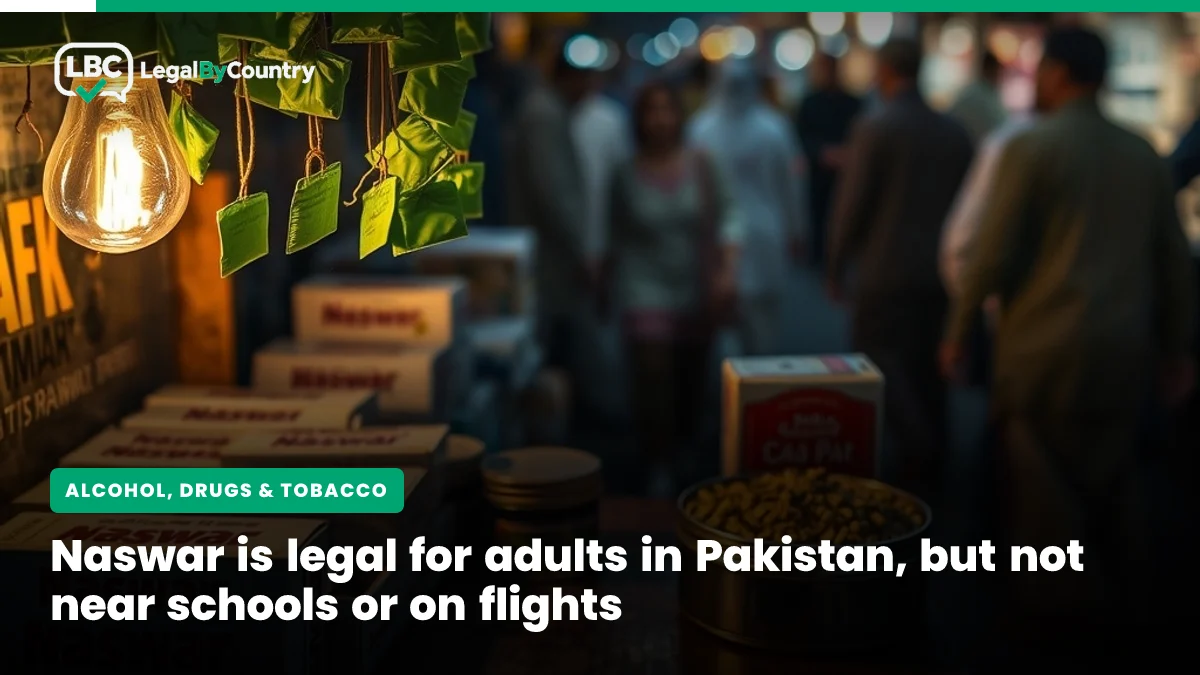
At a roadside khokha in Peshawar, green pouches of naswar hang beside cigarette packets, and a customer tucks a pinch under his lip. So is naswar legal in Pakistan? Yes. No federal or provincial law in force bans adults from buying or using it.
Naswar is a moist, powdered mix of tobacco, slaked lime and other ingredients, held in the mouth. Because it contains tobacco, the general tobacco laws reach it. Those laws do not ban it. They control where it is used, who it is sold to, and how close to a school it can be sold.
The main federal law is the Prohibition of Smoking and Protection of Non-Smokers Health Ordinance, 2002, which extends to the whole of Pakistan. Older provincial laws on tobacco sellers and on selling tobacco to children sit beside it. One provincial ban was tried in Punjab and dropped in 2025, and a regulation bill is pending in Khyber Pakhtunkhwa. This guide covers naswar only. Gutka and mainpuri have stricter rules and their own guide: is gutka legal in Pakistan.
Federal tobacco law covers naswar in public places and vehicles
Using naswar inside a place of public work or use, or in a bus, train or plane, breaks the 2002 Ordinance. Section 5 bans using tobacco "in any other form" there, and section 6 covers public service vehicles. Open places are excluded.
The wording matters. Most of the Ordinance talks about smoking, and naswar is not smoked. Sections 5 and 6, though, also ban using tobacco "in any other form", which plainly includes tobacco held in the mouth. The Ordinance lists the kinds of places it means:
- auditoriums, buildings, health institutions and public offices
- court buildings, cinema halls, conference halls and libraries
- restaurants, eating houses, hotel lounges and waiting lounges
- bus stations, sports stadiums and educational institutions
- public service vehicles, which section 2(e) says include railway trains and aeroplanes
Section 2(c) says the definition "does not include any open place". A pinch of naswar on an open street, in a field or at home is outside sections 5 and 6.
The fines for public use are small but real
Under section 11(a), a first offence under sections 5 or 6 carries a fine of up to Rs 1,000. A second or later offence carries a fine of at least Rs 1,000 and up to Rs 100,000. Section 12 lets an authorised officer, or a police officer of at least sub-inspector rank, remove a person from the premises. Under section 13, a court acts on these offences only on a written complaint by an authorised officer.
Selling naswar near schools or to children is where the law bites
Shops may not store, sell or distribute any tobacco product within 50 metres of a school or college. Selling tobacco "in any form" to children is also a provincial offence, with an age limit of 18 in Punjab and 16 in Khyber Pakhtunkhwa and Balochistan.
Section 9 of the 2002 Ordinance bans storing, selling or distributing "cigarettes or any other smoking substance or any other tobacco product" within 50 metres of any college, school or educational institution. Naswar is made from tobacco, so the phrase "any other tobacco product" covers it in our reading. Under section 11(b), a first offence carries a fine of up to Rs 5,000. A second or later offence can bring up to three months in prison, a fine of at least Rs 100,000, or both. Section 14 makes the offence cognizable, meaning police can arrest without a warrant, and bailable.
The federal under-18 rule has a gap for naswar
Section 8 of the Ordinance bans selling "cigarettes or any other smoking substance" to anyone under 18. Naswar is not smoked, so section 8 may not reach it on its plain words. Our reviewer has been asked to confirm this point. The provincial juvenile smoking laws fill much of the gap, because each defines "tobacco" as "tobacco in any form".
| Area | Law on selling tobacco to children | Age | Fine (as of 16 November 2026) |
|---|---|---|---|
| Punjab | Punjab Juvenile Smoking Ordinance, 1959, s. 3 (amended 2003) | Under 18 | Up to Rs 200 first time; up to Rs 500 and licence suspension second time; up to six months in prison or Rs 5,000 and licence cancellation after that |
| Khyber Pakhtunkhwa | West Pakistan Juvenile Smoking Ordinance, 1959, s. 3 | Under 16 | Up to Rs 20, Rs 50, then Rs 100 |
| Balochistan | Balochistan Juvenile Smoking Ordinance, 1959, s. 3 | Under 16 | Up to Rs 20, Rs 50, then Rs 100 |
| Sindh | We could not confirm a current Sindh text | Not confirmed | Not confirmed |
| Whole country, near schools | 2002 Ordinance, ss. 9 and 11(b) | Any age | Up to Rs 5,000 first time; then up to three months, a fine of at least Rs 100,000, or both |
The Khyber Pakhtunkhwa and Balochistan fines have never been raised from their 1959 levels, which is why they look so low. Punjab raised its age to 18 and its fines in 2003. Under the Punjab law the offence is non-cognizable, meaning police need a magistrate's order to arrest, and it is tried summarily.
Khyber Pakhtunkhwa also banned naswar on campuses
In November 2018, the Khyber Pakhtunkhwa government issued a notification banning naswar and cigarettes in colleges and universities, according to The Express Tribune on 14 November 2018. Staff were told to watch campus canteens and tuck shops. We could not find the notification itself or confirm it is still enforced.
Provinces have tried to ban or license naswar, but no ban is in force
Punjab's food regulator once declared naswar harmful and banned it, but the courts stayed that notice and the ban ended in October 2025. Khyber Pakhtunkhwa is considering a licensing bill, not a ban. Neither step makes naswar illegal for an adult buyer or seller today.
Punjab: the Food Authority ban was dropped in 2025
The Punjab Food Authority issued a notification declaring naswar "harmful to health" and stopping its sale. A trader challenged it in the Lahore High Court in Writ Petition No. 4177 of 2018, and the court stayed the notification. In early October 2025, Justice Syed Ahsan Raza Kazmi of the Multan Bench lifted the ban after the Food Authority told the court it was ready to withdraw the notification, ProPakistani reported on 3 October 2025. Manufacture, sale and purchase of naswar in Punjab are therefore not banned. We have not seen the written order.
Khyber Pakhtunkhwa: a regulation bill is pending
The Regulation of Snuff (Naswar) Bill, 2026 was introduced in the Khyber Pakhtunkhwa Assembly in April 2026 as a private member's bill by Aamna Sardar of the PML-N, the Associated Press of Pakistan reported on 20 April 2026. As reported by ARY News on 28 April 2026, the draft proposes:
- a licence for anyone who makes or sells naswar, with a fine of up to Rs 30,000 for doing so without one
- no sales within 100 metres of schools, madrassas and hospitals
- a Rs 50,000 fine and up to one year in prison for selling to minors
- sealed packaging, and no online, social media or delivery sales
- no advertising, promotion or free samples
- an on-the-spot fine of Rs 1,000 for spitting naswar in public
None of this is law. On 28 April 2026 the Assembly Secretariat raised an objection that no government department had been named to run the law, and progress stopped until one is identified. We found no report of the bill passing as of 16 November 2026.
Sindh: the gutka law does not name naswar
The Sindh Prohibition of Preparation, Manufacturing, Storage, Sale and Use of Gutka and Manpuri Act, 2019 does not mention naswar by name. Its definition of gutka and manpuri in section 2(viii) is broad, covering mixtures of tobacco, lime and other materials found unfit for consumption under the Sindh food law, plus any substance the government notifies. Whether that wording can reach naswar has not been settled in any judgment we found, so Sindh sellers should treat the point as open and check with the Sindh Home Department.
Shopkeepers in Punjab towns need a tobacco vendor licence
In Punjab, selling naswar by retail in a town, cantonment or railway station needs a dealer's licence from the Excise department. The Punjab Tobacco Vend Act, 1958 covers tobacco "for the purpose of smoking, chewing or for use as snuff", which takes in naswar.
Section 2(e) of the Punjab Tobacco Vend Act, 1958 defines "manufactured tobacco" to include "any preparation or admixture of tobacco" meant for smoking, chewing or snuff. Section 3 bars anyone who does not grow the tobacco from keeping it for retail sale, or selling it by retail, in an urban area without a dealer's licence. Section 2(h) defines an urban area as a municipality, town committee, cantonment or railway station.
The penalty in section 5 is a fine of up to Rs 100, and under section 6 a magistrate can also order the unpaid licence fee. The licence matters more than the fine. A conviction for selling to a child can lead to suspension or cancellation of a dealer's licence under the Punjab juvenile smoking law. Balochistan has the same 1958 Act with the same definition. We could not confirm the current Khyber Pakhtunkhwa or Sindh vendor law, so sellers there should ask their provincial Excise and Taxation department.
The lawful route for a naswar seller
- Check with your district Excise and Taxation office whether your shop needs a tobacco dealer's licence, and get one before you stock naswar.
- Measure the distance to the nearest school or college. Keep no tobacco, including naswar, within 50 metres of it.
- Refuse sales to children. In Punjab the line is 18; in Khyber Pakhtunkhwa and Balochistan it is 16, but refusing anyone under 18 keeps you safe everywhere.
- Do not advertise or promote naswar in ways that break the 2002 Ordinance's advertising rules in section 7.
- If you also sell gutka, mainpuri or similar mixes, read the separate gutka rules first, because Sindh and other areas treat them far more harshly.
Spitting naswar in public can be a nuisance offence
No federal law in force fines spitting naswar as such. Spitting that causes common annoyance to the public can still be a public nuisance under the Pakistan Penal Code, and local councils may also fine it under their own municipal bye-laws.
Section 268 of the Pakistan Penal Code, 1860 defines a public nuisance as an act that causes "common injury, danger or annoyance to the public". Section 290 punishes a public nuisance not covered elsewhere with a fine of up to Rs 600. Prosecutions for spitting under these sections are rare, and we did not find a reported case about naswar.
Two proposals would change that, and neither is law as of 16 November 2026:
- the Khyber Pakhtunkhwa naswar bill's Rs 1,000 spot fine, described above
- a Punjab heritage areas bill that, as ProPakistani reported on 24 April 2025, would allow fines of up to Rs 10,000 for spitting or littering in public and heritage zones
Cleanliness drives by city authorities sometimes target spitting. Check your local municipal or cantonment rules before assuming a street is fine-free.
Flying with naswar or taking it abroad is a separate risk
Pakistan's Civil Aviation Authority banned carrying naswar on all domestic and international flights in June 2019. Several Gulf countries reportedly treat it as a banned drug, so taking it abroad in your luggage can bring arrest and prosecution when you land there.
The CAA sent the notification to airports nationwide, The Express Tribune reported on 29 June 2019, after Gulf states listed naswar as an illegal drug and Pakistanis were arrested abroad for carrying it. Section 6 of the 2002 Ordinance separately bans using tobacco in any form on aeroplanes. Leave naswar at home when you fly. Smoking rules in public spaces have their own guide: is smoking in public legal in Pakistan, and our drugs, alcohol and tobacco guides cover the rest.
Frequently asked questions
Is naswar banned in Pakistan?
+
No. No federal or provincial ban on naswar is in force as of 16 November 2026. A Punjab Food Authority ban was stayed by the Lahore High Court and lifted in October 2025, and a Khyber Pakhtunkhwa bill would license naswar rather than ban it.
Can I use naswar in my office or on a bus?
+
No. Sections 5 and 6 of the Prohibition of Smoking Ordinance, 2002 ban using tobacco in any form in places of public work or use and in public service vehicles, including trains and planes. A first offence carries a fine of up to Rs 1,000.
Can a shop sell naswar near a school?
+
Not within 50 metres. Section 9 of the 2002 Ordinance bans storing, selling or distributing any tobacco product within 50 metres of a school, college or educational institution. A repeat offence can bring up to three months in prison, a heavy fine, or both.
What is the legal age to buy naswar in Pakistan?
+
It depends on the province. Punjab bans selling tobacco in any form to anyone under 18, while the Khyber Pakhtunkhwa and Balochistan laws set the line at 16. Refusing anyone under 18 is the safe course for every seller.
Do I need a licence to sell naswar?
+
In Punjab towns, yes. The Punjab Tobacco Vend Act, 1958 requires a dealer's licence from the Excise department to sell chewing tobacco or snuff by retail in an urban area. Check with your provincial Excise and Taxation office elsewhere.
Can I carry naswar on a flight from Pakistan?
+
No. The Civil Aviation Authority banned carrying naswar on all domestic and international flights in June 2019. Several Gulf countries reportedly treat naswar as a banned drug, so carrying it abroad can lead to arrest there.
Is there a fine for spitting naswar in public?
+
Not under a specific law yet. Spitting that annoys the public can be a public nuisance under section 290 of the Pakistan Penal Code, with a fine of up to Rs 600. The pending Khyber Pakhtunkhwa bill proposes a Rs 1,000 spot fine.
Is naswar treated the same as gutka in Sindh?
+
Not by name. The Sindh gutka and manpuri law of 2019 does not mention naswar, though its definition covers some mixtures of tobacco and lime. No judgment we found applies it to naswar, so treat the point as unsettled.
Sources
We compiled this guide from official sources: the law itself, government notifications and court records, checked against reporting of recent changes. It is for information only.
- Prohibition of Smoking and Protection of Non-Smokers Health Ordinance, 2002 (Ordinance No. LXXIV of 2002) · Ministry of Law and Justice (Pakistan Code)
- Punjab Juvenile Smoking Ordinance, 1959 (XII of 1959, as amended by Act VII of 2003) · Law and Parliamentary Affairs Department, Government of the Punjab (Punjab Code)
- Punjab Tobacco Vend Act, 1958 (XXXVIII of 1958) · Law and Parliamentary Affairs Department, Government of the Punjab (Punjab Code)
- West Pakistan Juvenile Smoking Ordinance, 1959 (as applied in Khyber Pakhtunkhwa) · Khyber Pakhtunkhwa Code, Government of Khyber Pakhtunkhwa
- Balochistan Juvenile Smoking Ordinance, 1959 · Government of Balochistan
- Balochistan Tobacco Vend Act, 1958 · Government of Balochistan
- Sindh Prohibition of Preparation, Manufacturing, Storage, Sale and Use of Gutka and Manpuri Act, 2019 (Sindh Act No. III of 2020) · Sindh Code, Government of Sindh
- Pakistan Penal Code, 1860 · Ministry of Law and Justice (Pakistan Code)
- Lahore High Court bench allows sale and purchase of naswar (3 October 2025) · ProPakistani
- Historic step in KP: Naswar Regulation Bill 2026 introduced in Provincial Assembly (20 April 2026) · Associated Press of Pakistan
- Khyber Pakhtunkhwa Naswar Bill 2026 faces objections (28 April 2026) · ARY News
- KP introduces Naswar Regulation Bill 2026 (20 April 2026) · ProPakistani
- Naswar, smoking banned in K-P educational institutions (14 November 2018) · The Express Tribune
- CAA places ban on carrying naswar in flights (29 June 2019) · The Express Tribune
- Punjab announces massive fine for spitting and littering in public (24 April 2025) · ProPakistani
Advocate, Supreme Court of Pakistan
Advocate of the Supreme Court of Pakistan and the Lahore High Court, former Assistant Advocate General Punjab and Assistant Attorney General for Pakistan, and adjunct professor of law in Lahore.
Full profile and credentials →
Is Vaping Legal in Pakistan?
Yes, for adults. No federal or provincial law bans buying or using a vape. The Prohibition of Smoking and Protection of Non-smokers Health Ordinance, 2002 still bars sales to under-18s and use in indoor public places, and some provinces add local restrictions.
Is It Legal to Buy Medicines Without a Prescription in Pakistan?
Only for ordinary medicines. The Drugs Act, 1976 and provincial drug rules let licensed shops sell prescription-only medicines, such as antibiotics, steroids and sedatives, only on a doctor's prescription. Buying psychotropic medicines without one can also breach narcotics law.
Is Shisha Legal in Pakistan?
Only in private. Serving shisha in cafes, restaurants and hotels is banned under the Prohibition of Smoking Ordinance, 2002, Supreme Court orders and provincial bans, and Islamabad has shut every shisha cafe. An adult smoking a hookah at home commits no offence.
Is Cannabis Legal in Pakistan?
No. The Control of Narcotic Substances Act, 1997 bans growing, possessing, selling and transporting cannabis, including charas and bhang. Only businesses licensed by the Cannabis Control and Regulatory Authority may handle it, for industrial hemp or medical use, never for personal consumption.