Is It Legal to Buy Medicines Without a Prescription in Pakistan?
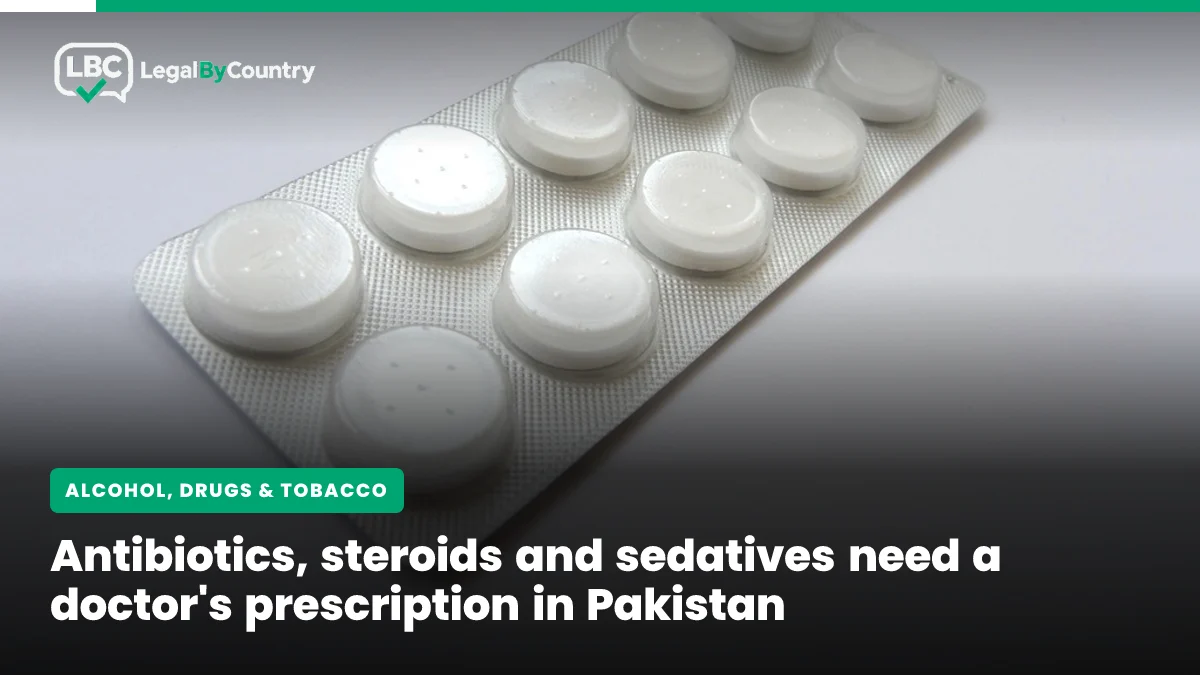
Only ordinary medicines. Antibiotics, steroids and sedatives need a doctor's prescription. See the Drugs Act rules, pharmacy penalties and your own risk.
Short answer: Only non-prescription medicines
Only for ordinary medicines. The Drugs Act, 1976 and provincial drug rules let licensed shops sell prescription-only medicines, such as antibiotics, steroids and sedatives, only on a doctor's prescription. Buying psychotropic medicines without one can also breach narcotics law.
- The law
Drugs Act, 1976, ss. 6, 23(1)(c), 23(1)(g), 27, 28, 41, 44
Drugs Act, 1976 as amended for Punjab (to December 2025), ss. 27(4), 28(3), 30(2)
Punjab Drugs Rules, 2007, rr. 2, 19, 20; Schedules B, D and G
Drug Regulatory Authority of Pakistan Act, 2012, Preamble, s. 7
- Penalty
- A seller who breaks the Drugs Act or its rules, for example by selling prescription-only medicine without a prescription, faces up to five years in prison and, in Punjab, a fine of up to Rs 500,000 under section 27(4) as amended.
General information only, not legal advice. For help with your own matter, consult a qualified lawyer or legal consultant. Read the disclaimer
Many medicines need a prescription, but not all of them
Ask for a strip of paracetamol at almost any medical store in Lahore or Karachi and you get it in seconds. Ask for an antibiotic or a sleeping pill and a careful pharmacy first asks "prescription?" That gap is the law in miniature.
So, is it legal to buy medicines without a prescription in Pakistan? For ordinary medicines that are not on a prescription list, yes. For prescription-only medicines, no: the shop may not sell them to you without a doctor's prescription, and for psychotropic drugs the buyer can be in trouble too.
The rules come from three layers. The federal Drugs Act, 1976 bans selling any drug except under a licence and its conditions. Section 6 of that Act hands the regulation of sales to the provinces, which write the detail in their own drug rules. The Control of Narcotic Substances Act, 1997 and its provincial versions then cover narcotic and psychotropic medicines separately.
The Drugs Act puts the duty on the seller, not the shopper
The Drugs Act, 1976 is written as a set of rules for sellers. Section 23(1)(c) says no one may sell any drug "except under, and in accordance with the conditions of, a licence". Selling a prescription-only medicine without a prescription breaks those licence conditions.
Section 6 says the Provincial Governments "shall regulate the sale of drugs", and section 44(1)(d) and (f) let them make rules on the conditions of sale and the conditions attached to sale licences. That is why the prescription lists sit in provincial rules, not in the Act itself.
Nothing in the Drugs Act makes it an offence simply to buy an ordinary medicine. The penalties in section 27 are aimed at whoever "sells", imports or manufactures. The buyer's risk is different and comes mainly from narcotics law, covered below.
The Drug Regulatory Authority of Pakistan Act, 2012 created DRAP "to provide for effective coordination and enforcement" of the Drugs Act. DRAP registers medicines, licenses manufacturers and sets quotas for narcotic and psychotropic drugs. Day-to-day inspection of pharmacies and medical stores is done by provincial drug inspectors.
Punjab spells out which medicines need a prescription
Punjab gives the clearest written rule. Under rule 20(1)(d) of the Punjab Drugs Rules, 2007, any drug in Schedule B or Schedule D, or any preparation containing one, may be sold only on a registered medical practitioner's prescription, and the shop keeps the original.
What the schedules cover
- Schedule B is headed "narcotics, psychotropic, anti depressant and other controlled drugs". Benzodiazepines and buprenorphine are named in it.
- Schedule D is headed "to be sold by a retailer strictly on the prescription of registered medical practitioner". It names antibiotics such as penicillin, cephalosporins, tetracycline, erythromycin and metronidazole, steroids such as prednisolone and dexamethasone, hormones, many antihistamines including promethazine, and tramadol.
- Schedule G lists drugs that a "medical store" may not stock at all, such as vaccines, cancer medicines, anaesthetics and some hospital antibiotics. Only a licensed "pharmacy" may hold them.
Anything not on Schedule B or D, such as plain paracetamol, can be sold by a licensed seller without a prescription. The 2007 lists name drug groups and salts, and some newer medicines are not named one by one. Whether a particular brand falls inside a listed group is a question for the drug inspector.
What counts as a valid prescription
Rule 20(2) says a prescription must be in writing, signed and dated by the doctor, name and address the patient, and state the total quantity and the dose. For Schedule B and D drugs, rule 20(1)(f) requires the sale to be entered in a special register with the prescriber, patient, batch and the qualified person's signature.
The emergency exception
Rule 20(1)(d) allows the prescription to be "dispensed with in case of an emergency", provided the emergency is recorded in writing in the register. No prescription is needed when the buyer is a registered doctor, a hospital dispensary or another institution.
Other provinces follow the same pattern with their own rules
Sindh, Khyber Pakhtunkhwa and Balochistan each regulate sales through their own drug rules made under section 44 of the Drugs Act. The structure is similar, a licence plus conditions, but the schedules and wording differ, and not every current text is published online.
| Area | Main sale rules | What we could confirm (as of 16 November 2026) |
|---|---|---|
| Punjab | Punjab Drugs Rules, 2007 | Schedules B and D need a doctor's prescription; Schedule G only in pharmacies; pharmacist supervision is a licence condition. |
| Sindh | Sindh Drugs Rules, 1979 (amended 2007 and 2010) | The 2010 amendments limit sale licences to outlets with registered pharmacists. The Sindh High Court upheld them on 22 August 2024. |
| Khyber Pakhtunkhwa | KP Drug Rules, 1982 (amended 2017, 2018, 2019) | The Health Department says revised Drug Sale Rules 2025 were sent for Cabinet approval. We could not confirm they are in force. |
| Balochistan and Islamabad | Their own sale rules | We could not find a current official text online. Ask the provincial drug inspector or DRAP. |
In the Sindh case, Pakistan Pharmaceutical Manufacturers' Association v. Province of Sindh (C.P. No. D-3906 of 2012), the court held that the amendments "do not restrict the business of sale of drugs" but regulate it, and dismissed the challenge. The KP Directorate General Drugs Control issues retail, wholesale, pharmacy and separate narcotic sale licences online.
Antibiotics are meant to be sold only on prescription
Antibiotics sit on Punjab's Schedule D, so a prescription is already a legal requirement there. In August 2024 DRAP went further and asked every provincial health department, Islamabad, AJK and Gilgit-Baltistan to make sure antibiotics are sold only on a doctor's prescription.
According to ProPakistani's report of 3 August 2024, DRAP's reason was antimicrobial resistance, the way bacteria stop responding to medicines that are overused. DRAP's letter was a direction to the provinces rather than a new statute, so the enforceable rule is still each province's drug rules.
Shoppers often hear that a pharmacist "can give you a course" for a sore throat. Under the Punjab rules, a seller who hands over an antibiotic without a prescription, outside a recorded emergency, is in breach of the licence condition.
Psychotropic and narcotic medicines carry criminal risk for the buyer too
Sleeping pills, anti-anxiety tablets and opioid painkillers are where the buyer's own position changes. Narcotics law bans anyone from purchasing or possessing a psychotropic substance except for medical purposes in the manner the law allows, which in practice means on a prescription.
Section 6 of the federal Control of Narcotic Substances Act, 1997 says no one shall "possess, offer for sale, sell, purchase" any narcotic drug, psychotropic substance or controlled substance "except for medical, scientific or industrial purposes in the manner and subject to such conditions" set by law. Schedule-I of the Act lists psychotropic substances, including alprazolam and diazepam.
Under the section 9(2) table, as amended in 2022 and 2023, a psychotropic offence involving up to 20 grams carries two months to one year in prison and a fine of up to Rs 50,000. Larger amounts carry far longer terms.
Sindh replaced the federal Act within the province with the Sindh Control of Narcotic Substances Act, 2024, and Punjab passed the Punjab Control of Narcotic Substances Act, 2025. Both keep the same basic ban with a medical-use exception. Our cannabis guide covers how those narcotics penalties work.
We found no reported case of a patient being prosecuted for a single strip of a prescription sedative bought without a prescription. The legal exposure exists all the same, and it grows quickly with the quantity.
Pharmacies face fines, prison and loss of their licence
A pharmacy that sells prescription-only medicine without a prescription breaches its licence and the rules. The federal Drugs Act punishes that with up to five years in prison or a fine of up to Rs 50,000, and Punjab has raised the fine to Rs 500,000.
| Breach by the seller | Federal Drugs Act, 1976 | Drugs Act as amended for Punjab |
|---|---|---|
| Selling against the Act or rules, such as without a required prescription (s. 27(4)) | Up to 5 years, or fine up to Rs 50,000, or both | Up to 5 years and fine up to Rs 500,000, or both |
| Repeat conviction under s. 27(4) (s. 28(3)) | Up to 7 years, or fine up to Rs 100,000, or both | 30 days to 7 years and fine of Rs 300,000 to Rs 1 million |
| Obstructing a drug inspector (s. 27(3)) | Up to 1 year, or fine up to Rs 10,000, or both | Up to 1 year, or fine up to Rs 50,000, or both |
| Selling an unregistered drug (s. 27(1)) | 3 to 10 years and fine up to Rs 100,000 | 3 to 10 years and fine of Rs 25 million to Rs 50 million |
Figures are from the Pakistan Code text of the federal Act and the Punjab Code consolidation of the Drugs Act, which includes amendments up to December 2025, as of 16 November 2026. Cases go to a Drug Court. In Punjab, section 30(2)(c) makes every offence under the Act non-bailable.
Section 41 also lets the licensing authority cancel or suspend a sale licence where a breach is "likely to endanger public health", after a hearing. For a shop owner, losing the licence is often the bigger blow.
A qualified person must supervise every sale
Pakistani rules do not let just anyone behind the counter sell medicine. Punjab's licence conditions require a person registered under the Pharmacy Act, 1967 to personally supervise sales, and Sindh's 2010 amendments tie licences to outlets with registered pharmacists.
- A Punjab "pharmacy" (Form 9 licence, green signboard) must be supervised by a pharmacist registered under section 24(1)(a) of the Pharmacy Act, 1967. Rule 20(1)(b) makes this a licence condition.
- A Punjab "medical store" (Form 10 licence, blue signboard) may be supervised by a person registered under section 24(1) of that Act, and may not stock Schedule G drugs.
- Doctors are not exempt from licensing. The Federal Constitutional Court has held that a doctor may dispense to his own patients but needs a drug sale licence to run a medicine outlet, according to The News of 3 October 2026.
Peddling or hawking any drug in a park, street, footpath or on public transport is banned outright by section 23(1)(g) of the Drugs Act. Medicines sold that way come with no licence, no warranty and no qualified person.
The lawful route is a prescription and a licensed seller
For any medicine on a prescription schedule, the safe and lawful way is simple: see a registered doctor, get a proper written prescription, and buy from a licensed pharmacy or medical store. Keep the paperwork, especially for controlled medicines.
- See a registered medical practitioner and explain your condition.
- Check the prescription is written, signed, dated, carries your name and address, and states the total quantity and the dose.
- Buy from a licensed outlet. In Punjab, look for the green "Pharmacy" or blue "Medical Store" board and a named qualified person.
- For Schedule B or D medicines, expect the shop to keep the original prescription and record the sale. Ask for a photocopy or keep a photo for your own records.
- Keep the bill. Sellers must keep sale records for at least three years under Punjab rule 20(1)(c), and your bill helps if a medicine turns out to be fake.
- For repeat supplies of a controlled medicine, go back to your doctor for a fresh prescription.
- Report a shop that sells controlled medicines freely, or a suspect product, to your district drug inspector or to DRAP.
Buying online and travelling with medicines raise their own rules. See our guides on selling medicines online in Pakistan and carrying medicines out of Pakistan, and the full list of drugs and alcohol guides.
Frequently asked questions
Can I buy antibiotics without a prescription in Pakistan?
+
No, not lawfully. Antibiotics such as penicillins, cephalosporins and metronidazole are on Punjab's Schedule D, which a retailer may sell only on a doctor's prescription. In August 2024 DRAP also asked every province to enforce prescription-only sale of antibiotics.
Is it a crime for me to buy medicine without a prescription?
+
For ordinary medicines, no. The Drugs Act, 1976 punishes the seller, not the buyer. Psychotropic medicines are different: narcotics law bans purchasing or possessing them except for medical purposes, so buying them without a prescription carries real legal risk.
Which medicines can I buy over the counter in Pakistan?
+
Medicines that are not on a prescription schedule, such as plain paracetamol, can be sold by a licensed shop without a prescription. In Punjab the prescription lists are Schedules B and D of the Punjab Drugs Rules, 2007. Ask the pharmacist if you are unsure.
Can a pharmacy sell sleeping pills without a prescription?
+
No. Benzodiazepines such as alprazolam and diazepam are psychotropic substances under the Control of Narcotic Substances Act, 1997 and appear on Punjab's Schedule B. They may be sold only on a prescription, which the shop keeps and records in a special register.
What is the punishment for a pharmacy selling without a prescription?
+
Up to five years in prison or a fine of up to Rs 50,000 under section 27(4) of the federal Drugs Act. In Punjab the fine can reach Rs 500,000, every offence is non-bailable, and the sale licence can also be suspended or cancelled under section 41.
Can a pharmacist give medicine without a prescription in an emergency?
+
In Punjab, yes, within limits. Rule 20(1)(d) of the Punjab Drugs Rules, 2007 allows a Schedule B or D drug to be supplied without a prescription in an emergency, provided the emergency is recorded in writing in the register.
Does a medical store need a qualified pharmacist?
+
Yes, a qualified person must supervise sales. Punjab requires a person registered under the Pharmacy Act, 1967 to personally supervise every licensed pharmacy or medical store, and Sindh's 2010 amendments limit sale licences to outlets with registered pharmacists.
Can a doctor sell medicines from his clinic?
+
Only to his own patients as part of treatment. The Federal Constitutional Court has held, as reported on 3 October 2026, that running a medicine outlet still needs a drug sale licence under section 23(1)(c) of the Drugs Act, 1976.
Sources
We compiled this guide from official sources: the law itself, government notifications and court records, checked against reporting of recent changes. It is for information only.
- Drugs Act, 1976 (Act XXXI of 1976) · Ministry of Law and Justice (Pakistan Code)
- Drugs Act, 1976 as amended for Punjab (consolidated to the Drugs (Second Amendment) Act 2025) · Law and Parliamentary Affairs Department, Government of the Punjab (Punjab Code)
- Punjab Drugs Rules, 2007 (with 2014 amendments) · Drug Regulatory Authority of Pakistan
- Drug Regulatory Authority of Pakistan Act, 2012 · Ministry of Law and Justice (Pakistan Code)
- Control of Narcotic Substances Act, 1997 (as amended by Act XX of 2022 and Act XXXVIII of 2023) · Ministry of Law and Justice (Pakistan Code)
- Sindh Control of Narcotic Substances Act, 2024 (Sindh Act No. VIII of 2024) · Sindh Code, Government of Sindh
- Punjab Control of Narcotic Substances Act, 2025 (LXIV of 2025) · Law and Parliamentary Affairs Department, Government of the Punjab (Punjab Code)
- Pakistan Pharmaceutical Manufacturers' Association v. Province of Sindh, C.P. No. D-3906 of 2012 (judgment on Sindh Drugs Rules amendments, short order 22 August 2024) · High Court of Sindh
- Quality Control and Drug Regulation · Directorate General Drugs Control, Health Department, Government of Khyber Pakhtunkhwa
- Antibiotics Can Only Be Sold With Prescription From a Licensed Doctor: DRAP (3 August 2024) · ProPakistani
- FCC rules doctors need drug sale licences to run medicine outlets (3 October 2026) · The News
Advocate, Supreme Court of Pakistan
Advocate of the Supreme Court of Pakistan and the Lahore High Court, former Assistant Advocate General Punjab and Assistant Attorney General for Pakistan, and adjunct professor of law in Lahore.
Full profile and credentials →
Is Cannabis Legal in Pakistan?
No. The Control of Narcotic Substances Act, 1997 bans growing, possessing, selling and transporting cannabis, including charas and bhang. Only businesses licensed by the Cannabis Control and Regulatory Authority may handle it, for industrial hemp or medical use, never for personal consumption.
Is Shisha Legal in Pakistan?
Only in private. Serving shisha in cafes, restaurants and hotels is banned under the Prohibition of Smoking Ordinance, 2002, Supreme Court orders and provincial bans, and Islamabad has shut every shisha cafe. An adult smoking a hookah at home commits no offence.
Is Naswar Legal in Pakistan?
Yes. No law in force bans adults from buying or using naswar. The Prohibition of Smoking Ordinance, 2002 still bars using it in public buildings and transport and selling it within 50 metres of schools, and provincial laws bar selling tobacco to children.
Is Vaping Legal in Pakistan?
Yes, for adults. No federal or provincial law bans buying or using a vape. The Prohibition of Smoking and Protection of Non-smokers Health Ordinance, 2002 still bars sales to under-18s and use in indoor public places, and some provinces add local restrictions.