Is Alcohol Legal in Pakistan?
Only for some. Muslims cannot drink lawfully, while non-Muslims and foreigners need licensed sellers and permits. See the law, provinces and penalties.
Short answer: Restricted: banned for Muslims
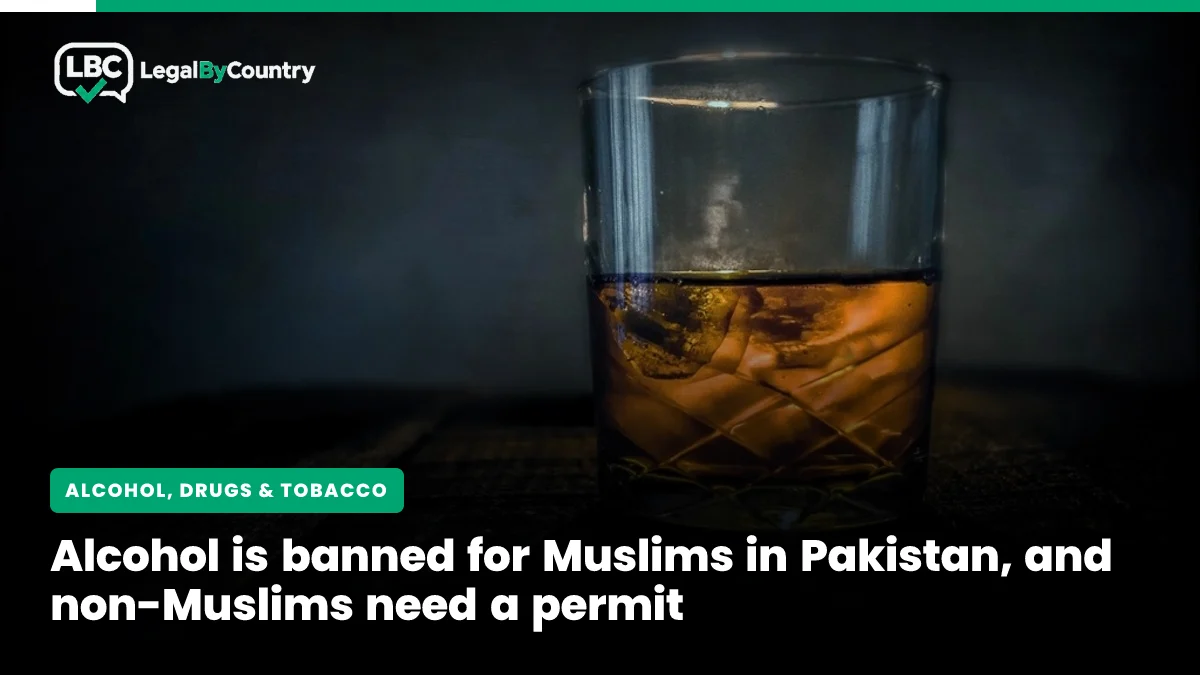
Only for some people. The Prohibition (Enforcement of Hadd) Order, 1979 bans drinking for Muslims. Non-Muslim foreigners, and non-Muslim citizens for religious ceremonies, may obtain alcohol lawfully, but only through provincially licensed sellers and usually with an excise permit.
- The law
Prohibition (Enforcement of Hadd) Order, 1979 (P.O. No. 4 of 1979), Arts. 2, 3, 4, 8, 9, 11, 16, 17, 20
Abolition of the Punishment of Whipping Act, 1996, s. 3
Constitution of the Islamic Republic of Pakistan, 1973, Art. 37(h)
Sind Prohibition Rules, 1979, rr. 13, 15, 16, 20, 23, 24, 25
- Penalty
- Selling, serving or manufacturing alcohol without a licence carries up to five years and a fine under Article 3 of the Hadd Order, and breaching a licence's conditions carries life imprisonment or at least two years under Article 20.
General information only, not legal advice. For help with your own matter, consult a qualified lawyer or legal consultant. Read the disclaimer
Alcohol is legal in Pakistan only for some people, and only within limits
On a Karachi street, a wine shop sells sealed bottles from behind a grille, licensed by the Sindh excise department. Down the road, a Muslim caught drinking the same beer faces prosecution. Is alcohol legal in Pakistan? Only for some people, and only within limits.
The governing law is the Prohibition (Enforcement of Hadd) Order, 1979, President's Order No. 4 of 1979, in force since 10 February 1979 and applying to the whole of Pakistan. Article 29 says it overrides any other law.
The Order sits on a constitutional base. Article 37(h) of the Constitution tells the state to "prevent the consumption of alcoholic liquor otherwise than for medicinal and, in the case of non-Muslims, religious purposes." That clause is a Principle of Policy: it guides governments, while the 1979 Order is the law police and courts actually apply.
The Order also covers cannabis, opium and coca products. This guide deals only with "intoxicating liquor": spirits, wine, beer, toddy and other alcoholic drinks. Our alcohol, drugs and tobacco guides cover the rest.
For a Muslim, drinking is a crime under the Hadd Order
A Muslim in Pakistan cannot drink alcohol lawfully, whatever the setting. The Order creates two drinking offences: hadd, a fixed punishment of 80 stripes with strict proof rules, and tazir, a lesser punishment of up to three years in prison. Neither has a permit route.
Article 6 defines "drinking" as intentionally taking an intoxicant "by any means whatsoever, whether such taking causes intoxication or not." Coercion and genuine necessity, such as fear of death from extreme thirst or serious illness, are the only excuses written into the Order.
Drinking liable to hadd
Under Article 8, an adult Muslim who "takes intoxicating liquor by mouth" is liable to 80 stripes. "Adult" means 18 or puberty. Article 9 allows only two forms of proof: a confession before a competent court, or at least two adult Muslim male witnesses whom the court has found truthful after an inquiry into their credibility.
The sentence cannot be carried out until the appeal court confirms it. Under Article 27, hadd cases are tried by a Court of Session, and appeals go to the Federal Shariat Court. Until confirmation, the convict is treated as if sentenced to simple imprisonment for bail purposes.
Drinking liable to tazir
Article 11 catches every other case. A Muslim whose drinking is proved by ordinary evidence, short of the Article 9 standard, is liable to tazir: imprisonment of up to three years. The Order also lists whipping of up to 30 stripes, but the Abolition of the Punishment of Whipping Act, 1996 abolished whipping in every law except where it is provided as hadd. The 80 stripes in Article 8 survive. The 30 stripes in Articles 3, 4 and 11 do not.
Non-Muslims and foreigners have a narrow lawful route
The Order carves out non-Muslims, but not equally. Non-Muslim foreigners may possess alcohol and drink it in private. Non-Muslim Pakistani citizens are allowed alcohol, in the Order's words, for a ceremony "prescribed by his religion." Supply must come through licensed channels in every case.
Three provisions draw the lines:
- Possession (Article 4). Owning or keeping any intoxicant is an offence, but the ban "shall not apply to a non-Muslim foreigner," or to a non-Muslim citizen who keeps "a reasonable quantity of intoxicating liquor" at or about the time of a religious ceremony for use in it.
- Drinking (Article 11). A non-Muslim citizen commits tazir drinking if he drinks "except as a part of a ceremony prescribed by his religion." A non-Muslim foreigner commits it only by drinking "at public place."
- Licences (Article 17). The provincial government or its Collector may license the manufacture, import, sale or possession of alcohol for medical, scientific or industrial use, "for consumption by a non-Muslim citizen of Pakistan as a part of a religious ceremony or by a non-Muslim foreigner," and for export.
The written law is stricter for Pakistani non-Muslims than many expect: it ties a citizen's lawful drinking to religious occasions. The Sindh High Court relied on that point in its 2016 and 2017 orders against Sindh's wine shops.
Minority legislators have themselves objected to how the system works. In September 2022, minority members of the Punjab Assembly demanded the cancellation of liquor permits issued in the name of non-Muslims, saying the system stigmatised their community, Dawn reported. The Law Minister replied that permits are also issued to foreigners.
Each province runs its own permit and licence system
The 1979 Order is federal, but the provinces run it. Each provincial government appoints the Collector, makes the rules, issues licences to shops and hotels, and grants personal permits through its excise department. Islamabad follows its own rules under the federal administration.
| Jurisdiction | Rules under the Order | Who issues permits and licences | What we could confirm, as of 16 November 2026 |
|---|---|---|---|
| Sindh | Sind Prohibition Rules, 1979 | Director General, Excise and Taxation (the Collector) | Retail "off" shops may sell only to permit holders, and no retail licence may go to a Muslim citizen (rules 24 and 25). About 150 licensed shops, roughly 70 in Karachi, according to ARY News on 3 November 2026. |
| Punjab | Provincial rules under the Order (we could not open an official copy) | Excise, Taxation and Narcotics Control Department | Licences are held by a small number of hotels: 12 across the province in February 2019, according to The Express Tribune. Murree Brewery manufactures under Punjab excise control. |
| Khyber Pakhtunkhwa | Khyber Pakhtunkhwa Prohibition (Enforcement of Hadd) Rules, 1980 | Excise, Taxation and Narcotics Control Department | The excise department has published the 1980 Rules, but the copy was offline when we checked. Ask the department for the current permit terms. |
| Balochistan | Provincial rules under the Order | Excise, Taxation and Anti-Narcotics Department | The department licensed a brewery and distillery in Hub in 2021 to supply Chinese nationals only, with no local sale, according to ProPakistani. |
| Islamabad Capital Territory | Islamabad Capital Territory Prohibition (Enforcement of Hadd) Rules, 1981 | ICT Excise and Taxation Department | The department lists "Liquor Permit Issuance" among its services. Five hotels hold L-2 licences, according to Interior Ministry figures given to the National Assembly and reported on 8 August 2025. |
How the Sindh rules work
Sindh is the only province whose rules we could read in full on an official site. The Sind Prohibition Rules, 1979 make the Director General of Excise the Collector for the whole province. Rule 13 requires a permit application on Form PR-I. Rule 15 makes every permit non-transferable and valid only for the period stated on it. Rule 16 measures the allowed quantity in "units," where one unit equals one quart bottle of spirits, three bottles of wine or sixteen bottles of beer. Rule 20 allows cancellation of a permit used to supply anyone else.
The fees in the 1979 schedule are long out of date, so ask the excise office for current ones.
Licensed shops and hotels sell under strict conditions
Lawful sale happens only at licensed premises: retail "off" shops that sell sealed bottles to take away, licensed hotels, some clubs, and duty-free outlets for international passengers. Every licence carries conditions, and breaching them is one of the most heavily punished offences in the Order.
The Sindh rules set out the licence classes. A retail "off" licence covers sale "to permit holders only." A hotel licence covers service "to non-Muslim foreign residents in their own room." A club licence covers off-sale to non-Muslim foreign members and to non-Muslim Pakistani members "on religious occasions." A duty-free licence covers non-Muslim foreign passengers on international flights.
The definition of "public place" matters here. Article 2(l) says it includes "a hotel, restaurant, motel, mess and club, but does not include the residential room of a hotel in the occupation of some person." A non-Muslim foreigner who drinks in a hotel room is within the law. Drinking in a lobby, restaurant or club area is drinking in a public place, unless a licence for that space lawfully covers it.
In September 2020, the Sindh High Court described how licensed wine shops are meant to operate. Excise officials told it in C.P. No. D-306 of 2020 that shops are licensed "only for the 'Off' sale of intoxicating liquor to non-Muslims in a sealed bottle," with no drinking on the premises, and that no shop may open within 100 yards of an educational or religious institution.
Courts have declined to shut hotel bars wholesale. On 23 July 2020, the Lahore High Court dismissed as not maintainable a petition asking it to cancel licensed hotels' liquor licences, according to Dawn.
The Sindh liquor shop case went to the Supreme Court and stayed there
Between 2016 and 2017, the Sindh High Court twice ordered every liquor shop in Sindh closed. Both times the Supreme Court stepped in: first by setting the order aside, then by suspending it. We could not find a final Supreme Court judgment on the appeals.
- 18 and 27 October 2016. The Sindh High Court directed the recall of shop licences granted in breach of the 1979 Order, then ordered all liquor shops closed. It read Article 17 as giving no basis for general, year-round shop licences, Dawn reported.
- 23 November 2016. A three-member Supreme Court bench led by Justice Mian Saqib Nisar set the order aside and sent the case back. The written order said the High Court had used suo motu powers it does not have, and that licences cannot be cancelled without hearing the holders, The Express Tribune reported.
- 2 March 2017. On a petition by MNA Dr Ramesh Kumar Vankwani, a High Court bench ordered all wine shops sealed and gave the government 30 days to devise a system. Its order, quoted in the 2020 judgment, found "120 shops selling wine and liquor throughout the province" but "not a single permit holder."
- 20 March 2017. The Supreme Court granted leave to appeal and suspended that order, while stating that police could still act on any breach of the Order, ProPakistani reported.
- September 2020. The Sindh High Court recorded that the appeals were still pending in the Supreme Court. It held that a licensed shop trading within its licence is protected by Article 18 of the Constitution, and that public drinking by buyers is for the authorities to handle case by case.
Shops reopened after each Supreme Court order. A November 2026 ARY News report says a three-member Supreme Court bench overturned the 2017 judgment, but gives no date, and we could not find that judgment. Treat the appeals as unresolved until a judgment is confirmed.
Murree Brewery is the best-known licensed manufacturer
Pakistan has lawful alcohol makers, licensed under Article 17 and the provincial rules. Murree Brewery in Rawalpindi, founded in 1860, is the oldest and best known. It brews beer and makes Pakistan Made Foreign Liquor for sale through licensed channels, under Punjab excise control.
A company report filed on the Pakistan Stock Exchange lists among its risks "dependence on Punjab Excise for ex-factory price fixation." In December 2025, the company received approval to export beer for the first time in nearly 50 years, Dawn reported. The same report notes that it is not allowed to advertise.
A manufacturing licence does not widen who may buy. The buyer still has to fall within the Order.
Selling without a licence and breaching licence terms carry long prison terms
The heaviest penalties fall on supply, not on drinking. Making, importing, transporting, selling or serving alcohol without a licence carries up to five years and a fine. A licence holder who breaches the licence faces life imprisonment or at least two years.
| Offence | Provision | Maximum penalty, as of 16 November 2026 |
|---|---|---|
| Manufacturing, importing, exporting, transporting, bottling, selling or serving alcohol, or allowing it on your premises | Hadd Order, Art. 3(1) | Up to 5 years and a fine |
| Owning, possessing or keeping alcohol (outside the non-Muslim exceptions) | Hadd Order, Art. 4 | Up to 2 years and a fine |
| Adult Muslim drinking, proved by confession or two qualified witnesses | Hadd Order, Arts. 8 and 9 | 80 stripes (hadd), after confirmation on appeal |
| Other drinking offences, including a non-Muslim foreigner drinking in public | Hadd Order, Art. 11 | Up to 3 years |
| Breaching the conditions of a licence | Hadd Order, Art. 20 | Life, or at least 2 years, and a fine, plus loss of the licence |
| Driving under the influence of drink | Provincial Motor Vehicles Ordinance, 1965, s. 100 | Up to 6 months or Rs 1,000 or both; up to 2 years for a repeat offence (federal text) |
The whipping that Articles 3, 4 and 11 still list was abolished in 1996, which is why it is left out of the table. "Sale" in Article 2(n) includes "any transfer by way of gift or otherwise," so handing a bottle to a friend counts as selling. Article 14 also lets courts confiscate the alcohol and any vehicle used to carry it.
Offences under Articles 4, 8 and 11 are cognizable, meaning police can arrest without a warrant, only when committed in a public place (Article 16). Selling under Article 3 is always cognizable.
Drinking in public and drunk driving are offences even with a permit
A permit never covers drinking in a street, park, restaurant or club, and never covers driving. For a non-Muslim foreigner, public drinking is the main way to commit an offence. For any driver, being too drunk to control the vehicle is a separate crime.
Section 100 of the Provincial Motor Vehicles Ordinance, 1965 punishes anyone driving or attempting to drive while "under the influence of drink or a drug to such an extent as to be incapable of exercising proper control over the vehicle." The federal text sets up to six months, a fine of up to Rs 1,000, or both, and up to two years for a repeat offence. Provinces apply their own amended versions and have raised many traffic fines, so the figure where you drive may be higher.
Section 100 sets no numeric blood alcohol limit. The test is whether drink left you unable to control the vehicle.
The lawful route for non-Muslims and foreigners runs through the excise department
If you are a non-Muslim, the safe path is a permit from your provincial excise department, purchase only from a licensed outlet, and private consumption. Travellers should also declare any alcohol to Customs on arrival and never assume a duty-free allowance applies.
- Confirm you fall within the Order. Non-Muslim foreigners are covered by Articles 4, 11 and 17. Non-Muslim citizens are covered for religious ceremonies.
- Apply to the excise department of the province where you live, or the ICT Excise and Taxation Department in Islamabad. In Sindh the application is on Form PR-I under rule 13. Ask the office which documents it needs.
- Buy only from a licensed shop, hotel or club, and only what your permit allows. In Sindh, a licensee may not sell to anyone who cannot produce a permit (rule 25).
- Carry the permit whenever you carry alcohol, so you can show that you hold it lawfully.
- Drink in private, such as your home or your own hotel room. A hotel lobby, restaurant or club counts as a public place under Article 2(l).
- Never pass alcohol to anyone else, including as a gift. Under the Order that is a sale, and it can cost you your permit.
- Do not drive after drinking.
Our editorial policy explains how we check statutes like these. If you are already facing a case under the Order, a lawyer can apply it to your facts.
Frequently asked questions
Can a Muslim drink alcohol legally anywhere in Pakistan?
+
No. The Prohibition (Enforcement of Hadd) Order, 1979 makes drinking an offence for any Muslim, in public or in private. No permit or licence covers a Muslim's own drinking, and the punishment is either 80 stripes as hadd or up to three years as tazir.
Can foreigners drink alcohol in Pakistan?
+
Yes, if they are non-Muslim and drink in private. Article 4 exempts non-Muslim foreigners from the possession offence, and Article 11 punishes them only for drinking in a public place. Hotel restaurants and clubs count as public places, but your own hotel room does not.
Do non-Muslim Pakistanis need a permit to buy alcohol?
+
In practice, yes. Licensed shops are meant to sell only to permit holders, and the Sindh rules say so expressly. The Order itself allows non-Muslim citizens alcohol for religious ceremonies, so a permit from your provincial excise department is the lawful route.
Is it legal to bring alcohol into Pakistan?
+
Not freely. Importing any intoxicant without a licence is an offence under Article 3 of the Hadd Order, and Muslims cannot bring alcohol in at all. Non-Muslim travellers should declare any alcohol to Customs on arrival and check the current rules first, because we could not confirm an official allowance.
Is Murree beer legal in Pakistan?
+
Yes, for buyers the law allows. Murree Brewery in Rawalpindi is a licensed manufacturer working under Punjab excise control, and it sells through licensed channels. A Muslim who drinks it still commits an offence, and a non-Muslim needs to stay within the permit rules.
What is the punishment for selling alcohol without a licence in Pakistan?
+
Up to five years in prison and a fine, under Article 3(1) of the Hadd Order. Article 2(n) defines sale to include any transfer by gift, so giving a bottle away also counts. The alcohol and any vehicle used to carry it can be confiscated.
Is drunk driving a separate offence in Pakistan?
+
Yes. Section 100 of the Provincial Motor Vehicles Ordinance, 1965 punishes driving while too drunk to control the vehicle with up to six months, a fine of up to Rs 1,000, or both, in the federal text. Provinces have amended their own versions, so local fines may be higher.
Are liquor shops in Sindh legal?
+
Licensed shops operate legally, selling sealed bottles to non-Muslim permit holders. The Sindh High Court ordered them all closed in 2016 and 2017, but the Supreme Court set aside and then suspended those orders. We could not find a final Supreme Court judgment on the appeals.
Sources
We compiled this guide from official sources: the law itself, government notifications and court records, checked against reporting of recent changes. It is for information only.
- Prohibition (Enforcement of Hadd) Order, 1979 (President's Order No. 4 of 1979) · Ministry of Law and Justice (Pakistan Code)
- Abolition of the Punishment of Whipping Act, 1996 (Act No. VII of 1996) · Ministry of Law and Justice (Pakistan Code)
- Constitution of the Islamic Republic of Pakistan, 1973 · Ministry of Law and Justice (Pakistan Code)
- Provincial Motor Vehicles Ordinance, 1965 · Ministry of Law and Justice (Pakistan Code)
- Sind Prohibition Rules, 1979 (Sind Government Gazette, 18 November 1979) · Sindh Code, Government of Sindh
- Samira Mahamadi v. Province of Sindh, C.P. No. D-306 of 2020 (judgment quoting the 2 March 2017 order and the Supreme Court order of 20 March 2017) · High Court of Sindh
- Vishandas v. Province of Sindh, C.P. No. D-1931 of 2011 and C.P. No. D-503 of 2017 (order of 8 December 2021, recording the Supreme Court order of 23 November 2016) · High Court of Sindh, Circuit Court Hyderabad
- Excise and Taxation Department services, including liquor permit issuance · Islamabad Capital Territory Administration
- Murree Brewery Company Ltd: company report · Pakistan Stock Exchange (company filing)
- Wine shops in Sindh seek SC permission to continue business (15 November 2016) · Dawn
- SHC used suo motu powers to revoke liquor shops licences, SC says (29 November 2016) · The Express Tribune
- Supreme Court suspends Sindh High Court's order to seal liquor shops (20 March 2017) · ProPakistani
- How do liquor sales continue across Pakistan despite legal restrictions? (3 November 2026) · ARY News
- Pakistan's historic Murree brewery cheers export licence (25 December 2025) · Dawn (AFP)
- Punjab may grant more liquor licences (17 February 2019) · The Express Tribune
- Plea against liquor sale dismissed by LHC as not maintainable (24 July 2020) · Dawn
- Punjab Assembly debate on liquor permits issued to non-Muslims (22 September 2022) · Dawn
- Here's why a Chinese liquor company was allowed to operate in Pakistan (30 March 2021) · ProPakistani
- How many hotels sell alcohol in Islamabad? New details revealed (8 August 2025) · Daily Pakistan
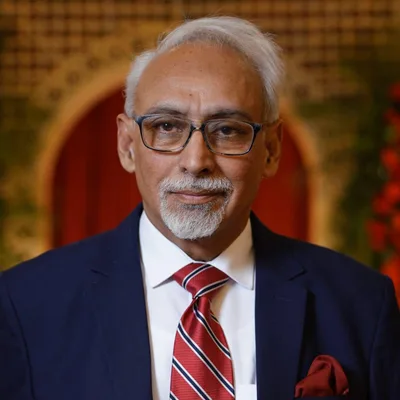
Advocate, Supreme Court of Pakistan
Advocate of the Supreme Court of Pakistan and the Lahore High Court, former Assistant Advocate General Punjab and Assistant Attorney General for Pakistan, and adjunct professor of law in Lahore.
Full profile and credentials →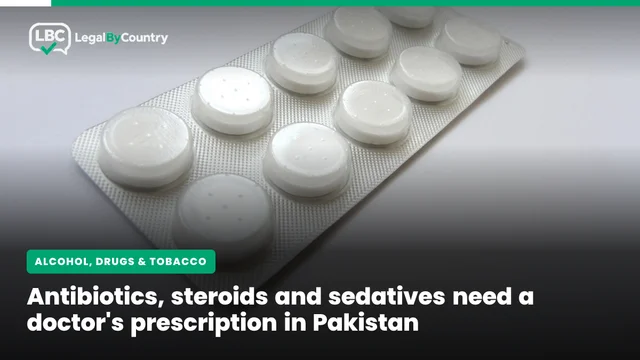
Is It Legal to Buy Medicines Without a Prescription in Pakistan?
Only for ordinary medicines. The Drugs Act, 1976 and provincial drug rules let licensed shops sell prescription-only medicines, such as antibiotics, steroids and sedatives, only on a doctor's prescription. Buying psychotropic medicines without one can also breach narcotics law.
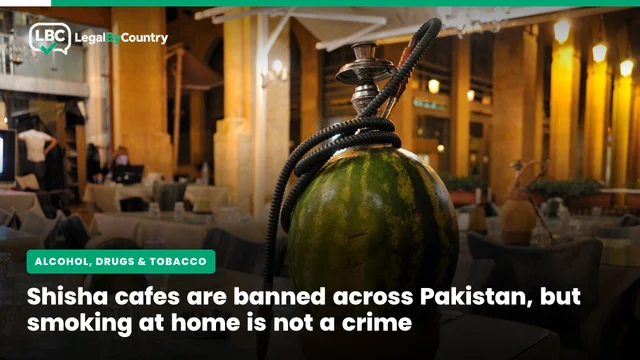
Is Shisha Legal in Pakistan?
Only in private. Serving shisha in cafes, restaurants and hotels is banned under the Prohibition of Smoking Ordinance, 2002, Supreme Court orders and provincial bans, and Islamabad has shut every shisha cafe. An adult smoking a hookah at home commits no offence.
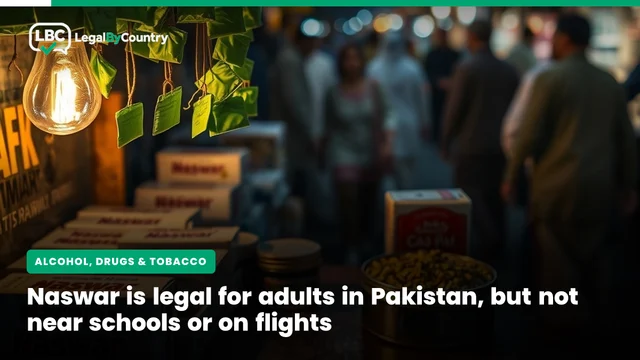
Is Naswar Legal in Pakistan?
Yes. No law in force bans adults from buying or using naswar. The Prohibition of Smoking Ordinance, 2002 still bars using it in public buildings and transport and selling it within 50 metres of schools, and provincial laws bar selling tobacco to children.
Is Cannabis Legal in Pakistan?
No. The Control of Narcotic Substances Act, 1997 bans growing, possessing, selling and transporting cannabis, including charas and bhang. Only businesses licensed by the Cannabis Control and Regulatory Authority may handle it, for industrial hemp or medical use, never for personal consumption.