

Is It Legal to Play Loud Music in Pakistan?
Music is legal, but speakers loud enough to disturb people are not. See the Punjab Sound Systems Act fines, noise limits, wedding times and your rights.

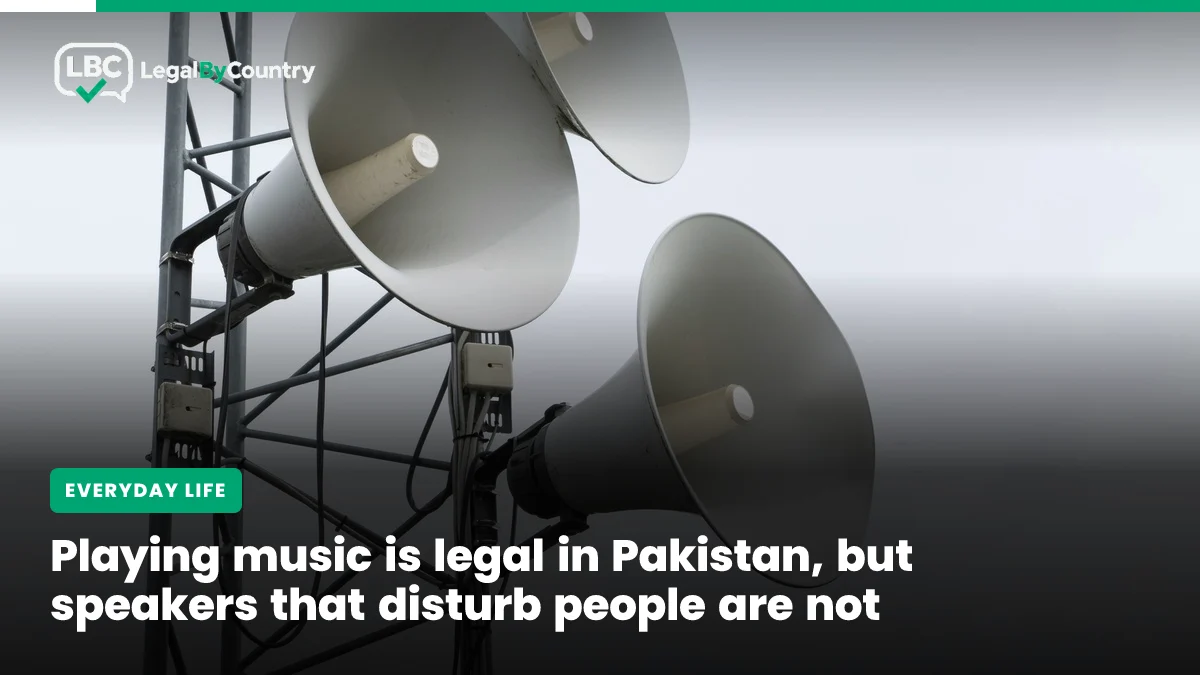
Short answer: Legal, but not at a volume that disturbs others
Playing music is legal, but not through speakers loud enough to annoy or disturb others. Punjab's Sound Systems (Regulation) Act 2015 punishes this with up to six months in jail and a Rs 25,000 to Rs 100,000 fine. Other provinces have similar laws.
- The law
Punjab Sound Systems (Regulation) Act 2015 (as amended in 2018), ss. 3, 4, 6, 7, 8, 9
Sindh Sound System (Regulation) Act, 2015, ss. 3, 4, 6, 8
Balochistan Sound Systems (Regulation) Act, 2016, ss. 3, 4, 6, 8, 9
West Pakistan Regulation and Control of Loudspeakers and Sound Amplifiers Ordinance, 1965 (KP and ICT), ss. 2, 3, 4
- Penalty
- In Punjab, using a sound system that annoys or disturbs people carries up to six months in prison and a fine of Rs 25,000 to Rs 100,000 under section 6 of the Punjab Sound Systems (Regulation) Act 2015, and the offence is cognizable and non-bailable.
General information only, not legal advice. For help with your own matter, consult a qualified lawyer or legal consultant. Read the disclaimer
Playing music is legal, but playing it loud enough to disturb people is not
A mehndi on the next street keeps the dhol going until 2 am. Is it legal to play loud music in Pakistan? Playing music is legal. Playing it through speakers loud enough to annoy or disturb other people is an offence in every province.
No law in Pakistan bans music itself. The laws target the volume and the speaker. Each province has a sound systems or loudspeakers law that makes noisy use of a loudspeaker, amplifier or similar equipment a crime. On top of that sit the Pakistan Penal Code rules on public nuisance, environmental noise limits measured in decibels, and wedding-time rules.
The strictest and most enforced law is the Punjab Sound Systems (Regulation) Act 2015. Section 3(1) makes it unlawful to use, or allow the use of, a sound system that "generates any loud, unnecessary or unusual noise or any noise which annoys, disturbs, injures, or endangers the comfort, repose, health, peace, or safety of persons in or beyond the vicinity." That wording covers a wedding speaker, a shop amplifier and a car stereo alike.
Punjab's Sound Systems Act carries up to six months in jail
In Punjab, breaking section 3 or 4 of the Sound Systems Act can bring up to six months in prison and a fine of Rs 25,000 to Rs 100,000. The offence is cognizable and non-bailable, and police can seize the speakers on the spot.
What the Act bans
Section 2 defines a "sound system" as a loudspeaker, sound amplifier or other prescribed equipment, and "vicinity" as anywhere within ten yards of the speaker. Section 4 then bans using a sound system:
- in a public place in a way that annoys or injures people nearby;
- near a place of worship during prayer times;
- near a hospital with indoor patients, at any time of day or night;
- near a school, court, office or other public institution during working hours, if it disturbs their work;
- near a house or other dwelling at times the government prescribes;
- for sectarian or other controversial speech likely to cause public disorder.
Section 4(2) allows up to four external speakers at a place of worship for azan, durood before or after azan, the Arabic Friday and Eid khutba, and death or lost-and-found announcements. The limit was raised from one to four by the Punjab Sound Systems (Regulation) (Amendment) Act 2018. Any other outdoor speaker in a public place needs prior government permission and must be used "during reasonable hours".
Penalties, seizure and compounding
Section 6 sets the punishment: imprisonment up to six months and a fine of at least Rs 25,000 and at most Rs 100,000. The fine is not optional on conviction. Under section 7, a police officer of Assistant Sub-Inspector rank or above can seize any sound system used or suspected of being used in the offence. Section 8 makes the offence cognizable, meaning police can arrest without a warrant, and non-bailable, meaning bail is at the court's discretion rather than a right. A first class magistrate tries the case summarily.
Section 9 lets the government or an authorised officer compound a first offence, which means settling it, against an administrative penalty of at least Rs 25,000. A repeat offender, or someone whose earlier offence was already compounded, cannot settle again. Under section 10 the court can confiscate the equipment for good.
Police do use it
Enforcement is real. In September 2025, Dawn reported that Lahore police registered an FIR under section 6 against a motorist for playing a Punjabi song loudly in his car, seized the car and arrested him. In January 2026, police in Okara district booked a groom after loud music at his wedding ran past 1:30 am, Daily Times reported, citing the Sound Systems Act and the Marriage Functions Act. On 6 December 2025, the Punjab Chief Minister ordered strict enforcement of loudspeaker rules at marriage halls, farmhouses and qawwali nights.
Every other province and Islamabad has its own loudspeaker law
Sindh and Balochistan passed sound systems laws almost identical to Punjab's, with six months in jail. Khyber Pakhtunkhwa and Islamabad still use the 1965 West Pakistan loudspeakers ordinance, and the penalty in each depends on which version applies there.
| Area | Law | Maximum penalty (as of 16 November 2026) | Arrest and bail |
|---|---|---|---|
| Punjab | Punjab Sound Systems (Regulation) Act 2015, s. 6 | 6 months and fine of Rs 25,000 to Rs 100,000 | Cognizable, non-bailable; compoundable once for at least Rs 25,000 |
| Sindh | Sindh Sound System (Regulation) Act, 2015, s. 6 | 6 months and fine of Rs 25,000 to Rs 50,000 | Cognizable, non-bailable |
| Balochistan | Balochistan Sound Systems (Regulation) Act, 2016, s. 6 | 6 months and fine of Rs 25,000 to Rs 100,000 | Cognizable, non-bailable; compoundable once for at least Rs 25,000 |
| Khyber Pakhtunkhwa | West Pakistan Regulation and Control of Loudspeakers and Sound Amplifiers Ordinance, 1965, s. 3 (KP Code text) | 1 month or fine up to Rs 200, or both | Cognizable |
| Islamabad (ICT) | Same 1965 Ordinance as amended for ICT in 2011, s. 3 | 1 year or fine up to Rs 50,000, or both | Cognizable |
Sindh and Balochistan
The Sindh Sound System (Regulation) Act, 2015 copies Punjab's sections 3 and 4 almost word for word, but caps the fine at Rs 50,000, still allows only one external speaker at a place of worship, and has no compounding section. A judicial magistrate tries the case summarily. The Balochistan Sound Systems (Regulation) Act, 2016 follows Punjab's penalty and compounding rules, and lets Levies officers seize equipment too.
Khyber Pakhtunkhwa and Islamabad
KP has no sound systems act of its own that we could find. The KP Code lists the 1965 West Pakistan ordinance, which bans loudspeakers that annoy people in residential areas or disturb mosques, hospitals, schools and courts. The KP text still shows a penalty of one month or Rs 200. In Islamabad, the Pakistan Code version of the same ordinance was amended in 2011, for ICT only, to one year or Rs 50,000.
Islamabad's district magistrate also issues temporary bans under section 144 of the Code of Criminal Procedure. In November 2025, ProPakistani reported a two-month ban on loudspeakers and sound systems across the capital, except for azan and Friday sermons. Breaking a section 144 order is a separate offence under section 188 of the Penal Code.
The Penal Code treats noise as a public nuisance
Even where no loudspeaker law fits, the Pakistan Penal Code's public nuisance sections can. Section 268 covers acts that annoy the public or people living nearby, section 290 fines it, and section 291 allows jail for carrying on after an official order.
Under section 268 of the Pakistan Penal Code, 1860, a person commits a public nuisance by any act that "causes any common injury, danger or annoyance to the public or to the people in general who dwell or occupy property in the vicinity". The section adds that a nuisance is not excused because it is convenient or useful to someone.
- Section 290: public nuisance not punished elsewhere in the Code carries a fine of up to Rs 600.
- Section 291: repeating or continuing a nuisance after a public servant has lawfully ordered you to stop carries up to six months' simple imprisonment, a fine, or both.
- Section 188: disobeying a lawful order, such as a section 144 loudspeaker ban, carries up to one month or Rs 600, rising to six months or Rs 3,000 where it endangers life, health or safety.
The Penal Code fines look small next to the sound systems laws. In practice, police in Punjab, Sindh and Balochistan usually reach for the provincial act first.
Environmental law sets decibel limits for homes and markets
Pakistan has written noise limits. In residential areas the limit is 55 decibels by day and 45 at night, under both the federal and Punjab environmental quality standards. Night runs from 10 pm to 6 am.
| Area | Day limit, 6 am to 10 pm | Night limit, 10 pm to 6 am |
|---|---|---|
| Residential | 55 dB(A) | 45 dB(A) |
| Commercial | 65 dB(A) | 55 dB(A) |
| Industrial | 75 dB(A) | 65 dB(A) |
| Silence zone (at least 100 metres around hospitals, schools and courts) | 50 dB(A) | 45 dB(A) |
The figures above are the current limits in the National Environmental Quality Standards for Noise (S.R.O. 1064(I)/2010), in force from 1 July 2012, and the Punjab Environmental Quality Standards for Noise (Notification No. SO(G)/EPD/7-26/2013, gazetted 15 August 2016), in force from 1 July 2013. Both are measured as an average level over time, not a single peak.
Section 11 of the Punjab Environmental Protection Act, 1997 bars anyone from emitting noise above these standards, and section 17 allows a fine of up to Rs 5 million, plus up to Rs 100,000 a day if it continues. The federal Pakistan Environmental Protection Act, 1997 sets up to Rs 1 million in Islamabad. These cases go through the environmental agency and environmental tribunals, so they suit a factory, a hall or a commercial venue that is noisy every night better than a single party.
Weddings must end by 10 pm in most of Pakistan
In Punjab, a statute requires every wedding at a hall, hotel, marquee or hired venue to finish by 10 pm. In 2026, energy-saving orders added a 10 pm closing time for wedding venues in Islamabad, Khyber Pakhtunkhwa and Balochistan too.
Section 6 of the Punjab Marriage Functions Act 2016 makes the owner or manager of a wedding venue ensure all ceremonies end "on or before 10:00 pm". Section 3(e) separately bars anyone holding a wedding from causing "nuisance or disturbance to the neighbourhood beyond reasonable celebrations". Under section 8, breaking either rule can mean up to one month in jail and a fine of Rs 50,000 to Rs 2 million.
The 2026 closing-time orders came on top of that:
- Federal decision, 6 April 2026: marriage halls and marquees to close by 10 pm, and no wedding functions after 10 pm even at homes, everywhere except Sindh, Dawn reported.
- Islamabad, 18 May 2026: the district magistrate's notification kept marriage halls and event venues to a 10 pm close, APP reported.
- Punjab, June 2026: a provincial notification set 10 pm for marriage halls and marquees, APP reported.
Sindh was not part of the April 2026 decision, and we found no confirmed Sindh notification on wedding hall hours. Energy orders like these change often, so check your district administration for the current timing. None of them makes a wedding speaker lawful before 10 pm if it still disturbs neighbours under the sound systems laws.
Car stereos fall under the same sound systems law
A car stereo is a sound system. In Punjab, blasting music from a car on a public road can be charged under section 6 of the Sound Systems Act, and police can seize the equipment. Normal listening inside a closed car is not an offence.
The Lahore case from September 2025 shows the risk: an FIR, an arrest and a seized car over one loud song. The test is the same as anywhere else: loud, unnecessary or unusual noise, or noise that annoys people in or beyond ten yards. Public transport is stricter in practice. In July 2019, The Express Tribune reported that Lahore traffic police acted against 1,649 vehicles for playing loud music and seized 1,469 tape recorders. Pressure horns and loud exhausts are a separate issue covered in our guide on modifying a car exhaust.
Neighbours have several lawful routes, from a polite word to a magistrate
A neighbour bothered by loud music can complain to the police, who can register an FIR and seize speakers under the provincial act. Persistent noise can also go to a magistrate under section 133 of the Code of Criminal Procedure, or to a civil court.
Take these steps in order, and keep a record of each:
- Talk first. Ask the host or the hall manager to lower the volume or switch off by 10 pm. Most disputes end here.
- Record the problem. Note dates, times and how long the noise lasted. A short phone video showing the time is useful evidence. Do not trespass to get it.
- Call the police. Dial 15 or go to the local police station. In Punjab, Sindh and Balochistan the sound systems offence is cognizable, so police can act without a warrant. Ask for an FIR if the noise continues.
- Report a venue. For a marriage hall running past 10 pm, complain to the district administration or Assistant Commissioner, who enforce the closing time.
- Go to a magistrate. Under section 133 of the Code of Criminal Procedure, a first class magistrate can order a trade or occupation that harms the "health or physical comfort of the community" to be stopped or regulated. Under section 136, a person who ignores the order without showing cause faces the penalty in section 188 of the Penal Code.
- Complain to the environmental agency. For a factory or commercial venue that is loud every night, the provincial environmental protection agency can test noise and issue an environmental protection order under section 16 of its Act.
- Sue for an injunction. Under section 54 of the Specific Relief Act, 1877, a civil court can grant a permanent injunction where someone invades your enjoyment of your property and money would not fix it.
What a neighbour may not do matters just as much. Cutting someone's electricity wires, smashing speakers or threatening the host are offences in their own right. Celebratory gunfire at the same wedding is a far more serious crime, covered in our guide on aerial firing, and fireworks bring their own licensing rules, set out in our guide on whether fireworks are legal. For more rules on daily life, see our everyday law guides.
Frequently asked questions
Can police arrest me for playing loud music in Pakistan?
+
Yes. In Punjab, Sindh and Balochistan, misusing a sound system is cognizable, so police can arrest without a warrant, and non-bailable, so bail is up to the court. In September 2025, Lahore police arrested a motorist and seized his car over loud music.
What is the fine for loud music in Punjab?
+
Rs 25,000 to Rs 100,000, plus up to six months in prison, under section 6 of the Punjab Sound Systems (Regulation) Act 2015. A first offence can be compounded, or settled, for an administrative penalty of at least Rs 25,000 under section 9.
Until what time can music play at a wedding in Pakistan?
+
Until 10 pm in Punjab, where section 6 of the Punjab Marriage Functions Act 2016 requires wedding venues to end all ceremonies by then. In 2026, energy-saving orders also set a 10 pm close for wedding venues in Islamabad, Khyber Pakhtunkhwa and Balochistan.
Is it illegal to play loud music in my car?
+
Yes, if it is loud enough to annoy or disturb people outside. A car stereo counts as a sound system, and in Punjab police have charged drivers under section 6 of the Sound Systems Act. Normal listening with the windows up is not an offence.
What is the legal noise limit in residential areas in Pakistan?
+
55 decibels by day and 45 decibels at night, measured as an average. The National Environmental Quality Standards for Noise and the Punjab standards both set these limits, with night running from 10 pm to 6 am.
How do I complain about a neighbour's loud music?
+
Ask them politely first, then call 15 or visit the local police station and ask for action under your province's sound systems law. For repeated noise, a magistrate can act under section 133 of the Code of Criminal Procedure, and a civil court can grant an injunction.
Can I use a loudspeaker outdoors with permission?
+
Yes. In Punjab, Sindh and Balochistan, an external sound system in a public place is allowed during reasonable hours with prior permission from the government or an authorised officer, as long as you follow the conditions of that permission.
Do mosque loudspeakers fall under the same law?
+
Yes, with set exceptions. Punjab allows up to four external speakers at a place of worship for azan, durood, the Friday and Eid khutba and announcements. Sindh and Balochistan allow one. Other speech must not be heard beyond ten yards outside the building.
Sources
We compiled this guide from official sources: the law itself, government notifications and court records, checked against reporting of recent changes. It is for information only.
- Punjab Sound Systems (Regulation) Act 2015 (XVIII of 2015) · Law and Parliamentary Affairs Department, Government of the Punjab (Punjab Code)
- Punjab Sound Systems (Regulation) (Amendment) Act 2018 (XVI of 2018) · Law and Parliamentary Affairs Department, Government of the Punjab (Punjab Code)
- Sindh Sound System (Regulation) Act, 2015 (Sindh Act No. XXIII of 2015) · Sindh Code, Government of Sindh
- Balochistan Sound Systems (Regulation) Act, 2016 (Act No. II of 2016) · Government of Balochistan
- West Pakistan Regulation and Control of Loudspeakers and Sound Amplifiers Ordinance, 1965 (KP Code) · Law and Parliamentary Affairs Department, Government of Khyber Pakhtunkhwa (KP Code)
- West Pakistan Regulation and Control of Loudspeakers and Sound Amplifiers Ordinance, 1965 (updated till 3.8.2022, ICT) · Ministry of Law and Justice (Pakistan Code)
- Pakistan Penal Code, 1860 · Ministry of Law and Justice (Pakistan Code)
- Code of Criminal Procedure, 1898 · Ministry of Law and Justice (Pakistan Code)
- Specific Relief Act, 1877 · Ministry of Law and Justice (Pakistan Code)
- Punjab Marriage Functions Act 2016 (XXIX of 2016) · Law and Parliamentary Affairs Department, Government of the Punjab (Punjab Code)
- Punjab Environmental Quality Standards for Noise (Notification No. SO(G)/EPD/7-26/2013, Punjab Gazette 15 August 2016) · Environment Protection Department, Government of the Punjab
- National Environmental Quality Standards for Noise, S.R.O. 1064(I)/2010 (Gazette of Pakistan, 26 November 2010) · Ministry of Environment, Government of Pakistan (via FAOLEX)
- Punjab Environmental Protection Act, 1997 (with amendments) · Environment Protection Department, Government of the Punjab
- Punjab Environmental Protection (Amendment) Act 2026 (XXIX of 2026) · Law and Parliamentary Affairs Department, Government of the Punjab (Punjab Code)
- Pakistan Environmental Protection Act, 1997 · Ministry of Law and Justice (Pakistan Code)
- Motorist booked for playing loud music in Lahore (10 September 2025) · Dawn
- Groom in trouble over late-night wedding celebrations (28 January 2026) · Daily Times
- Maryam Nawaz bans loudspeakers, enforces one dish at events (6 December 2025) · Daily Times
- Islamabad announces ban on loudspeakers and fireworks (21 November 2025) · ProPakistani
- Govt orders 8pm markets closure across country, sans Sindh (7 April 2026) · Dawn
- ICT admin extends market exemption till May 31, marriage halls to close by 10 pm (18 May 2026) · Associated Press of Pakistan
- Punjab government enforces revised business closing hours under austerity measures (11 June 2026) · Associated Press of Pakistan
- Noisy transporters face the music in Lahore (1 July 2019) · The Express Tribune
Advocate, Supreme Court of Pakistan
Advocate of the Supreme Court of Pakistan and the Lahore High Court, former Assistant Advocate General Punjab and Assistant Attorney General for Pakistan, and adjunct professor of law in Lahore.
Full profile and credentials →
Are Fireworks Legal in Pakistan?
Only within limits. The Explosives Act, 1884 treats fireworks as explosives, so making, storing and selling them needs a licence. District section 144 orders often ban sale and use around Shab-e-Barat and New Year, and unlicensed trade can mean 14 years.
Is It Legal Not to Carry Your CNIC in Pakistan?
Yes. The NADRA Ordinance, 2000 requires you to register and apply for a CNIC within 90 days of turning 18, but no law we found makes carrying it at all times compulsory. Flights, SIMs, banks and hotels still need it.
Is It Legal to Record the Police in Pakistan?
Yes, in a public place. No Pakistani law bans filming police on duty. You can still be charged for obstruction under section 186 of the Penal Code, for filming prohibited places, or under PECA for posting a false or harmful clip.
Is Begging Illegal in Pakistan?
Yes. Asking for alms in a public place is an offence under each province's vagrancy law, with up to three years in Punjab. Organising or forcing others to beg is far more serious, and since 2025 can count as human trafficking.