

Is It Legal Not to Carry Your CNIC in Pakistan?
Yes, no law makes carrying your CNIC compulsory. See what police can ask, where ID is required, expired cards and the Pak-ID digital CNIC.

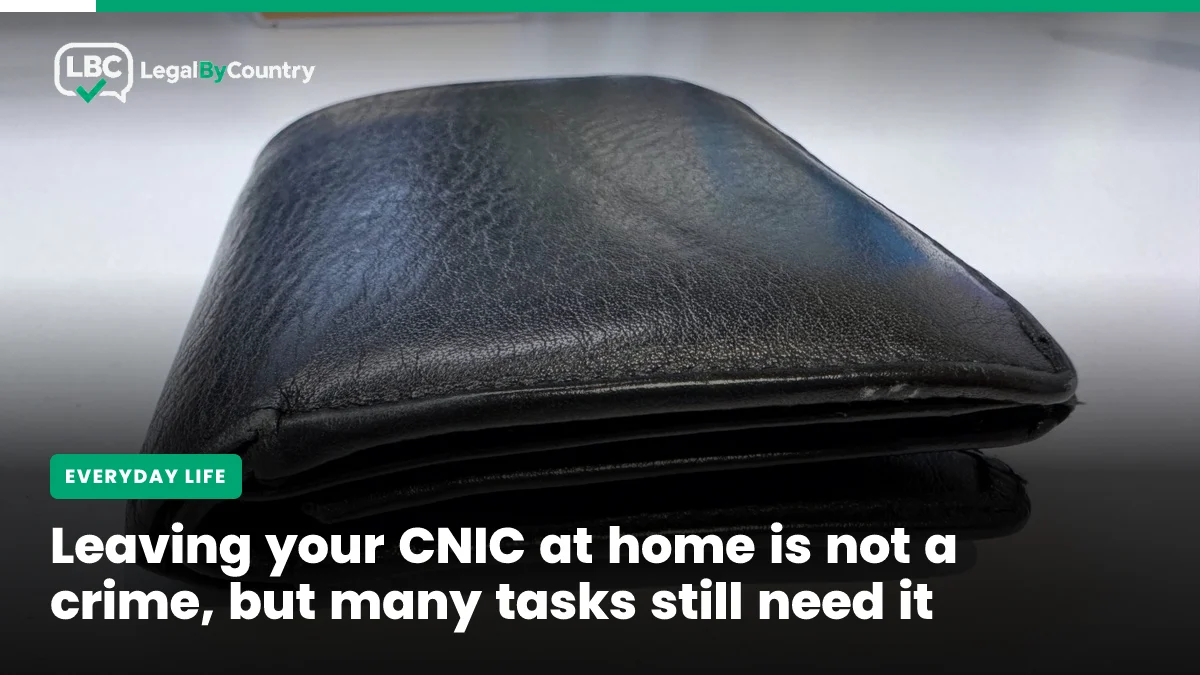
Short answer: Legal, no duty to carry it
Yes. The NADRA Ordinance, 2000 requires you to register and apply for a CNIC within 90 days of turning 18, but no law we found makes carrying it at all times compulsory. Flights, SIMs, banks and hotels still need it.
- The law
National Database and Registration Authority Ordinance, 2000, ss. 9, 10, 15, 16, 19, 30, 31
Code of Criminal Procedure, 1898, ss. 54, 57, 109, 144
Pakistan Penal Code, 1860, s. 188
Punjab Information of Temporary Residents Act 2015, ss. 5, 11
- Penalty
- Not carrying a CNIC carries no penalty, but failing to apply for one within 90 days of turning 18 is punishable with up to six months rigorous imprisonment, a fine up to Rs 50,000, or both under section 30(1)(e) of the NADRA Ordinance, 2000.
General information only, not legal advice. For help with your own matter, consult a qualified lawyer or legal consultant. Read the disclaimer
Leaving your CNIC at home is not a crime in Pakistan
A rider stopped at a Lahore police picket pats his pockets and remembers his card is on the dresser at home. Is it legal not to carry your CNIC in Pakistan? Yes. No federal law we found makes carrying it at all times compulsory.
The law that creates the card is the National Database and Registration Authority Ordinance, 2000 (the NADRA Ordinance). Its duties are about getting registered, getting a card, keeping it safe and reporting it lost. None of its sections says you must have the card on you when you leave the house.
That does not make the card optional in daily life. Police can still ask who you are, some security orders ask people to carry ID, and many ordinary tasks, from boarding a domestic flight to buying a SIM, cannot be done without it. The gap between "not a crime" and "not a problem" is what the rest of this guide covers.
The NADRA Ordinance makes you get a card, not carry it
Every citizen must register with NADRA at 18 and apply for a National Identity Card within 90 days of turning 18. Missing that deadline without a good reason is an offence. Forgetting to carry the card you already hold is not listed anywhere.
Section 9(1) says every citizen who has turned eighteen "shall get himself" registered. Section 10 tells NADRA to issue a card to each registered adult, with the validity period and fee set by the rules. Section 15(1) makes the holder "responsible for its safe custody and for maintaining it in proper shape."
The clearest clue sits in section 16. A NADRA Registration Officer may ask you to show your card, but if it is not in your possession at that moment, the officer directs you to produce it "within such time" and at a place the officer chooses. Even NADRA's own inspectors, in other words, must give you time to fetch it.
| Duty under the NADRA Ordinance | Section | Penalty if you break it (as of 16 November 2026) |
|---|---|---|
| Register with NADRA once you turn 18 | s. 9(1), s. 30(1)(a) | Up to 6 months rigorous imprisonment, a fine up to Rs 50,000, or both |
| Apply for a National Identity Card within 90 days of turning 18 | s. 30(1)(e) | Up to 6 months rigorous imprisonment, a fine up to Rs 50,000, or both |
| Report a lost card within 30 days | s. 30(1)(c) | Up to 6 months rigorous imprisonment, a fine up to Rs 50,000, or both |
| Do not let another person keep your card | s. 30(2)(d) | Up to 5 years rigorous imprisonment, a fine up to Rs 100,000, or both |
| Carry the card with you at all times | No such section | No penalty in the Ordinance |
Section 31 adds a safeguard. A court can only take up an offence under the Ordinance on a written complaint from NADRA or a gazetted officer it authorises. A police officer at a picket cannot start a NADRA Ordinance case on his own, even for the offences that do exist.
Police can ask who you are, but the card is only one way to answer
Police may stop you and ask your name and address, and giving a false one can lead to arrest. Not having the card is not, by itself, a reason to arrest you. What changes is how long the stop takes.
What the Code of Criminal Procedure allows
The Code of Criminal Procedure, 1898 sets the limits:
- Section 54 lets police arrest without a warrant someone reasonably suspected of a cognizable offence, meaning a serious offence where no warrant is needed. A missing CNIC is not a cognizable offence.
- Section 57 covers a person who has committed, or is accused of, a non-cognizable offence in front of a police officer and refuses to give a name and residence, or gives one the officer believes is false. That person may be arrested until the true name is found, then released on a bond.
- Under section 57(3), anyone whose identity is not confirmed within 24 hours must be sent to the nearest Magistrate. Article 10 of the Constitution separately requires every arrested person to be told the grounds and produced before a Magistrate within 24 hours.
- Section 109 lets a Magistrate, not a constable, ask for a bond for good behaviour from someone who "cannot give a satisfactory account of himself." That is a court process with a hearing, not an on-the-spot penalty for a forgotten card.
How checking works in practice
Checkpoints increasingly verify identity electronically. In June 2026, Rawalpindi police launched an app that scans a national identity card at entry checkpoints and bus terminals and shows any criminal record or pending case, The Express Tribune reported on 26 June 2026. Without a card, police may verify you another way, which usually means waiting longer.
Our honest view: the law is on your side, but the roadside is not the place to argue it. Give your real name, father's name and address, stay polite, and note the officer's name and the time. If you want to know whether you may film the stop, read our guide on recording the police.
Section 144 orders and security zones can raise the stakes
A district or provincial order under section 144 can tell the public to avoid specific acts in a set area for a set time. If such an order required ID, ignoring it could become an offence under section 188 of the Penal Code.
Section 144 of the Code of Criminal Procedure lets the district authority, and in some cases the provincial government, issue urgent written orders "to the public generally when frequenting or visiting a particular place." These orders are temporary and usually ban gatherings, pillion riding or the display of weapons.
We did not find a current order that makes carrying a CNIC compulsory. The closest example is a section 144 notification in Dera Ismail Khan, where, Dawn reported on 9 March 2026, citizens were "advised to carry identification documents" and follow security personnel. Advice is not a legal command.
Where an order does bind you, section 188 of the Pakistan Penal Code punishes knowing disobedience with up to one month of simple imprisonment or a fine up to Rs 600, or up to six months or a fine up to Rs 3,000 where the disobedience risks life, safety or a riot (consolidated text as of 16 November 2026). Before travelling to a sensitive area, check the latest district notification.
Some everyday tasks legally need your CNIC
You do not have to carry your CNIC on a walk, but several transactions are built around it. Leaving the card behind will not get you fined. It will get you turned away at the counter, the gate or the reception desk.
| Situation | What is required | Where the rule comes from (as of) |
|---|---|---|
| Getting a passport or travel document to leave Pakistan | An adult without a National Identity Card cannot be issued one | NADRA Ordinance, s. 19(1) (consolidated to 7 October 2022) |
| Voting | The polling officer may require your National Identity Card to confirm identity | NADRA Ordinance, s. 19(2) |
| Domestic flight | Islamabad airport lists "CNIC (Original)" and a valid ticket for domestic departures | Islamabad International Airport (16 November 2026) |
| New, duplicate or transferred SIM | Biometric verification through NADRA against your original CNIC | PTA instructions reported by ProPakistani (24 July 2026) |
| Opening a bank account or wallet | Biometric verification is the primary check for CNIC holders before the account opens | SBP BPRD Circular No. 1 of 2025, reported by Dawn (24 October 2025) |
| Checking into a hotel or hostel in Punjab or Sindh | The manager must be satisfied of your identity from your CNIC or passport and send a copy to police | Punjab and Sindh Information of Temporary Residents Acts 2015, s. 5 |
The hotel rule puts the legal duty on the hotel, not the guest. Section 5 of the Punjab Information of Temporary Residents Act 2015 bars a manager from letting a guest stay unless satisfied of identity "on the basis the computerized national identity card or passport." Under section 11, a manager who knowingly breaks it faces up to six months and a fine of Rs 10,000 to Rs 100,000. The Sindh Act has the same section 5, with a fine of Rs 10,000 to Rs 45,000. So a guest without ID will simply be refused a room. Renting a house works on the same idea, covered in our guide to tenant registration.
An expired CNIC is still your card, but services may stop
Carrying an expired card is not an offence in itself, and the Ordinance has no penalty for late renewal. NADRA has warned, though, that expired cards can lead to blocked SIMs, frozen bank access and failed verification at offices that check NADRA's records.
Section 10 lets NADRA fix each card's "period of validity" through its rules. On 9 April 2026, Dawn reported NADRA's warning that bank accounts, mobile SIMs and other verification-based services "may be adversely affected or suspended" if cards are not renewed. NADRA said it is "legally empowered to impose additional fees or penalties for delayed renewal" but had not done so, and that such charges could follow after June 2026. We could not confirm whether any were notified.
We found no rule on whether police or airlines must accept an expired card as proof of identity. In practice, treat an expired card as a weak document and renew it before it runs out.
The digital CNIC on Pak-ID has the same legal status as the plastic card
NADRA's Digital Identity Regulations 2025 say a digital identity credential issued through its Pak-ID app carries the same legal status as the physical card, and organisations asking for proof of identity must accept it. A phone can lawfully stand in for the card.
NADRA issued the regulations in October 2025, ProPakistani reported. On 13 March 2026 NADRA stated that regulation 9 gives digital credentials "the same legal validity, credibility, and evidentiary value" as physical ones and that regulation 10 requires government departments, regulated institutions and other organisations requesting proof of identity to accept them, as reported by The Express Tribune and Radio Pakistan.
Two limits matter. NADRA's statement does not name the police, and it admitted some offices were still demanding the plastic card or a photocopy. If you are refused, NADRA says to complain through its official channels. A flat phone battery also leaves you with no ID at all, so the physical card stays the safer choice for travel.
Handling your ID lawfully comes down to a few habits
Stay on the right side of the law by getting the card on time, keeping it safe, setting up the digital version and carrying the physical card whenever a task or area needs it. Cooperate at checkpoints and save any complaint for later.
- Apply for your CNIC within 90 days of your 18th birthday, as section 30(1)(e) of the NADRA Ordinance requires.
- Keep the card in your own custody. Do not lend it or leave it with anyone, because section 30(2)(d) makes that an offence.
- Set up the digital CNIC on NADRA's Pak-ID app as a lawful backup.
- Carry the physical card when you fly, buy a SIM, visit a bank, check into a hotel or travel through a district under security orders.
- If police stop you without it, give your true name and address. A false name is what turns a stop into an arrest under section 57 of the Code of Criminal Procedure.
- If the card is lost, report it to NADRA within 30 days and apply for a duplicate.
- Renew the card before its expiry date so your SIMs and bank accounts keep working.
- If you are held for more than 24 hours without being taken to a Magistrate, a lawyer or family member can raise it with the court under Article 10 of the Constitution.
More guides on daily rules sit in our everyday life section.
Frequently asked questions
Can police arrest me for not having my CNIC?
+
Not for that alone, because no law makes carrying the card an offence. Under section 57 of the Code of Criminal Procedure, police can hold someone accused of a non-cognizable offence who refuses to give a name and address, or gives a false one, until it is confirmed.
Is a photocopy or phone photo of my CNIC enough?
+
Not reliably. A photocopy or photo is not an official credential, so offices and airlines can refuse it. NADRA's digital CNIC on the Pak-ID app is different: NADRA says its Digital Identity Regulations 2025 give it the same legal status as the physical card.
Do police have to accept the digital CNIC on Pak-ID?
+
The rule points that way, but it has not been tested. Regulation 10 requires organisations asking for proof of identity to accept NADRA digital credentials, yet NADRA's March 2026 statement did not name the police. Carry the physical card when travelling.
Is it illegal to use an expired CNIC?
+
No section of the NADRA Ordinance punishes holding an expired card. NADRA warned in April 2026 that expired cards can lead to suspended SIMs, bank accounts and verification services, and said it may add late renewal fees. Renew before the expiry date.
What is the penalty for not making a CNIC at 18?
+
Up to six months rigorous imprisonment, a fine up to Rs 50,000, or both, under section 30(1)(e) of the NADRA Ordinance, if you do not apply within 90 days of turning 18 without reasonable cause. A court can act only on NADRA's written complaint.
Can I fly within Pakistan without my CNIC?
+
Usually not. Islamabad International Airport lists an original CNIC and a valid ticket as the documents for domestic departures. Ask your airline before you travel whether it accepts any other document, such as a passport.
Can a hotel refuse me a room without a CNIC?
+
Yes. In Punjab and Sindh, section 5 of the Information of Temporary Residents Acts 2015 bars a hotel or hostel manager from letting you stay unless your identity is confirmed from your CNIC or passport, and a copy must go to police.
What should I do if I lose my CNIC?
+
Report the loss to NADRA within 30 days and apply for a duplicate. Section 30(1)(c) of the NADRA Ordinance makes failing to report a lost card within 30 days, without reasonable cause, an offence. Set up the digital CNIC meanwhile.
Sources
We compiled this guide from official sources: the law itself, government notifications and court records, checked against reporting of recent changes. It is for information only.
- National Database and Registration Authority Ordinance, 2000 (updated till 7.10.2022) · Ministry of Law and Justice (Pakistan Code)
- Code of Criminal Procedure, 1898 · Ministry of Law and Justice (Pakistan Code)
- Pakistan Penal Code, 1860 · Ministry of Law and Justice (Pakistan Code)
- Constitution of the Islamic Republic of Pakistan, 1973 · Ministry of Law and Justice (Pakistan Code)
- Punjab Information of Temporary Residents Act 2015 (VIII of 2015) · Law and Parliamentary Affairs Department, Government of the Punjab (Punjab Code)
- Sindh Information of Temporary Residents Act 2015 · Sindh Code, Government of Sindh
- Departure procedures: documents for domestic and international departures · Islamabad International Airport
- Digital CNIC legally equivalent to physical CNIC (13 March 2026) · Radio Pakistan
- Digital ID cards carry same legal status as physical IDs, clarifies NADRA (13 March 2026) · The Express Tribune
- NADRA issues landmark digital ID and data exchange regulations (17 October 2025) · ProPakistani
- Nadra warns of penalties for those who delay obtaining, renewing identity documents (9 April 2026) · Dawn
- PTA makes it harder to get new SIM cards in Pakistan (24 July 2026) · ProPakistani
- SBP customer onboarding framework: biometric verification becomes primary (24 October 2025) · Dawn
- Smart ID scanning app launched (26 June 2026) · The Express Tribune
- Section 144 imposed in Dera Ismail Khan amid security concerns (9 March 2026) · Dawn

Advocate, Supreme Court of Pakistan
Advocate of the Supreme Court of Pakistan and the Lahore High Court, former Assistant Advocate General Punjab and Assistant Attorney General for Pakistan, and adjunct professor of law in Lahore.
Full profile and credentials →
Is It Legal to Record the Police in Pakistan?
Yes, in a public place. No Pakistani law bans filming police on duty. You can still be charged for obstruction under section 186 of the Penal Code, for filming prohibited places, or under PECA for posting a false or harmful clip.
Is It Legal to Rent Out Property Without Registering the Tenant in Pakistan?
No. Every province requires landlords to report tenants to the police: within 15 days in Punjab and 48 hours in Sindh under their Temporary Residents Acts 2015, and within 7 days in KP. Breaking it can mean arrest and up to a year in prison.

Is It Legal to Play Loud Music in Pakistan?
Playing music is legal, but not through speakers loud enough to annoy or disturb others. Punjab's Sound Systems (Regulation) Act 2015 punishes this with up to six months in jail and a Rs 25,000 to Rs 100,000 fine. Other provinces have similar laws.
Is Begging Illegal in Pakistan?
Yes. Asking for alms in a public place is an offence under each province's vagrancy law, with up to three years in Punjab. Organising or forcing others to beg is far more serious, and since 2025 can count as human trafficking.