

Is Begging Illegal in Pakistan?
Yes. Begging in public is an offence in every province, and running a begging ring can mean 10 years. See penalties by province and lawful help.

Short answer: Illegal in public places
Yes. Asking for alms in a public place is an offence under each province's vagrancy law, with up to three years in Punjab. Organising or forcing others to beg is far more serious, and since 2025 can count as human trafficking.
- The law
Punjab Vagrancy Ordinance, 1958 (as amended to 2026), ss. 2(g), 7, 9, 10, 19
Punjab Vagrancy (Amendment) Ordinance 2026 (XI of 2026), ss. 2, 5
Khyber Pakhtunkhwa Vagrancy Restraint Act, 2020 (Act VIII of 2020), ss. 10, 11, 13, 14
Balochistan Prevention of Beggary Act, 2025, ss. 4, 5, 6, 12
- Penalty
- Begging in a public place carries up to three years in prison in Punjab under section 9 of the Punjab Vagrancy Ordinance, 1958, while using a disabled person or child to beg carries seven to ten years and a fine of Rs 1 million to Rs 2 million under section 10(1)(e).
General information only, not legal advice. For help with your own matter, consult a qualified lawyer or legal consultant. Read the disclaimer
Begging in a public place is an offence in every province
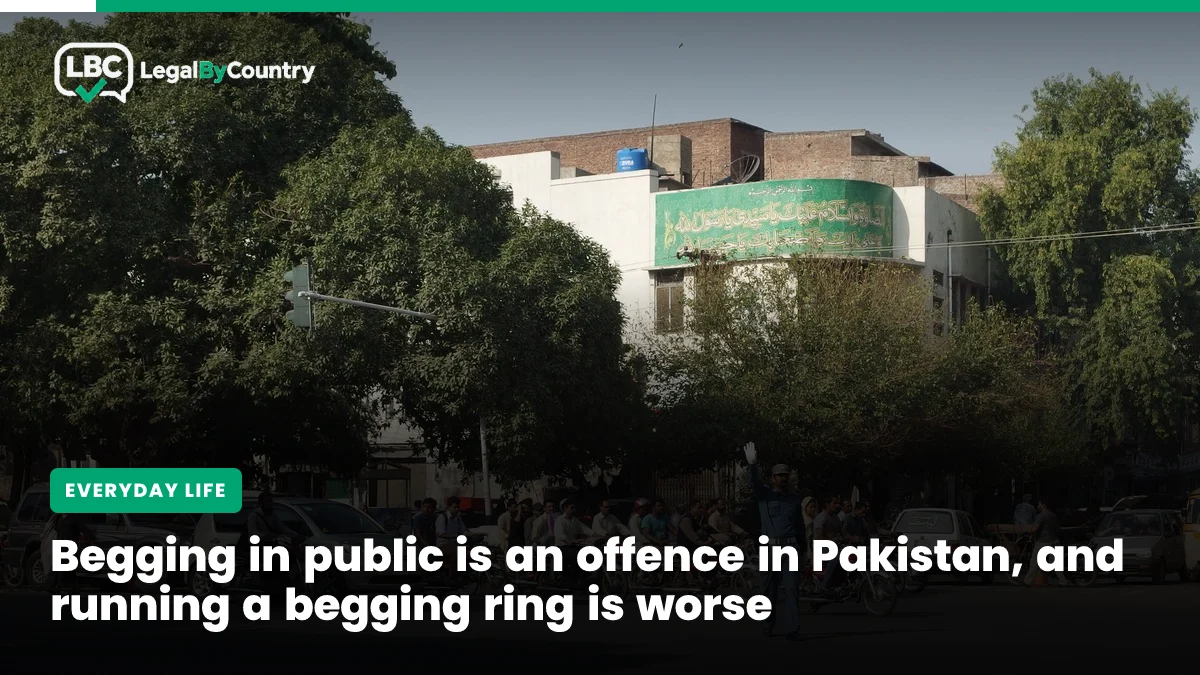
Stop at any traffic signal in Lahore or Karachi and someone will tap on the car window with an open hand. Most drivers wonder whether to give. Fewer ask the legal question: is begging illegal in Pakistan? The short answer is yes, in every province.
Asking for alms in a public place is an offence under each province's vagrancy law. The core text is the West Pakistan Vagrancy Ordinance, 1958, which Punjab, Sindh and Balochistan still use in amended form. Khyber Pakhtunkhwa replaced it with its own Act in 2020, and Balochistan passed a new beggary Act in April 2026.
The law counts four things as begging. Under section 2(g) of the Punjab Vagrancy Ordinance, 1958, a "vagrant" is a person who:
- asks for or receives alms in a public place;
- shows a sore, wound, injury, deformity or disease in public to get alms;
- lets himself be used as an "exhibit" to get alms; or
- enters private premises, uninvited, to ask for alms.
Collecting money, food or gifts for a purpose allowed under a government certificate is not vagrancy. A mosque committee or registered charity raising funds lawfully is a different thing from a person begging at a signal.
The law is much harder on the people who organise begging than on the people who beg. Since 2025, running a begging ring can also count as human trafficking under federal law, with up to fourteen years in prison where a child or woman is involved.
The penalty depends on your province
Each province sets its own punishment for begging, and the gap is wide. Punjab allows up to three years for an adult beggar, Balochistan now prefers a warning or welfare home for a first offence, and Khyber Pakhtunkhwa sends people to a shelter first.
| Province or area | Main law (as of 16 November 2026) | Penalty for begging | Penalty for organisers |
|---|---|---|---|
| Punjab | Punjab Vagrancy Ordinance, 1958, as amended in 2025 and by Ordinance XI of 2026 | Up to 3 years (s. 9); first offenders can be warned and released on a bond | Up to 3 to 10 years and fines up to Rs 2 million, depending on who is used (s. 10) |
| Sindh | West Pakistan Vagrancy Ordinance, 1958, as amended by Sindh Ordinance VII of 1983 | Up to 3 years, with a lighter term for people with a physical disability | Up to 5 years (s. 10, as amended in 1983) |
| Khyber Pakhtunkhwa | Khyber Pakhtunkhwa Vagrancy Restraint Act, 2020 | Up to 3 years' detention in a Dar-ul-Kafala; prison up to 3 years only for a habitual repeat offender (s. 13) | Up to 1 year, or a fine of Rs 300,000 to Rs 500,000, or both (s. 14) |
| Balochistan | Balochistan Prevention of Beggary Act, 2025 (in force April 2026) | First finding: warning on a bond or a welfare home order; begging again after detention: up to 6 months or Rs 20,000, then up to 2 years and Rs 50,000 (s. 6) | Up to 3 to 10 years and fines up to Rs 2 million (s. 12) |
| Islamabad | No separate begging law found; the 1958 Ordinance and federal trafficking law are used | Up to 3 years under the original 1958 text | Trafficking law: up to 10 years, or 14 for a woman or child victim |
Punjab
Section 9 of the Punjab Ordinance allows up to three years in prison for a person found to be a vagrant. For a first conviction, the magistrate can instead warn the person and release them on a bond to stop begging. Section 7 lets police arrest a suspected beggar without a warrant, and the person must be released on bail or produced before a magistrate within 24 hours.
Section 11 creates a presumption. If a person has no visible means of support and is found wandering in a public place in a way that suggests begging, the court presumes they are a vagrant unless they prove otherwise. Section 24 lets the state confiscate money found on a convicted vagrant, apart from necessary clothing.
Sindh
Sindh still uses the 1958 Ordinance. The Sind Vagrancy (Amendment) Ordinance, 1983 changed the sentence in section 9, keeping three years as the ceiling for an able-bodied person and setting a shorter term for a person with a physical disability. The same amendment raised the penalty for employing beggars to five years. The official Sindh Code copy is an Urdu translation, so check the authoritative English text with a lawyer before relying on exact figures.
Khyber Pakhtunkhwa
The Khyber Pakhtunkhwa Vagrancy Restraint Act, 2020 leans towards care. A Special Magistrate who finds someone to be a vagrant sends them to a Dar-ul-Kafala (shelter) for up to three years. Prison, also up to three years, is kept for habitual vagrants with an earlier conviction. Offences are cognizable and bailable under section 20. A replacement, the Khyber Pakhtunkhwa Vagrancy (Control and Rehabilitation) Bill, 2026, was introduced in April 2026 but the Assembly deferred it on 20 July 2026, so the 2020 Act still applies as of 16 November 2026.
Balochistan
The Balochistan Prevention of Beggary Act, 2025 was passed on 13 April 2026 and signed by the Governor on 14 April 2026. A person found begging is taken into "protective custody", which the Act says is not an arrest, and brought before a court. On a first finding, the court can only warn and release on a bond, or order a stay in a welfare home. Prison comes only after someone begs again following detention. A child found begging goes to the Juvenile Court.
Islamabad
We found no separate begging law for the Islamabad Capital Territory. The 1958 Ordinance, in its original form, sets up to three years for begging and up to one year or a fine for employing beggars. The federal trafficking law covers organised begging, and the Islamabad Capital Territory Child Protection Act, 2018 treats a begging child as a child in need of protection.
Organising or forcing others to beg is the serious crime
Every province punishes the organiser far more heavily than the beggar. In Punjab and Balochistan, using a disabled person or child to beg carries seven to ten years and a fine of at least Rs 1 million. Punjab made these offences non-bailable in March 2025.
The Punjab Vagrancy (Amendment) Act 2025 (Act XVI of 2025, gazetted on 24 March 2025) rewrote section 10. An "organizer" is anyone who organises, employs or causes another person or child to beg. Balochistan copied the same scale into section 12 of its 2026 Act, with minor differences.
| Who the organiser uses (Punjab s. 10(1), as of 16 November 2026) | Prison | Fine |
|---|---|---|
| One adult, not injured or disabled | Up to 3 years | Rs 100,000 to Rs 300,000 |
| More than one adult | 3 to 5 years | Rs 300,000 to Rs 500,000 |
| One child | 3 to 5 years | Rs 300,000 to Rs 500,000 |
| More than one child | 5 to 7 years | Rs 500,000 to Rs 700,000 |
| Any injured or disabled person or child | 7 to 10 years | Rs 1 million to Rs 2 million |
Unpaid fines add six months to two years in prison. A repeat offender faces double punishment under section 10(3). Section 19 makes all these offences cognizable and non-bailable, meaning police can arrest without a warrant and bail is not automatic. The begging offence in section 9 stays bailable.
Begging rings now count as human trafficking
The Prevention of Trafficking in Persons (Amendment) Act, 2025 (Act IX of 2025, assented on 14 March 2025) added "organized beggary" to section 3 of the Prevention of Trafficking in Persons Act, 2018. Recruiting, transporting or harbouring someone for organised begging through force, fraud or coercion now carries up to ten years and a fine of up to Rs 1 million. If the victim is a child or a woman, the maximum rises to fourteen years and Rs 2 million.
Two other changes matter. A victim's consent, or a guardian's consent for a child, is no defence for the trafficker. And under the new section 6, a trafficking victim is not criminally liable for acts that were the direct result of being trafficked, though they may be called as a witness.
Using a child to beg is punished under several laws
A parent who sends a child to beg can be prosecuted, not just a stranger running a ring. Punjab raised the age of a "child" under its vagrancy law from 14 to 16 in September 2026 and now punishes parents who fail to prevent it.
The Punjab Vagrancy (Amendment) Ordinance 2026 (Ordinance XI of 2026), published on 23 September 2026, punishes a parent or guardian who uses a child to beg, lets someone else use the child, or negligently fails to prevent it where it could reasonably have been foreseen. The penalty is three months to three years in prison and a fine of Rs 100,000 to Rs 300,000. A provincial ordinance lapses after 90 days unless the Assembly acts, and a bill to make it permanent cleared the Punjab Assembly's home affairs committee in early November 2026.
Other child laws apply too:
- Punjab: section 36 of the Punjab Destitute and Neglected Children Act 2004 punishes employing a child (under 18) for begging with three months to five years and a fine of Rs 10,000 to Rs 100,000. Making a child sell small goods as a cover for begging is a separate offence under section 36A. Both are non-bailable.
- Whole country: section 328A of the Pakistan Penal Code (cruelty to a child) punishes ill-treatment or neglect that harms a child with one to three years, or a fine of Rs 25,000 to Rs 50,000, or both.
- Trafficking: moving or harbouring a child for organised begging falls under section 3(2) of the trafficking Act, with up to fourteen years.
Children found begging are treated mainly as children in need of protection. Punjab's child protection officers can take a begging child into care, and Balochistan's 2026 Act sends child cases to the Juvenile Court. Wider rules on child work are in our guide on whether child labour is illegal in Pakistan.
Begging abroad can cost you your passport
Pakistan now treats begging overseas as a national problem. Airport officers offload suspected beggars before they fly, and in May 2025 the Interior Minister announced that deportees would lose their passports, face an FIR and stay on the Passport Control List for five years.
The crackdown grew after complaints from Gulf states. The main steps, with dates:
- October 2023: FIA officers at Multan airport offloaded groups of passengers flying to Saudi Arabia on Umrah visas whom they suspected of travelling to beg, as Dawn reported.
- 24 May 2025: Interior Minister Mohsin Naqvi announced that returning deportees would have their passports cancelled, an FIR registered and their names placed on the Passport Control List for five years. The same meeting heard that Saudi Arabia had deported 5,033 Pakistanis for begging (Dawn, 24 May 2025).
- 17 December 2025: the FIA Director General told a National Assembly committee that 66,154 passengers had been offloaded in 2025 and that Saudi Arabia had deported 24,000 Pakistanis for begging that year (The News, 18 December 2025).
Where begging abroad involves agents moving people out of Pakistan, the FIA investigates under section 8(2) of the trafficking Act. Officers can also stop travellers whose documents do not match their stated purpose. Anyone going abroad for work should use the formal emigration route covered in our guide on working abroad without the Protector stamp.
A Pakistani caught begging in a Gulf country faces that country's law and deportation first, then the passport and FIR consequences at home.
Giving money to a beggar is not an offence
No federal or provincial law we found makes it a crime to give alms to a person in need. The vagrancy laws punish the person asking and the person organising, never the giver. Zakat, sadaqah and khairat are lawful.
The risk is practical, not legal. Police and provincial governments say organised rings put children, elderly people and disabled people at busy junctions and take most of the money. Giving through a registered charity, a mosque or a government programme makes sure the help reaches the person and not a middleman.
Selling goods at a signal is also different from begging. A vendor with flowers or car wipes is running a small trade, which brings its own rules, covered in our guide on whether street vending is legal. Punjab's section 36A catches only the case where a child is made to sell goods as a cover for begging.
Lawful help exists for people who cannot support themselves
The same laws that ban begging also promise help. Every province must run welfare homes or shelters, and anyone old, disabled or without income can ask to be admitted voluntarily. Federal programmes such as BISP and Pakistan Bait-ul-Mal also give cash and care.
Section 6 of the Punjab Ordinance lets an old, infirm or disabled person, or a child, apply to the Deputy Director, Social Welfare and Bait-ul-Maal, for a place in a welfare home until they can support themselves. Khyber Pakhtunkhwa's 2020 Act (section 10) offers the same right to anyone who satisfies a Special Magistrate that they have no livelihood.
If you or a family member need support, these are the lawful routes, in order:
- Register in the National Socio-Economic Registry at a BISP registration centre with your CNIC, then check eligibility for Benazir Kafaalat by sending your CNIC number to 8171 or using the 8171 web portal.
- Apply to Pakistan Bait-ul-Mal for medical help, education stipends, a place in a Pakistan Sweet Home for orphaned children, or an old-age home. Its application forms are on the "How to Get Assistance" page.
- Contact your district Social Welfare office (in Punjab, Social Welfare and Bait-ul-Maal) to ask for voluntary admission to a welfare home or Dar-ul-Kafala.
- For a night's shelter and meals, go to a Panahgah. Punjab runs these under the Punjab Panah Gah Authority Act 2021.
- If someone is forcing you or a child to beg, report it to the police on 15. If the person was moved across a border, report it to the FIA.
Payment amounts and eligibility scores change often, so check the current figures on the official portal rather than on social media pages that copy BISP's branding. More everyday legal questions are in our everyday law guides for Pakistan.
Enforcement is uneven and the law is still changing
Begging remains common despite laws dating from 1958, and the Punjab Home Department admitted in 2025 that it is "rampant". Punjab, Balochistan and Khyber Pakhtunkhwa all changed or tabled laws in 2025 and 2026, and more change is due within months.
Three changes to watch, as of 16 November 2026:
- Punjab: Ordinance XI of 2026 lapses about 90 days after 23 September 2026 unless the Assembly passes the replacement bill or extends it.
- Khyber Pakhtunkhwa: the Vagrancy (Control and Rehabilitation) Bill, 2026 was deferred on 20 July 2026. Media reports on the cabinet draft said it proposes a warning or up to one month in jail for a first offence and the power to recommend blocking CNICs and passports. None of that is law yet.
- Balochistan: the 2026 Act requires rules within a year of commencement, which will set how welfare homes and protective custody work in practice.
Frequently asked questions
Is it a crime to give money to a beggar in Pakistan?
+
No. We found no federal or provincial law that punishes giving alms. The vagrancy laws punish the person begging and anyone who organises begging, not the giver. Giving through a registered charity or a government programme helps make sure the money reaches the person in need.
What is the punishment for begging in Punjab?
+
Up to three years in prison under section 9 of the Punjab Vagrancy Ordinance, 1958. For a first conviction, the magistrate can instead warn the person and release them on a bond. The offence is cognizable but bailable, so police can arrest without a warrant.
Can police arrest someone just for begging?
+
Yes, in Punjab, Sindh and Khyber Pakhtunkhwa police can arrest a suspected beggar without a warrant, and the person must be bailed or brought before a magistrate within 24 hours. In Balochistan the 2026 Act uses protective custody instead, which it says is not an arrest.
What happens to parents who make their children beg?
+
In Punjab they face three months to three years in prison and a fine of Rs 100,000 to Rs 300,000 under the Vagrancy (Amendment) Ordinance 2026. Punjab's Destitute and Neglected Children Act 2004 adds up to five years for employing a child to beg.
Is organised begging human trafficking in Pakistan?
+
Yes, when force, fraud or coercion is used. Since March 2025, the Prevention of Trafficking in Persons Act, 2018 covers recruiting or moving people for organised begging, with up to ten years, or fourteen years and Rs 2 million where the victim is a woman or child.
Can my passport be cancelled for begging abroad?
+
Yes. On 24 May 2025 the Interior Minister announced that Pakistanis deported for begging would have their passports cancelled, face an FIR and be placed on the Passport Control List for five years. The FIA also offloads travellers it suspects of going abroad to beg.
Is selling flowers or car wipes at a traffic signal begging?
+
No, genuine selling is trade, not begging, though street vending has its own local rules. Punjab does punish making a child sell goods as a cover for begging, under section 36A of the Destitute and Neglected Children Act 2004.
Where can a poor person get help instead of begging?
+
Register with BISP at a registration centre and check eligibility through 8171, apply to Pakistan Bait-ul-Mal for medical or education help, or ask your district Social Welfare office for voluntary admission to a welfare home. Panahgahs give free shelter and meals.
Sources
We compiled this guide from official sources: the law itself, government notifications and court records, checked against reporting of recent changes. It is for information only.
- Punjab Vagrancy Ordinance, 1958 (XX of 1958), consolidated with the Punjab Vagrancy (Amendment) Act 2025 · Law and Parliamentary Affairs Department, Government of the Punjab (Punjab Code)
- Punjab Vagrancy (Amendment) Ordinance 2026 (XI of 2026), Punjab Gazette, 23 September 2026 · Law and Parliamentary Affairs Department, Government of the Punjab (Punjab Code)
- Punjab Vagrancy (Amendment) Bill 2025 (Bill No. 20 of 2025), as introduced, with statement of objects and reasons · Provincial Assembly of the Punjab
- Punjab Destitute and Neglected Children Act 2004 (as amended to 2025) · Law and Parliamentary Affairs Department, Government of the Punjab (Punjab Code)
- Punjab Panah Gah Authority Act 2021 · Law and Parliamentary Affairs Department, Government of the Punjab (Punjab Code)
- Sind Vagrancy (Amendment) Ordinance, 1983 (Sindh Ordinance No. VII of 1983), Urdu translation · Sindh Code, Government of Sindh
- Khyber Pakhtunkhwa Vagrancy Restraint Act, 2020 (Act No. VIII of 2020) · Provincial Assembly of Khyber Pakhtunkhwa
- Khyber Pakhtunkhwa Vagrancy (Control and Rehabilitation) Bill, 2026: bill page and status · Provincial Assembly of Khyber Pakhtunkhwa
- Balochistan Prevention of Beggary Act, 2025 (assented 14 April 2026) · Provincial Assembly of Balochistan
- Balochistan Vagrancy Ordinance, 1958 (W.P. Ordinance XX of 1958) · Government of Balochistan
- Prevention of Trafficking in Persons Act, 2018 · Ministry of Law and Justice (Pakistan Code)
- Prevention of Trafficking in Persons (Amendment) Act, 2025 (Act No. IX of 2025), Gazette of Pakistan, 22 March 2025 · Senate of Pakistan
- Pakistan Penal Code, 1860 · Ministry of Law and Justice (Pakistan Code)
- Benazir Income Support Programme · Government of Pakistan
- BISP 8171 web portal · Benazir Income Support Programme
- Pakistan Bait-ul-Mal · Government of Pakistan
- Govt to cancel passports of deported Pakistanis, register cases against them (24 May 2025) · Dawn
- Saudi Arabia deports 56,000 Pakistanis for begging, FIA tells NA panel (18 December 2025) · The News
- 8 more 'beggars' travelling to Saudi Arabia offloaded at Multan airport: FIA (October 2023) · Dawn
- Punjab approves bill proposing jail and heavy fines for child begging (4 November 2026) · ProPakistani
- KP proposes strict punishments for begging (21 April 2026) · ProPakistani
Advocate, Supreme Court of Pakistan
Advocate of the Supreme Court of Pakistan and the Lahore High Court, former Assistant Advocate General Punjab and Assistant Attorney General for Pakistan, and adjunct professor of law in Lahore.
Full profile and credentials →
Is It Legal Not to Carry Your CNIC in Pakistan?
Yes. The NADRA Ordinance, 2000 requires you to register and apply for a CNIC within 90 days of turning 18, but no law we found makes carrying it at all times compulsory. Flights, SIMs, banks and hotels still need it.

Is It Legal to Play Loud Music in Pakistan?
Playing music is legal, but not through speakers loud enough to annoy or disturb others. Punjab's Sound Systems (Regulation) Act 2015 punishes this with up to six months in jail and a Rs 25,000 to Rs 100,000 fine. Other provinces have similar laws.
Is It Legal to Record the Police in Pakistan?
Yes, in a public place. No Pakistani law bans filming police on duty. You can still be charged for obstruction under section 186 of the Penal Code, for filming prohibited places, or under PECA for posting a false or harmful clip.

Is It Legal to Eat in Public During Ramadan in Pakistan?
No, not for Muslims obliged to fast. Section 3 of the Ehtram-e-Ramazan Ordinance, 1981 bans them from eating, drinking or smoking in public during fasting hours. Non-Muslims and people Islam excuses are outside it. Penalty: up to three months and a fine.