

Is It Legal to Eat in Public During Ramadan in Pakistan?
Not for Muslims obliged to fast. See who the Ehtram-e-Ramazan Ordinance covers, the exemptions, restaurant rules and the real fines by province.
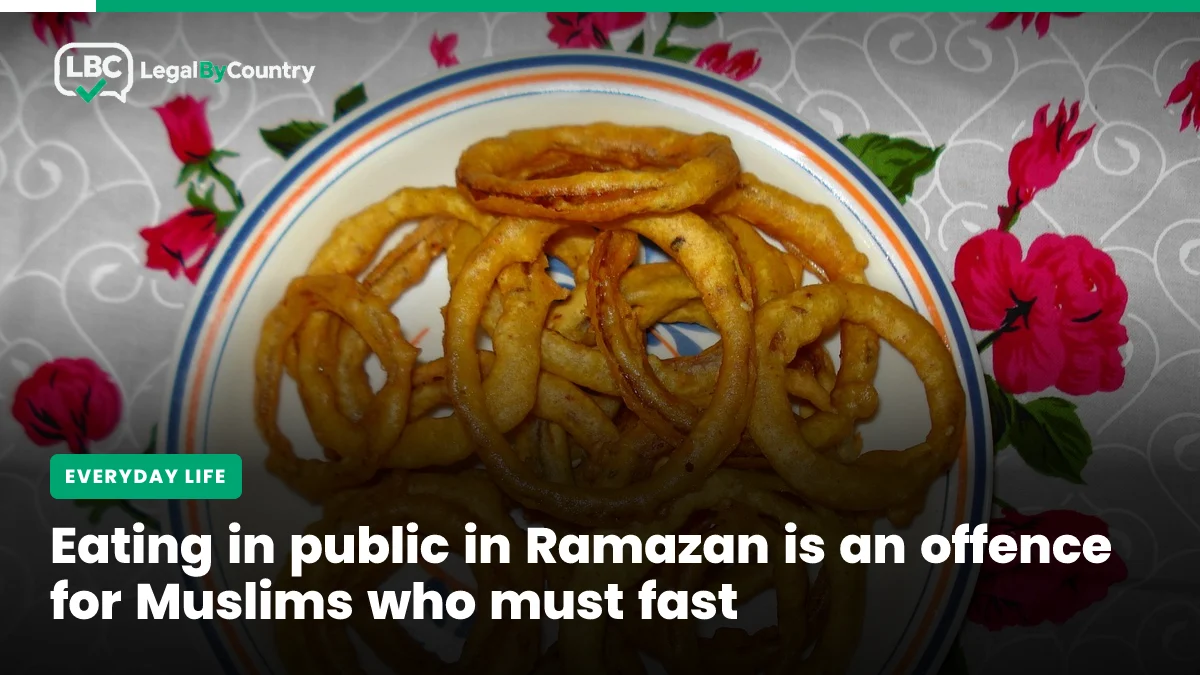
Short answer: Banned in public for those who must fast
No, not for Muslims obliged to fast. Section 3 of the Ehtram-e-Ramazan Ordinance, 1981 bans them from eating, drinking or smoking in public during fasting hours. Non-Muslims and people Islam excuses are outside it. Penalty: up to three months and a fine.
- The law
Ehtram-e-Ramazan Ordinance, 1981 (Ordinance XXIII of 1981), ss. 2 to 10
Ehtram-e-Ramazan Ordinance, 1981 as amended by the Punjab Ehtram-e-Ramazan (Amendment) Act 2017, ss. 3, 4, 6, 7
- Penalty
- Up to three months' simple imprisonment and a fine of up to Rs 500 under section 3(2) of the 1981 Ordinance, or up to Rs 5,000 in Punjab under its 2017 amendment; restaurants face up to Rs 50,000 in Punjab under section 4(2).
General information only, not legal advice. For help with your own matter, consult a qualified lawyer or legal consultant. Read the disclaimer
Eating in public during Ramazan is an offence for Muslims who must fast
By mid-morning in a Pakistani bazaar during Ramazan, dhaba shutters are half down and tea stalls sit under cloth. Is eating in public during Ramadan in Pakistan against the law, or only frowned on? For most adult Muslims, it is a criminal offence.
The rule comes from the Ehtram-e-Ramazan Ordinance, 1981 (Ordinance XXIII of 1981), made on 25 June 1981. Section 3(1) says that no person who, "according to the tenets of Islam, is under an obligation to fast shall eat, drink or smoke in a public place during fasting hours in the month of Ramazan."
Section 10 says the Ordinance has effect "notwithstanding anything contained in any other law." Punjab amended its own copy in 2017. Islamabad, Sindh, Khyber Pakhtunkhwa and Balochistan still follow the 1981 text as published, with its original fines.
The ban covers people obliged to fast, not everyone
Section 3 does not apply to every person in Pakistan. It applies only to someone who, under the tenets of Islam, is obliged to fast. Non-Muslims are outside it, and so, on the plain wording, are Muslims whom Islamic teaching excuses from fasting.
The Ordinance never lists who is obliged to fast. It hands that question to Islamic teaching. Under widely accepted teaching, these groups are not obliged to fast on a given day:
- Non-Muslims, including Christian, Hindu, Sikh and Parsi citizens and foreign visitors.
- Children who have not reached puberty.
- People who are ill, or whose health would suffer from fasting.
- Travellers on a journey.
- Women who are menstruating, pregnant or breastfeeding, in the circumstances Islamic scholars recognise.
- Elderly people too frail to fast.
The law and the street do not always match. The officer standing in front of you cannot see your religion, your illness or your travel plans. If you are stopped, the facts are sorted out later, before a Magistrate. Being outside section 3 is a defence, not a shield against being stopped.
Smoking and drinking water count too
Section 3 bans eating, drinking and smoking. A sip of water, a cigarette at a bus stop or chewing paan in the street all fall within the words of the section. Our separate guide on smoking in public in Pakistan covers the year-round rules.
A "public place" in the Ordinance is wider than the street
Section 2 defines a public place as including any hotel, restaurant, canteen, house, room, tent, enclosure, road, lane, bridge or "other place to which the public have access". The test is public access, not who owns the building.
Your own home, with the door closed, is not a place the public can enter, so eating there is outside section 3. An office kitchen used only by staff is a harder case. A shop counter, a park bench, a car parked on a busy road with the windows down, or a university lawn will usually count as public places.
The word "house" in the definition surprises people. Read with the rest of section 2, it covers a house or room that the public can enter, such as a guest house or a rented hall, not a private family home.
Restaurants may not serve fasting Muslims during fasting hours
Section 4 makes it an offence for a hotel, restaurant or canteen owner, manager or worker to "knowingly and wilfully" offer or serve food during fasting hours to a person obliged to fast. The penalty sits on the business side, separately from the customer.
Because the offence needs knowledge, the law does not stop a restaurant serving non-Muslims or people who are excused. In practice, most eateries close their dining halls from sehri to iftar, because staff cannot check a customer's religion or health.
Hospitals, stations, airports and schools are exempt
Section 5 lifts the section 4 ban for these places:
- A canteen or kitchen in a hospital serving food to patients.
- A restaurant, canteen, stall, wheelbarrow or vending contractor inside a railway station or on a train.
- A restaurant or canteen inside an airport, seaport or bus stand, or on an aircraft.
- The kitchen or dining car of a train.
- A kitchen or canteen for children inside a primary school.
The exemption protects the outlet from section 4. Section 9 lets the government make rules requiring food in these places to be served behind a curtain or screen and limiting who may be admitted. We could not find published federal rules under section 9 on an official site.
Courts have let businesses trade within the exemption
In June 2016 the Sindh High Court at Hyderabad disposed of more than a hundred petitions from hotels and restaurants. In C.P. No. D-1395 of 2016 and connected petitions (8 June 2016), the court said the petitioners could carry on business "strictly in accordance with the exemptions provided under Section 5", served out of public view by a curtain or screen. Any breach could still be acted on under the Ordinance.
Opening any food business also needs its ordinary licences. See our guide on running a restaurant without a food licence.
Cinemas and theatres must close for three hours after sunset
Section 6 requires every cinema, theatre and similar establishment to stay closed during Ramazan from sunset until three hours afterwards. The window covers iftar and taraweeh prayers. Daytime shows are not banned by this section.
The penalty falls on the owner, manager, staff member or person in charge: up to six months in prison, a fine, or both. The fine is higher in Punjab, as the table below shows.
Punjab raised its fines in 2017, other areas still use the 1981 figures
Punjab is the only province we found that has amended the Ordinance. Its 2017 Act raised the public eating fine tenfold and the restaurant and cinema fines to Rs 50,000. Islamabad's text on Pakistan Code still shows the 1981 figures.
The Punjab Ehtram-e-Ramazan (Amendment) Bill 2017 passed the Provincial Assembly on 25 October 2017. The Punjab Code text shows it became Act XXII of 2017, published in the Punjab Gazette on 8 November 2017. That Act also limited the Ordinance to Punjab and moved the rule-making power to the Provincial Government.
| Offence | Islamabad, Sindh, KP, Balochistan (1981 text) | Punjab (as amended 2017) |
|---|---|---|
| Eating, drinking or smoking in public, s. 3 | Up to 3 months simple imprisonment, fine up to Rs 500, or both | Up to 3 months simple imprisonment, fine up to Rs 5,000, or both |
| Serving food to a person obliged to fast, s. 4 | Up to 3 months simple imprisonment, fine up to Rs 500, or both | Up to 3 months simple imprisonment, fine up to Rs 50,000, or both |
| Cinema or theatre open after sunset, s. 6 | Up to 6 months imprisonment, fine up to Rs 5,000, or both | Up to 6 months imprisonment, fine up to Rs 50,000, or both |
Figures as of 16 November 2026, from the Pakistan Code text (registered 30 January 2025) and the Punjab Code consolidated text. "Simple imprisonment" means jail without hard labour.
We read the Sindh, Khyber Pakhtunkhwa and Balochistan positions from the absence of any amending Act, not from a consolidated provincial text. Khyber Pakhtunkhwa had its own Ehtram-e-Ramazan Act, 1972, but the Khyber Pakhtunkhwa Ehtram-e-Ramazan (Repeal) Ordinance, 1981 repealed it on 28 June 1981, three days after the national Ordinance. Azad Jammu and Kashmir has a separate Ehtram-i-Ramzan Ordinance, 1981 of its own.
No federal amendment raising the fines has become law
Several reports describe higher national fines of Rs 5,000, Rs 25,000 or Rs 50,000. Those figures come from bills, not law. The consolidated text on Pakistan Code still shows Rs 500 for eating in public and for serving food.
The history is a common source of confusion:
- In January 2017 a Senator introduced a private member's Ehtram-e-Ramazan (Amendment) Bill in the Senate. In May 2017 the Senate Standing Committee on Religious Affairs approved it, with a proposed hotel fine of Rs 25,000.
- On 16 January 2018 the federal cabinet approved a government version for Islamabad only, raising the eating fine to Rs 5,000 and the restaurant fine to Rs 50,000, Dawn reported on 17 January 2018.
- On 22 May 2018 The Express Tribune reported the bill was still waiting to be tabled in Parliament.
We found no record of either House passing a federal amendment in 2023 or any later year. Treat any article quoting new national fines with caution unless it names an Act and a gazette date.
Magistrates can arrest and try offenders on the spot
Section 7 lets a Magistrate and named local officials enter a public place and arrest a person they believe has broken the Ordinance. A Magistrate with summary powers can try the case where the arrest happens, using sections 262 to 265 of the Criminal Procedure Code.
In the 1981 text, the officials who can arrest include a Magistrate, the chairman of a district council, municipal or town committee, a mayor, and members of a district Zakat and Ushr Committee. Punjab's 2017 text names a Magistrate or an Assistant Commissioner. A person arrested by someone other than a Magistrate can be released on a bond or sent to the police station.
Under section 8, no court can take up the case except on a written complaint by an authorised official or the officer in charge of the police station. The police must complain to a Magistrate within 24 hours of the person reaching the station, and the trial is meant to be heard on a priority basis.
Enforcement is real but uneven
Enforcement depends on the district administration. On 23 February 2026, the Assistant Commissioner in Mianwali, Punjab, sealed two eateries for not observing the sanctity of the month, The Nation reported. District administrations also issue their own Ramazan orders on market and eatery timings each year, and these change from city to city.
Critics, including rights groups and some public figures, say the Ordinance is applied unequally to non-Muslims and the sick. We found no superior court judgment striking any section down. Questions about religion and the law are handled neutrally on this site, as our editorial policy explains.
Staying within the law during Ramazan is straightforward
The lawful position is simple. If you are obliged to fast, do not eat, drink or smoke in public between sehri and iftar. If you are not, eat out of public view, and businesses should either close or trade strictly within the section 5 exemptions.
- Check the fasting hours for your city. Sehri and iftar times are announced daily, and the next Ramazan is expected to begin in early February 2027, subject to moon sighting.
- If you are excused from fasting, eat at home, in a private office room or in an exempt place, not on the street or in a shop.
- If you are not a Muslim, you are outside section 3, but eating out of public view avoids misunderstandings with officials who cannot know that.
- If you travel, use the restaurants and canteens inside railway stations, airports and bus stands, which section 5 exempts.
- If you run an eatery, close the dining area during fasting hours unless you are inside an exempt place, and serve behind a screen if you are.
- If you run a cinema or theatre, close from sunset until three hours after.
- Follow any written order your district administration issues for Ramazan, and keep a copy if your business relies on it.
- If you are arrested, ask which section you are charged under, and contact a lawyer before the summary trial if you can.
Frequently asked questions
Can non-Muslims eat in public during Ramazan in Pakistan?
+
The ban in section 3 does not apply to them. Section 3 of the Ehtram-e-Ramazan Ordinance covers only a person who, under the tenets of Islam, is obliged to fast. Officials cannot see your religion, so eating out of public view avoids misunderstandings.
What is the fine for eating in public during Ramazan?
+
Up to Rs 500 under the 1981 text that applies in Islamabad, and up to Rs 5,000 in Punjab after its 2017 amendment. In both cases a court can also impose up to three months' simple imprisonment, or both. Figures as of 16 November 2026.
Can restaurants open during fasting hours in Ramazan?
+
Only within limits. Section 4 bars them from knowingly serving food to anyone obliged to fast. Outlets inside hospitals, railway stations, airports, seaports, bus stands and primary schools are exempt under section 5, and courts have required them to serve behind a screen.
Can a sick person or a traveller eat in public during Ramazan?
+
The Ordinance applies only to people obliged to fast under Islamic teaching, and that teaching excuses the sick and travellers. Being excused is a defence if you are stopped, not a guarantee you will not be, so eating out of public view is wiser.
Did Pakistan raise the Ehtram-e-Ramazan fines in 2023?
+
We found no federal amendment passed in 2023 or later. A 2017 Senate bill and a 2018 cabinet-approved bill proposed higher fines, but the Pakistan Code text still shows Rs 500. Punjab alone raised its fines, through an Act gazetted on 8 November 2017.
Do cinemas have to close during Ramazan?
+
Yes, from sunset until three hours afterwards, under section 6 of the Ordinance. The person in charge faces up to six months in prison, a fine of up to Rs 5,000 (Rs 50,000 in Punjab), or both. Daytime shows are not covered.
Who can arrest someone for eating in public in Ramazan?
+
A Magistrate and the local officials named in section 7. In Punjab the amended text names a Magistrate or an Assistant Commissioner. A Magistrate with summary powers can try the case on the spot, and courts act only on a written complaint.
Is smoking in public during Ramazan also an offence?
+
Yes, for anyone obliged to fast. Section 3 bans eating, drinking and smoking in a public place during fasting hours, so a cigarette carries the same penalty as a meal.
Sources
We compiled this guide from official sources: the law itself, government notifications and court records, checked against reporting of recent changes. It is for information only.
- Ehtram-e-Ramazan Ordinance, 1981 (Ordinance No. XXIII of 1981) · Ministry of Law and Justice (Pakistan Code)
- The Ehtram-e-Ramazan Ordinance, 1981 (full text PDF, registered 30-01-2025) · Ministry of Law and Justice (Pakistan Code)
- The Ehtram-e-Ramazan Ordinance, 1981 as amended by the Punjab Ehtram-e-Ramazan (Amendment) Act 2017 (XXII of 2017) · Law and Parliamentary Affairs Department, Government of the Punjab (Punjab Code)
- The Punjab Ehtram-e-Ramazan (Amendment) Bill 2017 (Bill No. 25 of 2017), passed 25 October 2017 · Provincial Assembly of the Punjab
- The Khyber Pakhtunkhwa Ehtram-e-Ramazan (Repeal) Ordinance, 1981 (Ordinance No. V of 1981) · Khyber Pakhtunkhwa Code, Government of Khyber Pakhtunkhwa
- C.P. No. D-1395 of 2016 and connected petitions, order dated 8 June 2016 · High Court of Sindh, Circuit Court Hyderabad
- The Ehtram-i-Ramzan Ordinance, 1981 (AJK Ordinance CXXXIII of 1981) · Law, Justice, Parliamentary Affairs and Human Rights Department, Azad Jammu and Kashmir
- Cabinet approves stricter penalties for Ehteram-i-Ramazan violators (17 January 2018) · Dawn
- Ehtram-e-Ramazan: Bill against Ramazan violators in limbo (22 May 2018) · The Express Tribune
- AC seals hotels, fines shopkeepers (24 February 2026) · The Nation
Advocate, Supreme Court of Pakistan
Advocate of the Supreme Court of Pakistan and the Lahore High Court, former Assistant Advocate General Punjab and Assistant Attorney General for Pakistan, and adjunct professor of law in Lahore.
Full profile and credentials →
Is It Legal to Play Loud Music in Pakistan?
Playing music is legal, but not through speakers loud enough to annoy or disturb others. Punjab's Sound Systems (Regulation) Act 2015 punishes this with up to six months in jail and a Rs 25,000 to Rs 100,000 fine. Other provinces have similar laws.
Is It Legal Not to Carry Your CNIC in Pakistan?
Yes. The NADRA Ordinance, 2000 requires you to register and apply for a CNIC within 90 days of turning 18, but no law we found makes carrying it at all times compulsory. Flights, SIMs, banks and hotels still need it.
Is It Legal to Record the Police in Pakistan?
Yes, in a public place. No Pakistani law bans filming police on duty. You can still be charged for obstruction under section 186 of the Penal Code, for filming prohibited places, or under PECA for posting a false or harmful clip.
Is Begging Illegal in Pakistan?
Yes. Asking for alms in a public place is an offence under each province's vagrancy law, with up to three years in Punjab. Organising or forcing others to beg is far more serious, and since 2025 can count as human trafficking.