

Is Kite Flying Legal in Pakistan?
Only on notified days. Punjab's 2026 Act bans kites outside Basant windows, with up to 7 years for dangerous string. See penalties and rules by province.

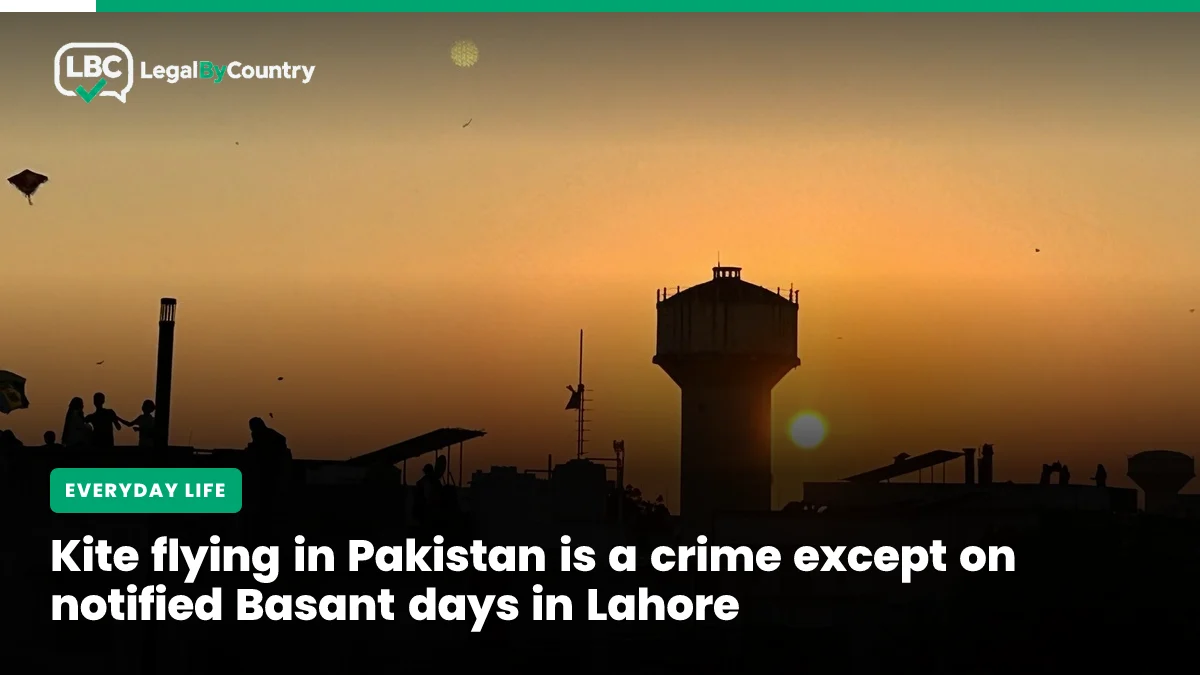
Short answer: Banned except on notified days
Only on notified days. Punjab's Regulation of Kite Flying Act 2025 bans flying, making and selling kites unless a deputy commissioner's notification allows it, as Lahore has for 12 to 14 March 2027. Metal, nylon and sharp maanjha string are never allowed.
- The law
Punjab Regulation of Kite Flying Act 2025 (Act I of 2026), ss. 3, 4, 5, 6, 9
Khyber Pakhtunkhwa Prohibition of Kite Flying Activities Act, 2006 (Act IV of 2006), ss. 3, 4, 5
Code of Criminal Procedure, 1898, s. 144
Pakistan Penal Code, 1860, s. 188
- Penalty
- In Punjab, making, transporting or selling kites, or metal, nylon or sharp-maanjha string, without permission carries 5 to 7 years in prison, a Rs 5 million fine, or both, under section 3(3) of the Punjab Regulation of Kite Flying Act 2025; flying carries 3 to 5 years or Rs 2 million under section 3(2).
General information only, not legal advice. For help with your own matter, consult a qualified lawyer or legal consultant. Read the disclaimer
Kite flying in Pakistan is banned by default, with narrow exceptions
For almost two decades, Lahore rooftops stayed empty in spring. On 6, 7 and 8 February 2026 they filled with kites, then the ban returned. Ask whether kite flying is legal in Pakistan and the honest answer is "only on notified days".
Punjab, the only province where Basant has legally returned, has a law that bans kite flying everywhere unless a deputy commissioner issues a notification allowing it for set dates and places. Khyber Pakhtunkhwa has its own prohibition law. Islamabad and the big cities of Sindh rely on temporary orders under section 144 of the Code of Criminal Procedure. Metal wire, nylon cord and glass-coated "sharp" maanjha are banned in every version of the rules we found.
So the verdict is "restricted". On 16 November 2026, flying a kite anywhere in Punjab is a crime, and the next lawful window we could confirm is Basant in Lahore on 12, 13 and 14 March 2027. Fireworks, drones and aerial firing have their own guides in our everyday life section.
Punjab's 2026 Act allows kites only under a deputy commissioner's notification
The Punjab Regulation of Kite Flying Act 2025 (Act I of 2026) bans flying, making, moving and selling kites unless a deputy commissioner, with prior government approval, notifies a period and an area where it is allowed. Outside those windows, every kite is illegal.
The Act was passed by the Provincial Assembly on 24 December 2025, received the Governor's assent on 2 January 2026, and came into force at once on publication in the Punjab Gazette (Extraordinary) the same day. You can read it on the Punjab Code. Section 13 gives it overriding effect over any other law.
How the Punjab law got here
The province has changed its kite law many times in 25 years. The short history explains why older articles online give different penalties.
- 2001: the Punjab Prohibition of Kite Flying Ordinance, 2001 (LIX of 2001) banned kite flying, with a window that allowed limited flying in spring. Ordinances in 2006 and 2007 and an amending Act in 2009 changed it, and all are listed on the Punjab Code.
- January 2025: the Punjab Assembly passed the Punjab Prohibition of Kite Flying (Amendment) Act, published as Act IV of 2025. Dawn reported on 21 January 2025 that it set three to five years in prison or a Rs 2 million fine for flying, and five to seven years or Rs 5 million for making or transporting kites.
- Late 2025: the government issued the Punjab Regulation of Kite Flying Ordinance 2025 (X of 2025), which switched from a total ban to a permit system so that Basant could return.
- 2 January 2026: the Assembly's Act I of 2026 replaced both. Section 17 repeals the 2001 Ordinance and the 2025 Ordinance, and treats anything done under them as done under the new Act.
What the Act forbids
Section 3(1) says that, subject to the permission system in section 6, no person shall:
- fly a kite, or help someone else fly one (the law calls this "abet");
- make, transport, sell or offer for sale a kite;
- make, transport, store, sell or offer for sale metallic wire, nylon cord (tandi), thread coated with sharp maanjha or any other injurious material for kite flying.
Every offence under the Act is cognizable and non-bailable under section 4. Cognizable means police can arrest without a warrant. Non-bailable means bail is not a right, and a court decides whether to grant it.
Punjab penalties under the 2026 Act
| Offence (Punjab Regulation of Kite Flying Act 2025) | Punishment | If the fine is not paid |
|---|---|---|
| Flying a kite or abetting it without permission, s. 3(2) | 3 to 5 years in prison, or a Rs 2 million fine, or both | 1 more year in prison |
| Making, transporting or selling kites, or making, storing or selling metal, nylon or sharp-maanjha string, s. 3(3) | 5 to 7 years in prison, or a Rs 5 million fine, or both | 2 more years in prison |
| Breaking the conditions of a Basant notification, s. 6(2) | 3 to 5 years in prison, or a Rs 2 million fine, or both | 1 more year in prison |
| Making or selling kite material without registration, s. 5(3) | 1 to 5 years in prison, or a fine of Rs 100,000 to Rs 500,000, or both | Not stated |
| A child breaking section 3(1), s. 3(4) | Rs 50,000 fine for a first offence, Rs 100,000 for a repeat | Recovered from parents or guardian, then as arrears of land revenue |
| Riding a motorcycle without prescribed safety measures in a district where flying is allowed, s. 6(3) | Rs 2,000 fine under the Provincial Motor Vehicles Ordinance, 1965 | Not stated |
Figures are as of 16 November 2026, taken from the text of Act I of 2026.
Children, parents and the police
A child who breaks section 3(1) is tried under the Juvenile Justice System Act, 2018, and faces fines rather than the adult prison terms. If the child cannot pay, the fine is recovered from the parents or guardian. Section 9 lets a police officer of Sub-Inspector rank or above arrest a suspect without a warrant, enter and search any place, and seize kites and string. Section 12 lets the Commissioner pay a whistleblower up to Rs 5,000 for credible information.
Basant is legal only on the dates and places in a notification
Under section 6, Basant is lawful only where a deputy commissioner has issued a notification, approved by the Punjab government, naming the dates, area and conditions. As of 16 November 2026, only Lahore has received one, for 12 to 14 March 2027.
Basant 2026 in Lahore
The Lahore deputy commissioner's notification of 29 December 2025 allowed kite flying in District Lahore on 6, 7 and 8 February 2026, Dawn reported. Registered businesses could make and trade material from 30 December 2025, and registered sellers could sell to the public from 1 to 8 February. On 31 December 2025, the Punjab Home Department said Basant would be held only in Lahore and that kite flying stayed fully banned in the rest of the province (Dawn, 31 December 2025).
The festival was not harmless. On 25 February 2026, the Punjab government told the Lahore High Court that 17 people died in District Lahore during those three days: 12 fell from rooftops, 3 were electrocuted and 2 fell from trees (Arab News, 25 February 2026). Those causes explain why the next season's rules focus on rooftops and power lines as much as string.
Basant 2027 is notified for 12 to 14 March
The Punjab cabinet moved Lahore's Basant 2027 from a planned 29 January to 7 February window to 12, 13 and 14 March 2027 (The Express Tribune, 20 October 2026). The deputy commissioner then notified the new schedule. According to Pakistan Today on 24 October 2026, the notification sets these windows:
| Activity in District Lahore | Allowed period (as notified, October 2026) | Condition |
|---|---|---|
| Making permitted material | 5 September 2026 to 14 March 2027 | Valid digital registration |
| Trade between businesses (buy, transport, store) | 1 February to 14 March 2027 | Registered traders only |
| Sale to the public | 10 February to 14 March 2027 | Registered sellers only |
| Kite flying | 12, 13 and 14 March 2027 | Permitted material only, outside the airport flight paths |
The same notification keeps kite flying banned under the aircraft approach and take-off paths around Lahore airport, including Nadirabad, Gulshan Ali Colony, Nishat Colony, Bhatta Chowk, DHA blocks P, Q, R and S, Al-Faisal Town, Jorraypul and Tajpura. The Home Department has also set the end of December 2026 as the deadline for rooftop walls of at least 3.5 feet at places where Basant will be held, and says unsafe rooftops will be barred.
The rest of Punjab stays closed
We found no notification allowing kite flying in Rawalpindi, Faisalabad, Multan or any other district for 2027. In March 2026, the Lahore High Court sent a petition for province-wide Basant to the Chief Secretary for a decision within 60 days (Dawn, 7 March 2026), and we could not find that decision. Until a district has its own notification, flying a kite there carries the full penalty in section 3(2).
Metal, nylon and glass-coated string is never allowed
No Basant notification can permit dangerous string. The Explanation to section 6(1) of the Punjab Act says nothing in the permission system allows kite flying with metallic wire, nylon cord (tandi) or thread coated with sharp maanjha, or making, storing or selling it.
The Act exists, in its own words, to save human life and property, and it treats dangerous string more harshly than flying itself: five to seven years in prison or a Rs 5 million fine, or both, under section 3(3). The Act defines sharp maanjha as chemicals, ground glass or any other injurious and dangerous material coated on thread for kite flying.
What the permitted material looks like
The Punjab Kite Flying Rules, 2025 list the only material that may be made, sold or used during a notified window. As reported by Dawn on 22 December 2025 and repeated in the Lahore notification:
- Patang (kite): no more than 35 inches wide and 30 inches long.
- Gudda: no more than 40 inches wide and 34 inches long.
- Dor (string): cotton only, no more than nine strands and at least 28 count, coated with maanjha of 350 mesh glass or finer, wound as a pinna (ball) and carrying a QR code.
- Banned outright: the charkhi (spool), sharp maanjha, nylon or plastic dor, metal wire and any non-permitted string.
Possessing or using a charkhi or sharp maanjha during Basant is still a crime, even on a permitted day.
Making and selling kites requires registration in Punjab
A kite maker, wholesaler or shopkeeper in Punjab needs two things to trade lawfully: registration with the deputy commissioner under section 5 of the Act, and a notification under section 6 covering the dates and place of business.
Registration alone is not enough. Section 3(1)(b) bans making, transporting or selling any kite, so a registered seller who trades outside the notified window still commits the five-to-seven-year offence. Rawalpindi, Gujranwala and other cities without a notification have no lawful kite trade at all, as of 16 November 2026.
Dawn reported that the rules set a yearly, non-refundable fee of Rs 1,000 for manufacturers, traders and sellers, and Rs 5,000 for a kite flying association. Applications go online through the e-Biz app or the government's Basant portal, and certificates must be displayed at the approved premises with stock and sales records kept for inspection. The deputy commissioner can cancel a registration under section 8 after hearing the holder, and appeals run to the deputy commissioner, then the Commissioner, within 30 days under section 11.
Sindh, KP and Islamabad ban kite flying in their own ways
Outside Punjab, no province has a Basant permission system in use. Khyber Pakhtunkhwa has a 2006 prohibition statute, while Islamabad and Sindh's cities use time-limited section 144 orders that ban flying, selling and dangerous string, usually during the spring season.
| Area | Legal basis | Position as of 16 November 2026 |
|---|---|---|
| Punjab | Punjab Regulation of Kite Flying Act 2025 (Act I of 2026) | Banned except where a DC notification allows it. Only Lahore notified, for 12 to 14 March 2027 |
| Khyber Pakhtunkhwa | KP Prohibition of Kite Flying Activities Act, 2006 | Banned unless the district authority allows up to 15 days in spring. Never near airports or airbases |
| Islamabad Capital Territory | Administrative orders, including section 144 CrPC | Complete ban on flying, making and selling announced on 29 December 2025 |
| Sindh | Section 144 CrPC orders by commissioners | No provincial kite statute found. Seasonal bans, such as Hyderabad from 1 January to 31 March 2026 |
Khyber Pakhtunkhwa
The Khyber Pakhtunkhwa Prohibition of Kite Flying Activities Act, 2006 (Act IV of 2006) bans flying kites, making or selling them, and making or selling metal wire, nylon cord or sharp maanjha. Section 4(2) lets the district authority, with provincial approval, allow flying at specified places for up to 15 days in spring, but never near an airport or airbase. The Act defines "place" to include a 6 kilometre radius around them. The penalty in section 4(3) is up to three months in prison or a fine up to Rs 40,000, or both. Trading without registration carries up to three years or a fine up to Rs 100,000 under section 5. Offences are cognizable and non-bailable. Peshawar has also used section 144 orders against kite flying near Bacha Khan International Airport and PAF bases.
Islamabad
No federal kite statute applies to the capital. A private member's Prohibition of Kite Flying Bill 2021 reached the National Assembly's interior committee in March 2023 (Dawn, 12 March 2023), and we found no record of it passing. Instead, the ICT administration bans kites by order. On 29 December 2025 it announced a complete ban on flying, making, storing, transporting and selling kites in every sector of Islamabad, with raids and cases against violators (The Express Tribune, 30 December 2025).
Sindh
We found no Sindh kite statute on Sindh Laws. Commissioners issue section 144 orders instead. Karachi banned making, selling and flying kites and maanjha string from 30 March to 29 May 2024 (Dawn, 31 March 2024), and Hyderabad did the same from 1 January to 31 March 2026, with chemical and metal string named specifically (The Nation, 2 January 2026). Breaking a section 144 order is an offence under section 188 of the Pakistan Penal Code, and police register an FIR. When no order is in force, flying an ordinary cotton-string kite in Sindh is not, on our reading, a crime in itself, but metal and chemical string remain dangerous and are the first thing police seize.
The lawful route is narrow but clear
Flying a kite lawfully in Pakistan means waiting for a notified festival, buying permitted material from a registered seller, and flying it only within the dates, places and safety conditions the notification sets. Anything else risks arrest without a warrant.
- Check whether your district has a current notification. In Punjab, only the deputy commissioner's notification, approved by the government, makes flying lawful. As of 16 November 2026, that means Lahore on 12 to 14 March 2027.
- Buy only from a seller who displays a registration certificate, and only during the public sale window (10 February to 14 March 2027 in Lahore).
- Use cotton dor wound as a pinna with its QR code. Do not buy or keep a charkhi, nylon dor, metal wire or sharp maanjha.
- Fly only on the notified days, from a rooftop with a wall at least 3.5 feet high, and away from the airport flight paths and power lines.
- Supervise children. Under section 3(4), parents pay the fine if a child breaks the law.
- Fit the safety rod the regulations require on your motorcycle if you ride in a district where flying is allowed.
- Outside Punjab, check for a section 144 order with your local police station or the deputy commissioner's office before buying or flying.
If you want to trade, register with the deputy commissioner before the manufacturing window opens, and keep stock and sales records.
Courts are still hearing challenges to the Basant law
The Punjab law is in force but still under challenge. The Lahore High Court refused to suspend the 2025 Ordinance (Dawn), and petitions against the Act and the Basant notifications were still being heard in 2026, with no final ruling we could find.
The Judicial Activism Panel and other petitioners argue that the permission system endangers lives, pointing to the 17 deaths in February 2026. The provincial government defends the Act as regulation for safety. Until a court rules otherwise, the Act and its notifications are the law. Read our legal disclaimer for how to use this guide, and check the latest notification before you buy a single kite.
Frequently asked questions
Is kite flying banned in Punjab right now?
+
Yes, as of 16 November 2026. The Punjab Regulation of Kite Flying Act 2025 bans kite flying everywhere in Punjab unless a deputy commissioner's notification allows it. The only notification we found allows flying in District Lahore on 12, 13 and 14 March 2027.
When is Basant 2027 in Lahore?
+
Basant 2027 in Lahore is notified for 12, 13 and 14 March 2027. The Punjab cabinet moved it from an earlier 29 January to 7 February plan in October 2026, and the Lahore deputy commissioner then notified the new dates, with public kite sales from 10 February 2027.
What is the punishment for kite flying in Punjab?
+
Three to five years in prison, a Rs 2 million fine, or both, under section 3(2) of the Punjab Regulation of Kite Flying Act 2025. Failing to pay the fine adds one year. The offence is cognizable and non-bailable, so police can arrest without a warrant.
Is metal or chemical kite string legal during Basant?
+
No, never. The Explanation to section 6(1) of the Punjab Act says no notification can allow metallic wire, nylon cord (tandi) or sharp maanjha. Making, storing or selling it carries five to seven years in prison, a Rs 5 million fine, or both.
What happens if a child is caught flying a kite in Punjab?
+
The child faces a Rs 50,000 fine for a first offence and Rs 100,000 for a repeat, under section 3(4) of the Punjab Act. The child is tried under the Juvenile Justice System Act, 2018, and unpaid fines are recovered from the parents or guardian.
Can I sell kites in Punjab if I register?
+
Only during a notified window and only if registered. Section 5 requires registration with the deputy commissioner, and section 3(1)(b) bans selling any kite outside a section 6 notification. In Lahore, public sales are allowed from 10 February to 14 March 2027.
Is kite flying legal in Karachi?
+
Not while a section 144 order is in force. Sindh has no kite statute we could find, but commissioners issue seasonal bans, such as Karachi's from 30 March to 29 May 2024. Breaking such an order is an offence under section 188 of the Pakistan Penal Code.
Is kite flying allowed in Islamabad?
+
No. The Islamabad Capital Territory administration announced a complete ban on flying, making, storing, transporting and selling kites in every sector of the city on 29 December 2025. Violators face seizure of material and criminal cases.
Is kite flying legal in Khyber Pakhtunkhwa?
+
Only if the district authority allows it for up to 15 days in spring, with provincial approval. Otherwise the KP Prohibition of Kite Flying Activities Act, 2006 bans it, with up to three months in prison or a Rs 40,000 fine. Flying near airports is never allowed.
Sources
We compiled this guide from official sources: the law itself, government notifications and court records, checked against reporting of recent changes. It is for information only.
- Punjab Regulation of Kite Flying Act 2025 (Act I of 2026), Punjab Gazette (Extraordinary), 2 January 2026 · Government of the Punjab (Punjab Code)
- Punjab Regulation of Kite Flying Act 2025 (Act I of 2026), text copy · Khalid Zafar & Associates
- Punjab Prohibition of Kite Flying (Amendment) Act 2025 (Act IV of 2025) · Government of the Punjab (Punjab Code)
- Punjab Prohibition of Kite Flying Ordinance, 2001 · Government of the Punjab (Punjab Code)
- Khyber Pakhtunkhwa Prohibition of Kite Flying Activities Act, 2006 (Act IV of 2006) · Government of Khyber Pakhtunkhwa (KP Code)
- Code of Criminal Procedure, 1898 · Ministry of Law and Justice (Pakistan Code)
- Pakistan Penal Code, 1860 · Ministry of Law and Justice (Pakistan Code)
- Sindh Laws portal · Government of Sindh
- Lahore fixes Basant 2027 for March 12-14, imposing strict kite-flying rules (24 October 2026) · Pakistan Today
- Punjab govt reschedules Basant 2027 in Lahore for second time, sets March dates (20 October 2026) · The Express Tribune
- Punjab issues strict kite flying rules for Basant 2027 (2 May 2026) · The Nation
- Punjab tells court 17 killed during Basant kite-flying festival this month (25 February 2026) · Arab News
- Basant in entire Punjab: court asks CS to decide plea (7 March 2026) · Dawn
- Lahore DC gives formal go-ahead for 3-day Basant celebrations (29 December 2025) · Dawn
- Basant to be celebrated only in Lahore; no plans for festival in rest of Punjab: home dept (31 December 2025) · Dawn
- Punjab notifies rules for kite flying on Basant (22 December 2025) · Dawn
- Plea to suspend Kite Flying Ordinance rejected (11 December 2025) · Dawn
- Punjab passes bill for complete ban on kite flying (21 January 2025) · Dawn
- Kite flying, sale banned in capital (30 December 2025) · The Express Tribune
- NA body to take up bill suggesting strict punishment for kite flyers, manufacturers (12 March 2023) · Dawn
- Kite flying, manufacturing banned in Karachi for two months (31 March 2024) · Dawn
- Kite flying banned in Hyderabad under Section 144 (2 January 2026) · The Nation

Advocate, Supreme Court of Pakistan
Advocate of the Supreme Court of Pakistan and the Lahore High Court, former Assistant Advocate General Punjab and Assistant Attorney General for Pakistan, and adjunct professor of law in Lahore.
Full profile and credentials →
Are Fireworks Legal in Pakistan?
Only within limits. The Explosives Act, 1884 treats fireworks as explosives, so making, storing and selling them needs a licence. District section 144 orders often ban sale and use around Shab-e-Barat and New Year, and unlicensed trade can mean 14 years.
Is It Legal to Fly a Drone in Pakistan?
Only in limited cases. Since February 2026, a federal directive and provincial section 144 orders have banned outdoor drone flying without written permission. The Pakistan Civil Aviation Act, 2023 also treats drones as aircraft, requiring registration and allowing seizure.
Is It Legal Not to Carry Your CNIC in Pakistan?
Yes. The NADRA Ordinance, 2000 requires you to register and apply for a CNIC within 90 days of turning 18, but no law we found makes carrying it at all times compulsory. Flights, SIMs, banks and hotels still need it.
Is It Legal to Play Loud Music in Pakistan?
Playing music is legal, but not through speakers loud enough to annoy or disturb others. Punjab's Sound Systems (Regulation) Act 2015 punishes this with up to six months in jail and a Rs 25,000 to Rs 100,000 fine. Other provinces have similar laws.