

Is It Legal to Slaughter Animals in the Street During Eid in Pakistan?
Qurbani outside a slaughterhouse is lawful on Eid ul Adha and the two days after, but blocking roads or dumping offal can mean fines. See the 2026 rules.

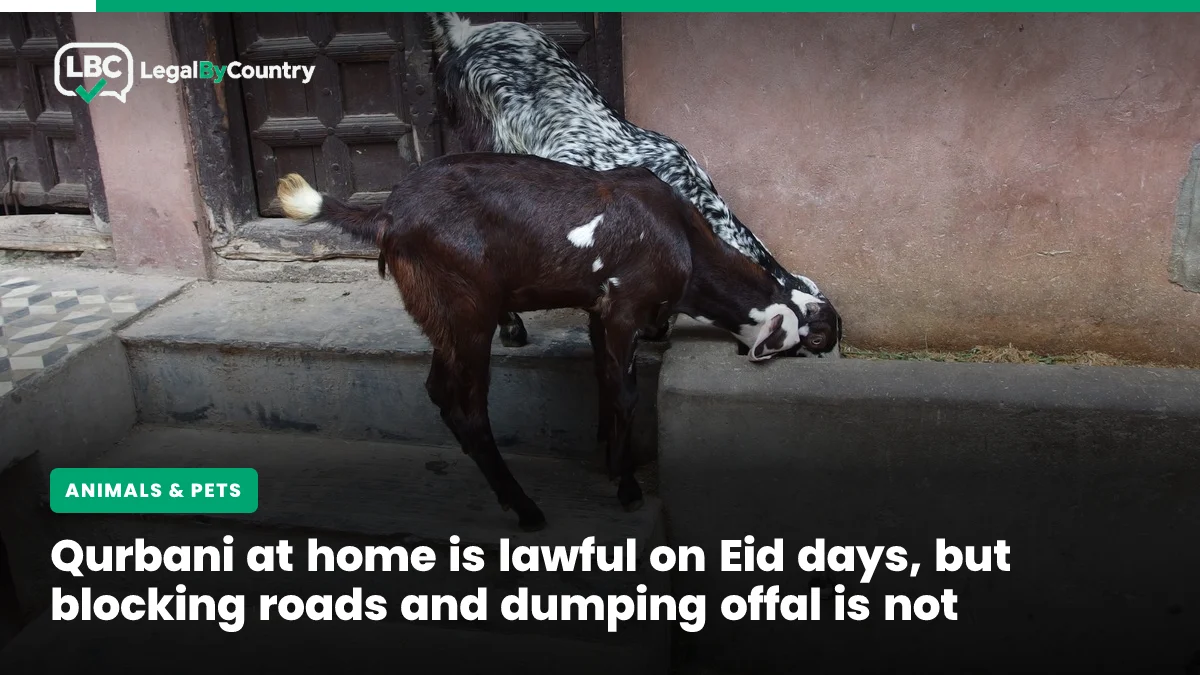
Short answer: Allowed on Eid, with limits
Mostly yes, on Eid ul Adha and the two days after. Punjab's Animals Slaughter Control Act, 1963 and Balochistan's 2025 Act exempt qurbani from the slaughterhouse rule, but blocking roads, dumping offal or breaking a local Eid order can still bring fines.
- The law
Punjab Animals Slaughter Control Act, 1963 (as amended by Act XXV of 2016), ss. 3(2), 3(4), 8, 8A
Balochistan Animal Slaughter Control Act, 2025 (Act No. I of 2026), ss. 3, 9, 15
Pakistan Penal Code, 1860, ss. 188, 268, 269, 278, 283, 290, 291
Code of Criminal Procedure, 1898 (Eid orders under section 144), s. 144(6)
- Penalty
- Slaughtering outside a slaughterhouse on any day other than Eid ul Adha and the two days after can bring 15 days to six months in prison and a fine of Rs 25,000 to Rs 100,000 on first conviction in Punjab, under section 8 of the Punjab Animals Slaughter Control Act, 1963 as amended in 2016.
General information only, not legal advice. For help with your own matter, consult a qualified lawyer or legal consultant. Read the disclaimer
Qurbani outside a slaughterhouse is lawful on the three days of Eid
On Eid ul Adha morning, gates stand open along Pakistani lanes and a butcher walks from house to house with his knives. Neighbours watching often wonder: is it legal to slaughter animals in the street during Eid in Pakistan? The slaughter is protected. The street is not.
Put simply, the sacrifice has legal cover, but the public road does not become a free zone. Pakistan's provincial slaughter laws normally require every animal to be killed in an approved slaughterhouse. They make one clear exception for qurbani by a Muslim on the day of Eid ul Adha and the two days after it.
What those laws do not do is suspend the rest of the law. Blocking a road, washing blood and dung into drains, dumping offal, or ignoring an Eid order issued by the district or a housing authority can each bring a fine or a criminal case. The rules below are taken from the statutes and the orders issued for Eid ul Adha 2026, which fell on 27 May 2026.
Punjab's slaughter law exempts Eid ul Adha by name
The Punjab Animals Slaughter Control Act, 1963 bans slaughter outside an approved slaughterhouse, but section 3(4) lifts that rule for slaughter by a Muslim on Eid ul Adha and the two following days. Qurbani at home is therefore not an offence under this Act.
The Act began as a West Pakistan law and was rewritten for Punjab by the Punjab Animals Slaughter Control (Amendment) Act 2016, published in the Punjab Gazette on 20 April 2016. The rewritten section 3(2) says an animal "shall not be slaughtered" except in a slaughterhouse, unless approved for slaughter, and not on Tuesday or Wednesday or other notified meat-free days.
The new section 3(4) then reads: "Nothing contained in this section shall apply to the slaughter of an animal by a Muslim on the day of Eid-ul-Azha and the two succeeding days of Eid-ul-Azha or any other religious ceremony." The earlier consolidated text of the 1963 Act carried the same Eid exception in its proviso to section 3.
What happens on the fourth day
The exception is tied to the calendar. Outside those three days, slaughter outside an approved slaughterhouse falls back under section 3(2). Section 8 of the 2016 text punishes a first conviction with 15 days to six months in prison and a fine of Rs 25,000 to Rs 100,000, and section 8A makes the offence cognizable and non-bailable. Those figures apply to the general offence; nothing in the Act targets Eid families who slaughter on time.
Model bye-laws add a cleanliness condition
Punjab's model slaughterhouse bye-laws of 2023, written for local governments under the Punjab Local Government Act, 2022, repeat the Eid exception in bye-law 5(1)(b). They attach a proviso: halal slaughter must be followed, and the contents of the stomach and bowels "shall not be washed into the drain" but emptied into buckets and disposed of properly. Each council adopts its own version, so the exact wording in your city may differ.
Balochistan's new 2026 law keeps the same Eid exception
Balochistan replaced the old West Pakistan law in March 2026. Its new Animal Slaughter Control Act again limits slaughter to approved slaughterhouses, and again exempts slaughter by a Muslim on Eid ul Adha and the two succeeding days. Penalties elsewhere in the Act are modest.
The Balochistan Animal Slaughter Control Act, 2025 (Act No. I of 2026) was passed on 25 February 2026 and signed by the Governor on 2 March 2026. Section 15 repeals the West Pakistan Act of 1963 for Balochistan. The proviso to section 3 exempts Eid ul Adha slaughter, and section 9 sets a first-conviction penalty of a fine up to Rs 5,000, up to one month in prison, or both.
Sindh, Khyber Pakhtunkhwa and Islamabad rely on local orders
We could not open an official, current text of the slaughter law in force in Sindh, Khyber Pakhtunkhwa or Islamabad. In practice, governing Eid there is the yearly set of district, civic body and housing authority instructions on offal, drains and slaughter points.
- Sindh. Sindh amended its version of the 1963 Act in 2004, according to the Sindh Police digital library, but we did not see the consolidated text. In Karachi, a meeting chaired by the commissioner on 16 May 2026 authorised vigilance committees to register FIRs against people dumping offal on roads and streets, The News reported, with section 144 orders against dumping offal in drains.
- Islamabad. The Capital Development Authority's 27 May 2026 release told residents not to throw offal into drains, open spaces, forests, dustbins or skips, and warned of legal action.
- Khyber Pakhtunkhwa. We found no KP-specific Eid slaughter rule for 2026 on an official site. The general Penal Code offences below still apply.
The street itself is where people get into trouble
No federal law makes Eid slaughter outside your own house a crime. Offences come from what the slaughter does to the road and the neighbours: obstruction of a public way, public nuisance, polluted drains, and disobeying a section 144 order issued for Eid.
The Pakistan Penal Code, 1860 applies in every province:
- Section 283: causing danger or obstruction "in any public way", for example tying a bull across a road or slaughtering in the carriageway. Fine up to Rs 600.
- Sections 268 and 290: public nuisance, meaning an act causing "common injury, danger or annoyance" to people nearby. Fine up to Rs 600 under section 290.
- Section 278: making the air "noxious to health", which can fit rotting offal left for days. Fine up to Rs 1,500.
- Section 269: a negligent act likely to spread a disease dangerous to life. Up to six months, a fine, or both.
- Section 188: disobeying an order lawfully promulgated by a public servant, which covers Eid section 144 orders. Up to one month or Rs 600, rising to six months or Rs 3,000 if the breach endangers health or safety.
- Section 291: carrying on a nuisance after an official has told you to stop. Up to six months, a fine, or both.
Those Penal Code fines are old and small. The larger risk in 2026 came from provincial orders, which are covered next.
Eid 2026 orders targeted offal, drains and cattle markets
For Eid ul Adha 2026, Punjab issued a province-wide section 144 order and the Chief Minister approved a Rs 50,000 fine for dumping animal waste in streets. Karachi and Islamabad ran their own offal plans. None of these orders banned qurbani at home outright.
| Place | Rule for Eid ul Adha 2026 | Source and date |
|---|---|---|
| Punjab | Section 144 ban, 27 May to 2 June 2026, on burning animal heads and feet in public places, throwing offal into manholes, drains or canals, and selling sacrificial animals outside notified cattle markets | Home Department notification of 19 May 2026, reported by Dawn on 20 May 2026 |
| Punjab | Fine of Rs 50,000 for dumping animal waste in streets and neighbourhoods | Chief Minister's approval, The Express Tribune, 23 May 2026; no statute named |
| Karachi | 97 offal collection points; deputy commissioners to supervise; section 144 against dumping offal in drains | The News, 7 May 2026 |
| Islamabad | Over 151 offal pits at 89 locations, over 200,000 free biodegradable bags, helpline 1334 | Dawn, 27 May 2026 |
| DHA Islamabad-Rawalpindi | Cows, bulls and camels only at designated slaughter points; small animals may be slaughtered at home; fines for breach | DHA notice reported by ProPakistani, 27 May 2026; amount not stated |
Two things stand out. The Rs 50,000 figure was announced as a Chief Minister's decision, and we could not find the notified legal instrument behind it, so treat it as the announced penalty rather than a statutory one. And the DHA restriction is a housing authority rule that binds residents of that scheme, not the public at large.
Eid orders change every year. Look for your district's 2027 section 144 order a week or so before Eid, usually published by the provincial Home Department and reported in the press.
Buying the animal is regulated more tightly than slaughtering it
Sacrificial animal markets, or mandis, are now tightly controlled in Punjab. The 2026 section 144 order banned buying and selling animals outside notified cattle markets, so a roadside sale point near your home may itself be unlawful.
In Lahore, the Punjab government moved trade to five temporary markets, at Saggian, Wagah Sports Complex, Burki Road, LDA City and Raiwind, plus the permanent Shahpur Kanjran Model Cattle Market run by the Punjab Cattle Market Management and Development Company, ProPakistani reported on 13 May 2026. The same Punjab order allowed only institutions registered with the Punjab Charity Commission to collect hides, The News reported on 21 May 2026.
Roadside livestock trade is a separate question from street vending in general, which our guide on whether street vending is legal in Pakistan covers.
A lawful qurbani follows a few simple steps
Doing qurbani lawfully is mostly about timing, place and clean-up. Slaughter within the three days, keep the public road clear, contain the blood and waste, and hand offal to the municipal system rather than the drain. Check any local order first.
- Check the local order. Before Eid, look for your district's section 144 order and any housing society or cantonment rule on slaughter points.
- Buy from a notified market. In Punjab, buying outside a notified cattle market was banned for Eid 2026.
- Slaughter on Eid day or the two days after. The legal exception in Punjab and Balochistan covers those three days only.
- Use your own premises or a designated point. A courtyard, garage, driveway or collective slaughter point keeps the road free. Large animals are the usual target of designated point rules.
- Keep the road open. Do not tie animals across a carriageway or footpath, which risks section 283.
- Collect blood and stomach contents. Use buckets, not the drain, as the Punjab model bye-laws require.
- Bag the offal and hand it over. Use the civic body's bags and collection points, or call the civic helpline (1334 in Islamabad in 2026).
- Give hides only to authorised collectors. In Punjab that meant institutions registered with the Charity Commission in 2026.
None of these steps limits the religious duty. They protect the neighbours, the drains and the person sacrificing from a fine or an FIR. For other questions about animals and the law, see our animals guides for Pakistan, and our editorial policy explains how we check these rules.
Frequently asked questions
Can I do qurbani outside my house in Pakistan?
+
Yes, in Punjab and Balochistan the slaughter laws exempt qurbani by a Muslim on Eid ul Adha and the two following days from the slaughterhouse rule. Keep the public road clear, contain the waste and follow any local Eid order or housing society rule.
Is it legal to slaughter an animal on the fourth day of Eid?
+
Not outside a slaughterhouse in Punjab. The exemption in section 3(4) of the Punjab Animals Slaughter Control Act covers Eid day and the two succeeding days only, so after that the normal slaughterhouse rule applies again.
What is the fine for throwing offal in the street in Punjab?
+
Rs 50,000, as approved by the Punjab Chief Minister on 23 May 2026 for Eid ul Adha 2026. We could not find the notified instrument behind the figure. The 2026 section 144 order also banned throwing offal into manholes, drains or canals.
Can my housing society force me to use a slaughter point?
+
It can set rules for its own residents. In 2026, DHA Islamabad-Rawalpindi required cows, bulls and camels to be slaughtered at designated points and allowed small animals at home, warning of fines. Check your society's notice before Eid.
Can I buy a sacrificial animal from a roadside seller?
+
In Punjab, not during the 2026 Eid period. A section 144 order from 27 May to 2 June 2026 banned buying and selling sacrificial animals outside notified cattle markets. Other provinces set their own rules each year.
Can I wash the blood into the drain after qurbani?
+
You should not. Punjab's model slaughter bye-laws say stomach and bowel contents must not be washed into the drain, and Eid orders in Punjab, Karachi and Islamabad in 2026 banned putting offal into drains.
Who can I call to remove offal after Eid sacrifice?
+
Your city's waste management helpline. In 2026 the Capital Development Authority listed 1334 for Islamabad. Lahore, Karachi and other cities publish their own numbers and collection points before each Eid.
Sources
We compiled this guide from official sources: the law itself, government notifications and court records, checked against reporting of recent changes. It is for information only.
- Punjab Animals Slaughter Control (Amendment) Act 2016 (Act XXV of 2016), Punjab Gazette (Extraordinary), 20 April 2016 · Provincial Assembly of the Punjab (via FAOLEX)
- Punjab Animals Slaughter Control Act, 1963 (W.P. Act III of 1963), consolidated to 2012 · Government of the Punjab (via FAOLEX)
- Balochistan Animal Slaughter Control Act, 2025 (Act No. I of 2026) · Provincial Assembly of Balochistan
- Model (Slaughter of Animals and Maintenance of Slaughterhouses) Bye-laws, 2023 · Punjab Municipal Development Fund Company, Government of the Punjab
- Pakistan Penal Code, 1860 · Ministry of Law and Justice (Pakistan Code)
- Eid-ul-Adha cleanliness and sanitation arrangements finalized in Islamabad (27 May 2026) · Capital Development Authority
- Punjab govt bans activities 'injurious to public health, peace' ahead of Eidul Azha (20 May 2026) · Dawn
- Section 144 imposed across Punjab, restrictions on four types of activities from May 27 to June 2 (21 May 2026) · The News
- Punjab approves Rs50,000 fine for illegal dumping of animal waste during Eidul Azha (23 May 2026) · The Express Tribune
- Commissioner tells DCs to supervise offal collection during Eid (7 May 2026) · The News
- FIRs ordered against those who dump offal on roads and streets (17 May 2026) · The News
- Over 2,000 workers, 200 vehicles mobilised for Eid cleanliness: Capital Development Authority (27 May 2026) · Dawn
- DHA Residents to Face Heavy Fines For Slaughtering Animals Outside Designated Points (27 May 2026) · ProPakistani
- Six Cattle Markets Established in Lahore for Eid (13 May 2026) · ProPakistani
Advocate, Supreme Court of Pakistan
Advocate of the Supreme Court of Pakistan and the Lahore High Court, former Assistant Advocate General Punjab and Assistant Attorney General for Pakistan, and adjunct professor of law in Lahore.
Full profile and credentials →
Is Hunting Legal in Pakistan?
Yes, but only with a provincial hunting licence or permit, during the notified season and for listed game species. Protected animals, national parks and sanctuaries are off limits under every provincial wildlife Act, and Punjab now jails illegal hunters for up to seven years.

Is It Legal to Sell Homemade Food in Pakistan?
Yes, with a licence. Provincial food laws, such as section 15 of the Punjab Food Authority Act, 2011, ban any food business, profit or not, without registration or a licence. No province has notified an exemption for home kitchens or online sellers.

Is Dog Fighting Legal in Pakistan?
No. Section 6C of the Prevention of Cruelty to Animals Act, 1890 bans inciting or baiting animals to fight, and Khyber Pakhtunkhwa's Animal Welfare Act, 2024 bans fighting ventures. Betting on fights adds gambling charges carrying up to five years in Punjab.
Is It Legal to Kill Stray Dogs in Pakistan?
No. Shooting, poisoning or beating a stray dog can be charged under sections 428 and 429 of the Pakistan Penal Code and provincial cruelty laws. High Courts have stopped municipal culling in Punjab and Islamabad, and only vets may euthanise rabid or incurable dogs.