Is It Legal to Sell Homemade Food in Pakistan?
Yes, but a home kitchen needs the same food authority licence as any food business. See the rules in each province, fines, hygiene and labelling duties.

Short answer: Legal with a food licence
Yes, with a licence. Provincial food laws, such as section 15 of the Punjab Food Authority Act, 2011, ban any food business, profit or not, without registration or a licence. No province has notified an exemption for home kitchens or online sellers.
- The law
Punjab Food Authority Act, 2011 (as amended 2016), ss. 2(i), 15, 25, 26, 28, 32, 39
Sindh Food Authority Act, 2016 (Sindh Act No. XIV of 2017), ss. 19, 29, 30, 32, 36, 43
Khyber Pakhtunkhwa Food Safety and Halal Food Authority Act, 2014, ss. 15, 16, 26, 27
Balochistan Food Authority Act, 2014, ss. 15, 32
- Penalty
- In Punjab, selling food without the required registration or licence carries 3 days to 1 year in jail and a fine of Rs 10,000 to Rs 500,000 under section 32 of the Punjab Food Authority Act, 2011, doubled for a repeat offence under section 34.
General information only, not legal advice. For help with your own matter, consult a qualified lawyer or legal consultant. Read the disclaimer
Selling homemade food is legal, but the food law treats a home kitchen as a food business
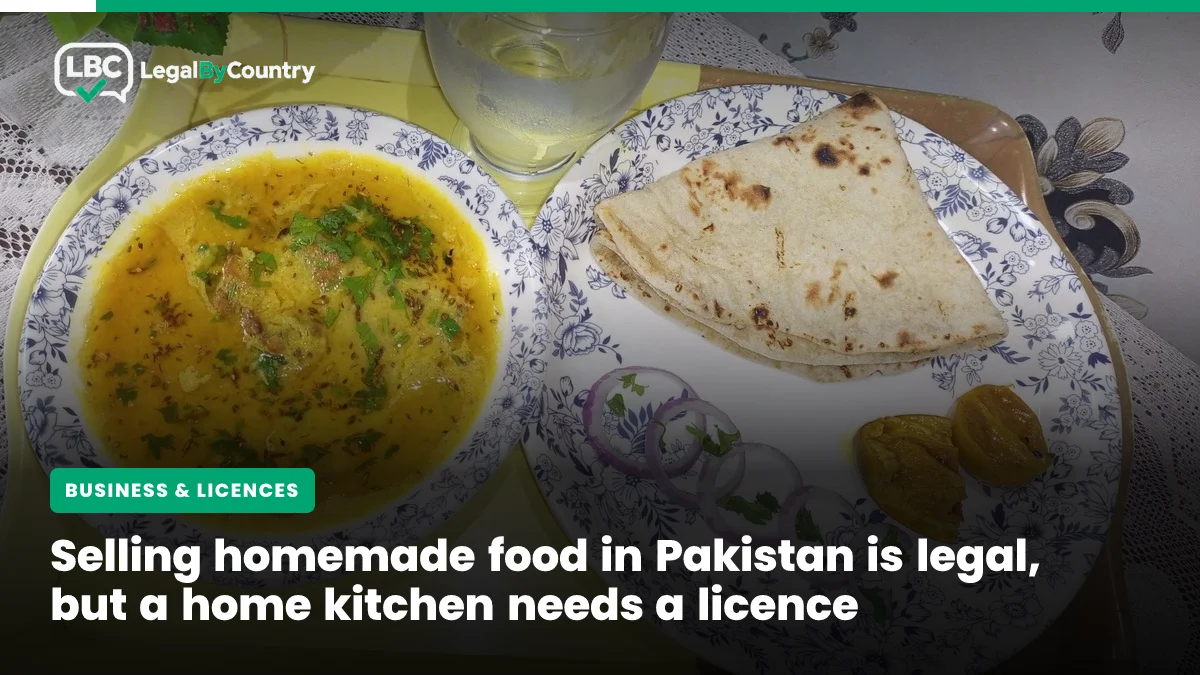
Scroll through any Lahore or Karachi neighbourhood group on a Friday and you will see frozen kebabs, biryani by the pot and custom cakes from home kitchens. Selling homemade food in Pakistan is legal, but the provincial food laws give home kitchens no free pass.
Every province and Islamabad has a food safety law that bans running a "food business" without the registration or licence the food authority requires. The definition is wide. Section 2(i) of the Punjab Food Authority Act, 2011 covers "any undertaking, whether or not for profit" that makes, stores, delivers or sells food, and it expressly includes catering and food services. Nothing in that wording depends on whether the kitchen is in a shop or a house.
So the honest answer is: yes, you can sell food you cook at home, as long as you take the same licence as any other food business in your province, keep your kitchen hygienic and label honestly. The rest of this guide explains each of those duties, the penalties and the steps to get legal.
Each province has its own food authority and its own licence
Food safety is a provincial subject, so the law you follow depends on where you cook. Punjab, Sindh, Khyber Pakhtunkhwa, Balochistan and Islamabad each have a food authority Act. All five require a licence or registration before you sell food to the public.
The licence clauses read almost the same everywhere:
- Punjab: section 15(1) of the Punjab Food Authority Act, 2011 says "A person shall not use any place for food business except under the prescribed registration or licence."
- Sindh: section 19(1) of the Sindh Food Authority Act, 2016 (Sindh Act No. XIV of 2017) uses the same words and adds "possessing of a valid licence".
- Khyber Pakhtunkhwa: section 15 of the Khyber Pakhtunkhwa Food Safety and Halal Food Authority Act, 2014 sets out how to apply for a licence before "commencing any food business". A licence lasts two years.
- Balochistan: section 15 of the Balochistan Food Authority Act, 2014 requires a registration or valid licence from the authority.
- Islamabad: section 9 of the Islamabad Capital Territory Food Safety Act, 2021 copies the Punjab wording and created the Islamabad Food Authority.
The authorities can exempt a class of sellers, but we found no home kitchen exemption
The Punjab, Sindh, Balochistan and Islamabad laws each let the authority "exempt a class of food operators" from compulsory registration or licensing. That is the legal route a small home seller exemption would take. We checked the licensing pages of the Punjab, Sindh and KP food authorities on 16 November 2026 and found no such exemption for home kitchens or online sellers. Until an authority notifies one, assume you need a licence.
Selling online does not change the licence rule
The food laws regulate what you do with food, not where you advertise it. Taking orders on WhatsApp, Instagram, Facebook or a delivery app is still selling food. A home cook who sells through any of these channels is a food operator under the Acts.
Punjab's food authority said as much years ago. On 31 May 2017, Daily Pakistan reported that the then Director General of the Punjab Food Authority ordered an advertisement giving online home food sellers one month to obtain licences. He said no new legislation was needed, because the 2011 Act already covered them. Some sellers argued they were not running "a proper food business". The statute's "whether or not for profit" wording does not support that argument.
Online selling also brings duties outside food law. Registration with the platform, income tax and consumer rules are covered in our guide on selling on Facebook or Instagram without registering a business. If you plan a shop, dine-in space or cloud kitchen with staff, read opening a restaurant without a food licence as well.
Cooking for family and guests is not a food business
The Acts bite when food is made for sale or supplied as a service. Cooking for your household, or feeding guests at home for free, is not selling. The grey zone is the occasional sale, such as one cake a month for a neighbour. The Acts set no minimum number of sales, so a licensing officer could treat even small but regular sales as a food business.
Running a home kitchen without a licence carries jail terms and fines
Every food Act makes selling food without the required registration or licence an offence. Punjab sets at least three days in jail and a Rs 10,000 fine. Khyber Pakhtunkhwa uses fines, with jail only if unpaid. Authorities can also fine you directly.
| Area and law | Licence section | Penalty for selling without a licence (as of 16 November 2026) | Fine the authority itself can impose |
|---|---|---|---|
| Punjab: Punjab Food Authority Act, 2011 (as amended 2016) | s. 15 | s. 32: 3 days to 1 year in jail and a fine of Rs 10,000 to Rs 500,000 | s. 39(1)(d): up to Rs 1 million |
| Sindh: Sindh Food Authority Act, 2016 | s. 19 | s. 36: up to 1 year in jail and/or a fine up to Rs 500,000 | s. 43(1)(c): up to Rs 500,000 |
| Khyber Pakhtunkhwa: Food Safety and Halal Food Authority Act, 2014 (as amended 2017) | s. 15 | s. 27(1): fine of Rs 50,000 to Rs 300,000, or one year in jail if unpaid | s. 16(1)(c): up to Rs 50,000 |
| Balochistan: Balochistan Food Authority Act, 2014 | s. 15 | s. 32: up to 1 year in jail and a fine up to Rs 500,000 (original 2014 text) | Set by the Act and its amendments; ask the authority |
| Islamabad: ICT Food Safety Act, 2021 | s. 9 | s. 18: up to 6 months in jail or a fine up to Rs 500,000, or both | s. 27(1)(d): up to Rs 1 million |
Repeat offences cost more. Section 34 of the Punjab Act doubles the jail term and fine for a second conviction, adds up to Rs 200,000 and cancels the licence. Sindh's section 38 and Islamabad's Act have similar clauses.
Officers can also stop you from trading
Food safety officers can serve an improvement notice listing what you must fix. If health risks are serious, section 18 of the Punjab Act lets an officer restrain the business straight away, with the authority confirming or setting aside the order. Courts can also order forfeiture of food and equipment after a conviction.
Hygiene, medical fitness and training rules apply inside a home kitchen too
A licence is only the start. The Acts punish keeping or preparing food in unhygienic conditions, and Punjab expects food handlers to pass medical screening and food safety training. The kitchen, the cook and the helpers all fall under these rules once you sell.
Unhygienic conditions are a separate offence
Section 28 of the Punjab Act punishes anyone who "manufactures or processes or keeps any food under unhygienic or unsanitary conditions" with 3 days to 6 months in jail and a fine of Rs 20,000 to Rs 1 million. Sindh's section 32 sets up to 6 months or a fine up to Rs 1 million. Selling unsafe food that injures someone is far more serious: in Punjab, section 24 sets up to 3 years, and up to life imprisonment if a customer dies.
Medical screening and training in Punjab
The Punjab Food Authority states in its 2023 procurement documents that "Medical Screening of all Food Handlers working in a food industry is mandatory, as per law." Its training page says the Punjab Pure Food Regulations, 2018 make food safety training mandatory for food business operators. The basic course is free for small-scale operators, and certificates last two years.
Punjab health officials also enforce health certificates under the Punjab Hepatitis Act, 2018. The Express Tribune reported on 16 September 2025 that Rawalpindi's District Health Authority would fine food establishments Rs 5,000 for each worker without a valid certificate from a Punjab Healthcare Commission registered lab.
Other provinces
Sindh, KP, Balochistan and Islamabad leave medical and training rules to their regulations. We could not confirm their current requirements for home cooks on an official page, so ask your authority when you apply.
Labels and adverts must be honest, even on Instagram
If you pack food in boxes or jars, the label must meet the prescribed standard and must not mislead. Adverts count too. The food Acts punish false descriptions of food and adverts that do not carry the seller's true name and business address.
- False labelling: Punjab section 26 sets 6 months to 1 year in jail and a fine of Rs 500,000 to Rs 1 million for labels that are false, misleading or below standard. KP section 26 sets a fine of Rs 100,000 to Rs 1 million. Islamabad section 20(1) allows up to 3 years for preparing, packing or labelling food that does not meet the prescribed standards.
- Misleading adverts: Punjab section 25(1) covers any advert that "falsely describes any food" or is likely to deceive a buyer about its quality, purity, weight or origin. Calling a cake "pure desi ghee" when it is made with margarine is the kind of claim this targets.
- Name and address: Punjab section 25(2), Sindh section 29(2) and Islamabad section 19(2) punish an advert that does not contain the true name of the advertiser or the address of the place of business.
The detailed label contents (ingredients, dates, net weight and so on) sit in each province's regulations, which change. Ask your food authority for its current labelling rules before you print boxes or stickers.
Tax registration is a separate question from the food licence
A food licence does not register you for tax, and a tax number does not license your kitchen. Income from selling food is business income under the Income Tax Ordinance, 2001, and catering services may also fall under provincial sales tax on services.
Whether you must take an NTN, file a return or register with the Punjab Revenue Authority, Sindh Revenue Board or KP Revenue Authority depends on your income, turnover and the type of service. Those thresholds change with each Finance Act. Our guide on running a business without an NTN covers the rules.
Getting a home food business legal takes a few clear steps
The process is mostly online and does not need a lawyer. Apply to your provincial food authority, pass its inspection, pay the fee it sets for your category, and then keep your kitchen, staff and labels up to standard for as long as you sell.
- Find your authority. Punjab Food Authority, Sindh Food Authority, KP Food Safety and Halal Food Authority, Balochistan Food Authority or the Islamabad Food Authority, depending on where you cook.
- Apply for a licence or registration. In Punjab, apply through the PFA app or website with your CNIC, a photo and a photo of your business, or at a PFA office. Sindh takes applications through the Sindh Food Authority licensing page. KP uses its online licence portal.
- Prepare for the inspection. Officers verify the premises before the licence is issued. Keep raw and cooked food apart, store food covered and off the floor, and keep the kitchen free of pests.
- Pay the fee for your category. Fees depend on business scale and category and are revised by each authority. In Punjab, you receive the amount by SMS after verification. A PFA licence lasts one year; a KP licence lasts two.
- Get medical screening and training. In Punjab, register yourself and any helpers for screening and the basic food safety course. Elsewhere, ask the authority what it requires.
- Label and advertise honestly. Put your real name or business name and address in your listings, and do not make claims about ingredients you cannot back up.
- Check your tax position. Work out whether you need an NTN or provincial sales tax registration as your sales grow.
- Renew on time. Diary the expiry date and renew before it. Selling on an expired licence is selling without one.
For other trades and permits, see our business and licences guides for Pakistan.
Frequently asked questions
Do I need a food licence to sell food from home in Pakistan?
+
Yes. Every provincial food Act and the Islamabad Act ban running a food business without registration or a licence, and the definition of food business covers any sale of food, profit or not. We found no notified exemption for home kitchens.
Do I need a licence if I only sell on Instagram or WhatsApp?
+
Yes. The food laws regulate selling food, not the channel you use to advertise it. In 2017 the Punjab Food Authority publicly told online home food sellers to get licences, saying the 2011 Act already covered them.
What is the fine for selling homemade food without a licence?
+
In Punjab it is 3 days to 1 year in jail and a fine of Rs 10,000 to Rs 500,000 under section 32. Sindh allows up to 1 year or Rs 500,000, KP fines Rs 50,000 to Rs 300,000, and Islamabad allows up to 6 months or Rs 500,000.
Do home cooks need a medical certificate?
+
In Punjab, the Punjab Food Authority says medical screening of food handlers is mandatory by law and food safety training is required under its 2018 regulations. Other provinces set this in their own regulations, so ask your food authority when you apply.
How long does a food licence last?
+
A Punjab Food Authority licence lasts one year, according to the authority's licensing page. A Khyber Pakhtunkhwa licence lasts two years under section 15(3) of the 2014 Act. Check the expiry date on your certificate and renew before it.
Do I need to label homemade food?
+
Packaged food must meet each province's labelling standards, and every food Act punishes false or misleading labels. Punjab, Sindh and Islamabad also punish adverts that leave out the seller's true name and business address.
Is selling a cake to a neighbour once in a while illegal?
+
The Acts set no minimum number of sales, so even small but regular sales can count as a food business. Cooking for your family or feeding guests for free is not selling, so the licence rules do not apply.
Do I need an NTN to sell homemade food?
+
A food licence and tax registration are separate. Whether you need an NTN, a tax return or provincial sales tax registration depends on your income and turnover under the current Finance Act, which our NTN guide explains.
Sources
We compiled this guide from official sources: the law itself, government notifications and court records, checked against reporting of recent changes. It is for information only.
- Punjab Food Authority Act, 2011 (Act XVI of 2011, consolidated with the Punjab Food Authority (Amendment) Act 2016) · Government of the Punjab, via FAO FAOLEX
- Sindh Food Authority Act, 2016 (Sindh Act No. XIV of 2017) · Sindh Code, Government of Sindh
- Khyber Pakhtunkhwa Food Safety and Halal Food Authority Act, 2014 (Act No. X of 2014, as amended by Act No. XVI of 2017) · Health Department, Government of Khyber Pakhtunkhwa
- Balochistan Food Authority Act, 2014 (Act No. VI of 2014) · Health Department, Government of Balochistan
- Islamabad Capital Territory Food Safety Act, 2021 (Act No. L of 2021) · National Assembly of Pakistan
- Islamabad Capital Territory Food Safety Act, 2021 (Gazette of Pakistan, Extraordinary, 4 December 2021) · Government of Pakistan, via FAO FAOLEX
- Resource and Licensing Wing: licensing FAQs · Punjab Food Authority
- Apply for License · Punjab Food Authority
- Food Safety Training (register for medical and training) · Punjab Food Authority
- Bidding Documents for Diagnostic Laboratories for Medical Screening of Food Handlers (2023) · Punjab Food Authority
- Food Business Licensing · Sindh Food Authority
- Licensing and Product Registration · Khyber Pakhtunkhwa Food Safety and Halal Food Authority
- Health proof made mandatory for food staff (16 September 2025) · The Express Tribune
- PFA to monitor online home-made food sellers (31 May 2017) · Daily Pakistan
Advocate, Supreme Court of Pakistan
Advocate of the Supreme Court of Pakistan and the Lahore High Court, former Assistant Advocate General Punjab and Assistant Attorney General for Pakistan, and adjunct professor of law in Lahore.
Full profile and credentials →
Is It Legal to Open a Private School Without Registration in Pakistan?
No. A private school must be registered before it opens. Punjab's 1984 Ordinance, Islamabad's 2013 PEIRA Act, Sindh's 2001 Ordinance and the KP and Balochistan Acts all require it, and Punjab fines an unregistered school Rs300,000 to Rs4 million.
Is It Legal to Run a Tuition Centre From Home in Pakistan?
Mostly yes for small home tutoring, no for an unapproved academy. Development authority land use rules, such as section 38 of the LDA Act, 1975, bar converting a house without approval, and Islamabad, Khyber Pakhtunkhwa and now Punjab require tuition centres to register.
Is MLM or Network Marketing Legal in Pakistan?
Only genuine direct selling is legal. Section 301 of the Companies Act, 2017 and the SECP's 2026 regulations treat MLM that pays mainly for recruitment, pyramid schemes and Ponzi schemes as unlawful, and the promoters can face winding up, penalties and cheating charges.

Is It Legal to Work for a Foreign Company From Pakistan?
Yes. No Pakistani law stops you working remotely for a foreign employer or client. Receive the money through a bank and pay tax under the Income Tax Ordinance, 2001: 0.25% for PSEB-registered IT exporters, 1% for other services, salary rates for employees.