

Is It Legal to Open a Private School Without Registration in Pakistan?
No. Every province and Islamabad require a private school to be registered first. See each law, the regulator, fines up to Rs4 million and lawful steps.

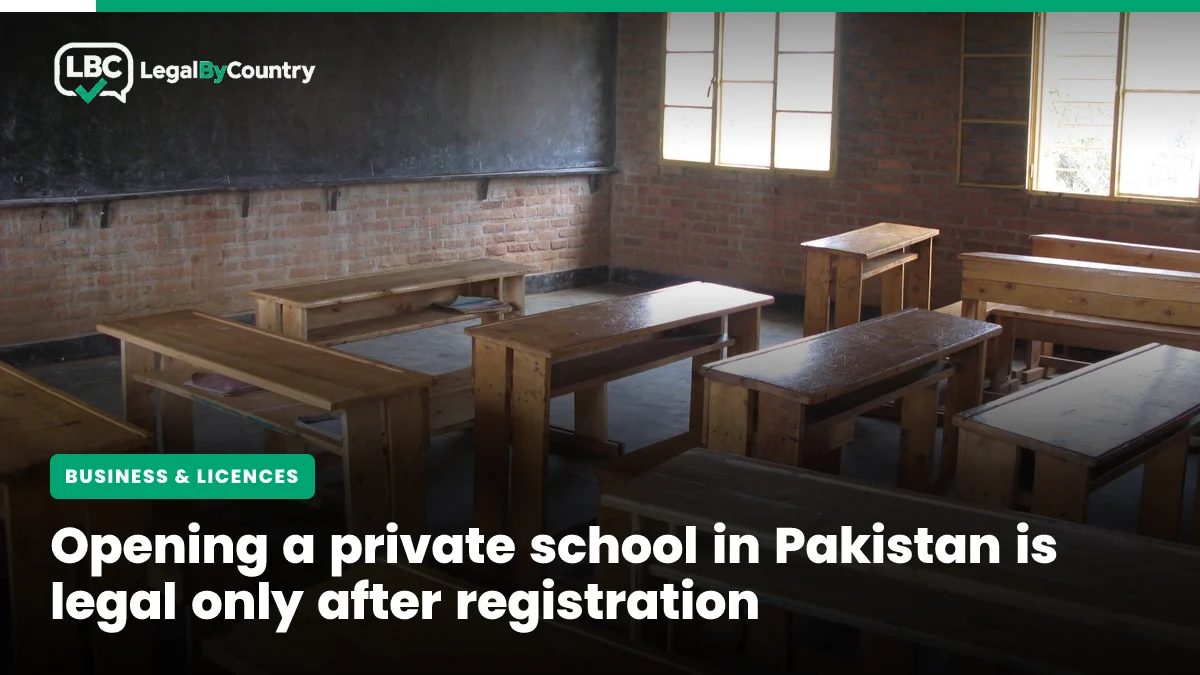
Short answer: Legal only once registered
No. A private school must be registered before it opens. Punjab's 1984 Ordinance, Islamabad's 2013 PEIRA Act, Sindh's 2001 Ordinance and the KP and Balochistan Acts all require it, and Punjab fines an unregistered school Rs300,000 to Rs4 million.
- The law
Punjab Private Educational Institutions (Promotion and Regulation) Ordinance, 1984, ss. 3, 7A, 11, 12, 12A
Islamabad Capital Territory Private Educational Institutions (Registration and Regulation) Act, 2013, ss. 5, 12, 13, 16, 19, 20
Khyber Pakhtunkhwa Private Schools Regulatory Authority Act, 2017, ss. 8, 21, 22
Balochistan Private Educational Institutions Registration, Regulation and Promotion Act, 2022, ss. 3, 9
- Penalty
- In Punjab, running a school without registration is punishable with a fine of Rs300,000 to Rs4 million under section 11(3) of the 1984 Ordinance; in Islamabad, section 19 of the 2013 Act allows up to one year in prison or Rs5,000 a day, or both.
General information only, not legal advice. For help with your own matter, consult a qualified lawyer or legal consultant. Read the disclaimer
A private school needs registration before it opens
Rent a house, paint a sign that says "Grammar School", hire four teachers and admit forty children. In Pakistan that order of events breaks the law. Opening a private school without registration is not legal in any province or in Islamabad.
Every province, and the federal capital, has a statute that says a privately run school must be registered with a government body. In Punjab the duty arises "before the commencement of business". In Islamabad, Khyber Pakhtunkhwa and Balochistan the wording is just as direct. Sindh's Ordinance follows the same pattern.
The question is not a technicality. In July 2026, after roofs collapsed at two Lahore tuition centres, the Punjab government sent notices to 744 unregistered institutions in a single day, Dawn reported on 5 July 2026. Days later, the Lahore District Education Authority recommended sealing 213 private schools, according to The Express Tribune on 8 July 2026. Registration is how the state checks the building, the staff and the fees before children walk in.
Each province has its own private schools law
Education is a provincial subject, so the law you must follow depends on where the school sits. Punjab, Sindh, Khyber Pakhtunkhwa, Balochistan and Islamabad each have a separate statute, a separate regulator and separate penalties, as the table below shows.
| Where | Law | Who registers you |
|---|---|---|
| Punjab | Punjab Private Educational Institutions (Promotion and Regulation) Ordinance, 1984 | Registering Authority notified for the district (in practice, the District Education Authority) |
| Islamabad (ICT) | Islamabad Capital Territory Private Educational Institutions (Registration and Regulation) Act, 2013 | ICT Private Educational Institutions Regulatory Authority (PEIRA) |
| Sindh | Sindh Private Educational Institutions (Regulation and Control) Ordinance, 2001, and Rules, 2005 | Directorate of Inspection and Registration of Private Institutions |
| Khyber Pakhtunkhwa | Khyber Pakhtunkhwa Private Schools Regulatory Authority Act, 2017 | Private Schools Regulatory Authority (PSRA) |
| Balochistan | Balochistan Private Educational Institutions Registration, Regulation and Promotion Act, 2022 | Registering Authority under the Act |
The definitions matter too. Islamabad's Act and the KP Act both count a tuition centre or tuition academy as a school. Punjab's Ordinance covers schools of every level, from pre-primary to A-Level, plus vocational and special education institutions. If you only plan small-group coaching, read our guide on running a tuition centre from home before you decide which rules reach you.
Punjab requires registration before the first day of classes
Section 3 of the Punjab Ordinance says the person in charge "shall, before the commencement of business by the institution, register the institution". Running a school without registration carries a fine of Rs300,000 to Rs4 million under section 11(3).
What the Ordinance says
The text of the Punjab Private Educational Institutions (Promotion and Regulation) Ordinance, 1984, as amended up to 2020, sets out the process:
- Who must register: the "Incharge", which includes every owner, head teacher, principal and manager of the school (section 2(5)).
- Deadline for the regulator: the Registering Authority must decide an application within sixty days (section 3(2)).
- Pending applications: until the application is decided, the institution "may continue to function without registration" (section 3(3)).
- Refusal: no refusal without a hearing and written reasons (section 6(4)), with an appeal to the Divisional Commissioner within thirty days (section 10).
- Cancellation: registration can be cancelled for breaking the Ordinance or rules, usually after a chance to fix a minor default (section 9).
Academies and tuition centres are being added
The Punjab Private Educational Institutions (Promotion and Regulation) (Amendment) Act 2026 (Act LXIII of 2026, gazetted on 10 September 2026) adds "academy, coaching center, tuition center" to the definition of institution. Section 1(2) says it comes into force on a date the Government notifies. We could not find that commencement notification as of 16 November 2026.
How registration works in practice
The School Education Department runs registration online through the Punjab Education Private Registration Information System (PEPRIS), which Dawn's July 2026 report names as the record district officers rely on. On 11 May 2026, Dawn reported that the department told every district to register all private schools and that schools need a building fitness certificate from the Communications and Works Department.
Islamabad's PEIRA must approve every private school first
In the federal capital, section 12 of the 2013 Act says no institution "shall be established or continued" except under the Act. Section 13 requires an application to PEIRA, with prescribed documents and fee, before you open. Each branch needs its own registration.
The Islamabad Capital Territory Private Educational Institutions (Registration and Regulation) Act, 2013 (Act XI of 2013) defines an institution as a privately managed school, college, tuition centre or other institution up to higher secondary level. Its definition of school includes day-care centres.
- Inspection: PEIRA may send an Inspection Committee, which reports within thirty days (section 14).
- Separate branches: every branch at different premises is registered separately (section 13(3)).
- Board affiliation: affiliation with the Federal Board or any foreign board depends on PEIRA registration (section 13(4)).
- Closure: if registration is cancelled, PEIRA closes the institution (section 16(3)).
- Appeal: within thirty days to the Secretary of the federal ministry responsible for Islamabad (section 17).
PEIRA now runs fixed renewal windows. In January 2026 it said renewal applications are taken from 1 March to 30 April each year, ProPakistani reported on 22 January 2026. On 13 May 2026, Radio Pakistan reported that PEIRA had decided to take legal action against unregistered private schools.
Sindh registers schools through a Directorate
Sindh's Ordinance requires privately managed schools to be registered with the government, and the Directorate of Inspection and Registration of Private Institutions handles it. Running a school without that registration exposes the owner to fines, closure and legal proceedings, the Directorate warned in May 2026.
The warning reported by The News on 21 May 2026 told parents to check a school's registration before admitting a child. It listed what inspectors look at: classrooms, sanitation, drinking water, a library, laboratories, a playground, security and qualified staff, plus attendance and fee registers.
Fees in Sindh are tightly controlled. Under Rule 7 of the Sindh Private Educational Institutions (Regulation and Control) Rules, 2005, as described by the Sindh High Court in C.P. No. D-2194 of 2013 (6 August 2020), the fee schedule is approved at registration and cannot rise during the academic year. Any yearly increase is capped at 5 percent, with justification and approval.
We could not open an official consolidated copy of the Sindh Ordinance, so we do not state its fine for an unregistered school. A Directorate letter reported by Dawn on 10 July 2026 cited a fine of up to Rs500,000 for fee breaches. Ask the Directorate for the current figures.
Khyber Pakhtunkhwa and Balochistan set fixed fines
Khyber Pakhtunkhwa bans opening or operating any private school, Montessori or tuition academy without PSRA registration, with fines of Rs50,000 or Rs200,000. Balochistan's 2022 Act requires registration before commencement and allows a year in prison.
Khyber Pakhtunkhwa
Section 21 of the Khyber Pakhtunkhwa Private Schools Regulatory Authority Act, 2017 says no school "shall be opened or operated" without registration, whatever its board. No board may affiliate an unregistered school. On 23 February 2026, Dawn reported that KP education boards were told not to enrol students of unregistered high and higher secondary schools for matric and intermediate exams.
Balochistan
Section 3 of the Balochistan Private Educational Institutions Registration, Regulation and Promotion Act, 2022 says every institution must be registered under it, even if registered under another law, and that the person in charge must register "before the commencement of business". The 2022 Act repealed the 2015 Authority Act.
Penalties range from daily fines to sealing
Fines depend on the province and on how long the breach lasts. Punjab sets the highest figure, up to Rs4 million for an unregistered school. Islamabad and Balochistan add up to a year in prison, and every regulator can close a school.
| Where | Running without registration | Other breaches | Source (as of 16 November 2026) |
|---|---|---|---|
| Punjab | Fine of Rs300,000 to Rs4,000,000 | Up to Rs20,000 a day; Rs200,000 to Rs2,000,000 if the breach lasts over 30 days | Ordinance 1984, s. 11 |
| Islamabad | Up to 1 year in prison, or up to Rs5,000 a day, or both | Same penalty for any breach of the Act or rules | Act 2013, s. 19 |
| Khyber Pakhtunkhwa | Rs200,000 (high, higher secondary, intermediate); Rs50,000 (Montessori, kindergarten, tuition academy, primary, middle) | Rs20,000 (Act); Rs10,000 (rules); repeat breach: punitive action as prescribed | Act 2017, s. 22, as amended by Act XXVII of 2017 |
| Balochistan | Court fine up to Rs200,000 plus administrative penalty, or 1 year in prison, or both | Up to Rs10,000 a day after notice | Act 2022, s. 9 |
| Sindh | Fines and closure (amount not verified) | Suspension or cancellation of registration | Ordinance 2001; Directorate notices 2026 |
How cases are brought
In Punjab, a first class Magistrate tries offences summarily on the Registering Authority's complaint (section 12). The Authority may compound an offence for an administrative penalty of at least Rs100,000, unless the owner was convicted or compounded before (section 12A). Unpaid fines are recovered as arrears of land revenue (section 12B). In Islamabad, no court can act except on a written complaint by PEIRA (section 20).
Sealing
Sealing is the penalty owners fear most, because it shuts the doors mid-term. Islamabad's Act tells PEIRA to close an institution whose registration is cancelled. In Punjab, the 2026 drive ran through the district administration: the Lahore District Education Authority sent its sealing list to the district administration for approval, after 30 schools had already been sealed, as The Express Tribune reported.
Registration also brings fee control
Once registered, a school cannot set fees freely. Punjab caps yearly increases at 5 percent for schools charging Rs4,000 a month or more, Sindh at 5 percent with approval, and KP lets its Authority sanction up to 10 percent.
- Punjab (section 7A): a school charging Rs4,000 or more a month may raise fees by up to 5 percent a year. With a justified application at least sixty days before the new session, the Registering Authority may allow up to 8 percent. Admission fee or security cannot exceed one month's tuition, and parents cannot be forced to buy books or uniforms from a named shop.
- Islamabad (section 5(1)(b)): PEIRA fixes the grade-wise admission fee, security, monthly tuition and other charges.
- Khyber Pakhtunkhwa (section 8(2)): the PSRA sets a maximum fee by school category, may sanction increases of up to 10 percent once a year announced a month in advance, and orders a sibling concession of at least 20 percent.
- Sindh (Rule 7, Rules 2005): the fee schedule approved at registration, with a 5 percent yearly ceiling subject to approval.
In June 2019 the Supreme Court upheld a 5 percent annual cap on tuition fee increases in the private school fee appeals, Dawn reported. Owners who plan a business model on large yearly rises should plan again.
Opening a private school lawfully takes these steps
The lawful route is the same in outline everywhere: secure a safe building, prepare your documents, apply to the right regulator, pass inspection and open only once registered or, in Punjab, once a complete application is pending. Fees and forms change, so confirm them first.
- Find your regulator. Use the table above: the District Education Authority in Punjab, PEIRA in Islamabad, the Directorate in Sindh, the PSRA in KP, or the Registering Authority in Balochistan.
- Check the building and land use. Get a building fitness certificate (Punjab requires one) and check that the premises may be used as a school. Our guide on building without an approved map explains why approved plans matter.
- Prepare your documents. Typically ownership or rent deed, building plan, staff appointments and qualifications, the proposed fee structure, enrolment details and the school's rules. Ask the regulator for its current checklist.
- Apply and pay the prescribed fee. In Punjab apply through PEPRIS. In Islamabad apply to PEIRA online. Keep the receipt and application number.
- Get through the inspection. Expect inspectors to check classrooms, toilets, drinking water, fire safety and staff files.
- Open at the right time. Start classes once the certificate is issued. In Punjab, section 3(3) lets an institution function while its application is pending, but treat that as a narrow allowance, not a shortcut.
- Keep the registration alive. Renew on schedule (in Islamabad, 1 March to 30 April), keep fee and attendance registers, and get approval before any fee increase.
Running a school is also a business for tax purposes. Our business and licences guides cover the other registrations a new school usually needs.
Frequently asked questions
Can I start classes in Punjab while my registration application is pending?
+
Section 3(3) of the Punjab Ordinance says an institution may continue to function until its application is decided, and section 3(2) gives the Registering Authority sixty days to decide. Apply first, with a complete file, and keep proof of filing.
Who registers private schools in Islamabad?
+
The Islamabad Capital Territory Private Educational Institutions Regulatory Authority (PEIRA) does, under the 2013 Act. Every branch at a different address needs its own registration, and renewal applications are taken from 1 March to 30 April each year.
Does a tuition academy need registration like a school?
+
In Islamabad and Khyber Pakhtunkhwa, yes: both laws define a tuition centre or academy as a school. Punjab passed an amendment in 2026 adding academies and tuition centres, but it starts only on a date the government notifies.
What is the fine for an unregistered school in Khyber Pakhtunkhwa?
+
Rs200,000 for a high, higher secondary or intermediate level school, and Rs50,000 for a Montessori, kindergarten, tuition academy, primary or middle school, under section 22(1) of the KP Private Schools Regulatory Authority Act, 2017. Repeat breaches bring further punitive action.
Can an unregistered school's students sit board exams?
+
Usually not. The KP Act bars boards from affiliating unregistered schools, and Islamabad's Act makes board affiliation depend on PEIRA registration. In February 2026 KP boards were told not to enrol students of unregistered schools for matric and intermediate exams.
How much can a private school raise its fees each year in Punjab?
+
Up to 5 percent a year for a school charging Rs4,000 a month or more, under section 7A of the Ordinance. With a justified application at least sixty days before the session, the Registering Authority may allow up to 8 percent.
Can a private school force parents to buy uniforms from one shop?
+
Not in Punjab. Section 7A(10) of the Ordinance says an institution shall not require parents to buy textbooks, uniforms or other material from a particular shop or provider.
Can an unregistered school be sealed?
+
Yes. Islamabad's Act requires PEIRA to close a school whose registration is cancelled, KP allows punitive action for repeat violations, and in July 2026 Lahore's education authority sent 213 unregistered schools for sealing after 30 were already sealed.
Sources
We compiled this guide from official sources: the law itself, government notifications and court records, checked against reporting of recent changes. It is for information only.
- Punjab Private Educational Institutions (Promotion and Regulation) Ordinance, 1984 (IV of 1984), as amended to 2020 · Higher Education Department, Government of the Punjab
- Punjab Private Educational Institutions (Promotion and Regulation) (Amendment) Act 2026 (Act LXIII of 2026) · Law and Parliamentary Affairs Department, Government of the Punjab (Punjab Code)
- Islamabad Capital Territory Private Educational Institutions (Registration and Regulation) Act, 2013 (Act XI of 2013), Gazette of Pakistan, 19 March 2013 · ICT Private Educational Institutions Regulatory Authority (PEIRA)
- Khyber Pakhtunkhwa Private Schools Regulatory Authority Act, 2017 (Act No. XXV of 2017) · Provincial Assembly of Khyber Pakhtunkhwa
- Khyber Pakhtunkhwa Private Schools Regulatory Authority (Amendment) Act, 2017 (Act No. XXVII of 2017) · Provincial Assembly of Khyber Pakhtunkhwa
- Balochistan Private Educational Institutions Registration, Regulation and Promotion Act, 2022 (Act No. XXVIII of 2022) · Provincial Assembly of Balochistan
- Muhammad Anwer and others v. Fouji Foundation Model School and others, C.P. No. D-2194 of 2013 (order of 6 August 2020) · High Court of Sindh
- 744 unregistered educational institutions issued notices in a day in Punjab (5 July 2026) · Dawn
- Over 200 private schools face sealing (8 July 2026) · The Express Tribune
- Districts told to register every private school (11 May 2026) · Dawn
- PEIRA to launch strict action against unregistered private educational institutions in Islamabad (13 May 2026) · Radio Pakistan
- Islamabad Introduces New Rules for Private School Registration (22 January 2026) · ProPakistani
- Sindh warns against running unregistered private schools (21 May 2026) · The News
- Private school in Karachi ordered to reverse unlawful fee hikes (10 July 2026) · Dawn
- Education boards stopped from conducting exams of unregistered private schools in KP (23 February 2026) · Dawn
- Private schools' tuition fee to increase annually by 5pc only, SC rules (June 2019) · Dawn
Advocate, Supreme Court of Pakistan
Advocate of the Supreme Court of Pakistan and the Lahore High Court, former Assistant Advocate General Punjab and Assistant Attorney General for Pakistan, and adjunct professor of law in Lahore.
Full profile and credentials →
Is It Legal to Run a Tuition Centre From Home in Pakistan?
Mostly yes for small home tutoring, no for an unapproved academy. Development authority land use rules, such as section 38 of the LDA Act, 1975, bar converting a house without approval, and Islamabad, Khyber Pakhtunkhwa and now Punjab require tuition centres to register.
Is It Legal to Build a House Without an Approved Map in Pakistan?
No. In every city and development authority area you need an approved building plan before construction starts. The LDA Act 1975, Sindh Buildings Control Ordinance 1979 and CDA Ordinance 1960 allow fines, prison, sealing and demolition at the owner's cost.
Is MLM or Network Marketing Legal in Pakistan?
Only genuine direct selling is legal. Section 301 of the Companies Act, 2017 and the SECP's 2026 regulations treat MLM that pays mainly for recruitment, pyramid schemes and Ponzi schemes as unlawful, and the promoters can face winding up, penalties and cheating charges.

Is It Legal to Work for a Foreign Company From Pakistan?
Yes. No Pakistani law stops you working remotely for a foreign employer or client. Receive the money through a bank and pay tax under the Income Tax Ordinance, 2001: 0.25% for PSEB-registered IT exporters, 1% for other services, salary rates for employees.