

Is It Legal to Build a House Without an Approved Map in Pakistan?
No. LDA, SBCA, CDA and local councils require an approved building plan first. See the penalties, sealing, demolition, regularisation and lawful steps.

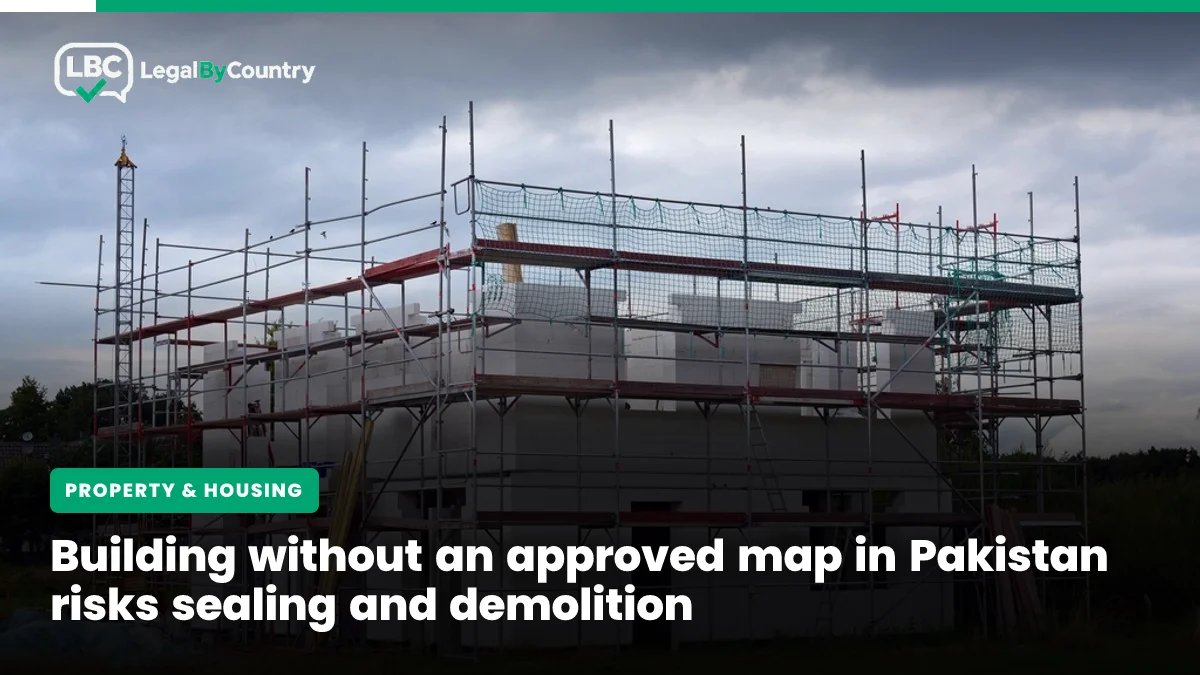
Short answer: Illegal without an approved plan
No. In every city and development authority area you need an approved building plan before construction starts. The LDA Act 1975, Sindh Buildings Control Ordinance 1979 and CDA Ordinance 1960 allow fines, prison, sealing and demolition at the owner's cost.
- The law
Lahore Development Authority Act, 1975, ss. 33, 35, 40 and Second Schedule
Sindh Buildings Control Ordinance, 1979, ss. 6, 7-A, 18-G, 19
Capital Development Authority Ordinance, 1960, ss. 46, 46-B, 49-C
Punjab Local Government Act, 2025, s. 160; Sixth Schedule paras 19 to 28; Seventh Schedule
- Penalty
- In Lahore, building without LDA approval carries up to three years in prison or a Rs 100,000 fine, or both, plus up to Rs 10,000 a day after a stop order, under section 35(1)(b) of the LDA Act 1975, and the building can be sealed or demolished under section 40.
General information only, not legal advice. For help with your own matter, consult a qualified lawyer or legal consultant. Read the disclaimer
Building without an approved map is illegal in Pakistan's cities
A Lahore family pours their roof slab on Sunday. On Tuesday an inspector tapes a notice to the gate: five days to show an approved plan or face sealing. Build a house without an approved map in Pakistan, in any city or development authority area, and you break the law.
Every major building law says the same thing in different words. Section 6(1) of the Sindh Buildings Control Ordinance, 1979 says "No building shall be constructed before the Authority has, in the prescribed manner, approved the plan of such building." The Lahore Development Authority Act, 1975 makes "doing an act without license, approval or permission" an offence. The Capital Development Authority Ordinance, 1960 lets the CDA demolish anything built against its regulations.
"Map" is the everyday word for the building plan. The authority wants drawings signed by a registered architect, proof you own the plot, and a fee. Once it approves them, you build to those drawings, and later you get a completion or occupancy certificate. Skipping the first step does not make the house disappear from the law. It makes the house an offence that keeps running until it is fixed.
Each city and province has its own building authority
Pakistan has no single national building code that grants permission. Approval comes from the development authority or local government that controls your plot. Lahore uses the LDA, Karachi the SBCA, Islamabad the CDA, and smaller towns their municipal or tehsil council.
| Where you build | Who approves the map | Main law | Maximum penalty for building without approval (as of 16 November 2026) |
|---|---|---|---|
| Lahore Development Authority area | LDA Town Planning Wing | LDA Act 1975, ss. 35 and 40; LDA Building and Zoning Regulations 2019 | Up to 3 years, or a fine up to Rs 100,000, or both, plus up to Rs 10,000 a day if you keep going after being told to stop |
| Karachi and other notified areas of Sindh | Sindh Building Control Authority (SBCA) | Sindh Buildings Control Ordinance 1979, ss. 6, 7-A and 19 | Simple imprisonment up to 3 years, or a fine of at least Rs 50,000, or both, plus up to Rs 500 a day while it continues |
| Islamabad Capital Territory | CDA Building Control directorate | CDA Ordinance 1960, ss. 46 and 49-C; ICT Building Control Regulations 2020 (amended 2023) | Up to 6 months, or a fine, or both |
| Other Punjab towns and rural tehsils | Municipal committee, corporation or tehsil council | Punjab Local Government Act 2025 and its building bye-laws | Up to 3 years, or a fine up to Rs 100,000, or both (Part-II offence, bill text) |
| Khyber Pakhtunkhwa | Tehsil Municipal Administration, development authorities, LUBCA | KP Local Government Act 2013, s. 66 and Fourth Schedule; KP Land Use and Building Control Act 2021 | Up to 6 months, or a fine up to Rs 5,000, or both, under the 2013 Act |
Defence Housing Authorities and cantonment boards run their own approvals under their own byelaws, so a DHA plot needs DHA sanction, not LDA or SBCA. Balochistan's Quetta Development Authority and local councils approve plans there; we have not set out their penalty figures because we could not verify a current text.
Lahore: the LDA Act and the 2019 Regulations
Section 35 of the LDA Act, inserted in 2013, lists offences in a Second Schedule. Part-B includes "doing an act without license, approval or permission" and "violation of the master plan, building plan or sanctioned site development scheme." Both carry up to three years in prison or a Rs 100,000 fine, or both. The offence is cognizable, meaning police can register a case, once an LDA officer complains in writing.
The LDA Building and Zoning Regulations 2019 (as amended to 28 January 2020) fill in the detail. Plans must be prepared by a registered architect. LDA must decide a complete residential application within 45 days. An approved plan stays valid for 3 years on plots up to 2 kanal and 5 years above that. LDA can also have utility connections cut for illegal, non-compoundable construction.
Karachi and Sindh: the SBCA Ordinance
The Sindh Ordinance goes further than most. Section 6(2) bars anyone from living in a new building until the SBCA issues an occupancy certificate. Section 18-G stops utility companies from giving electricity, gas, water or sewerage connections, and stops registration of a sale deed or lease, unless the approved completion plan is produced.
The Ordinance applies in areas the Sindh government notifies under section 1, which now covers Karachi and other Sindh cities. Only the SBCA or a person it authorises can file a criminal complaint under section 19(2), so a neighbour cannot prosecute you directly. They can complain to the SBCA.
Islamabad: CDA Ordinance and ICT regulations
CDA notices state that construction, alteration, renovation or occupancy without prior CDA approval anywhere in ICT, including Zones I, II, IV and V, is illegal under the ICT Building Control Regulations 2020. A CDA demolition notice dated 13 June 2025 shows the standard form: demolish within 15 days, or CDA does it "by using Force (including Police Force)" and recovers the cost.
Sealing and demolition are the real risks, not prison
Prison terms exist on paper, but the usual consequences are a stop-work notice, sealing, demolition at your cost and refused utility connections. Authorities can also refuse to register a sale, which leaves the house hard to sell or mortgage for years.
The powers are wide. Section 40 of the LDA Act lets the Director General order an owner to remove, demolish or alter illegal work, and if the order is ignored, to demolish it or seal the premises after a hearing, recovering the cost. Section 7-A of the Sindh Ordinance allows demolition at the owner's cost, "without prejudice to any other action including sealing of the building or ejectment of the occupants." Section 49-C of the CDA Ordinance gives the CDA and the Deputy Commissioner the same power, with police help.
Enforcement is active in 2026. On 8 September 2026, Dawn reported new LDA procedures that give owners five days' notice in illegal construction cases before action, with QR-coded notices and geo-tagged photos. A sealed property is de-sealed only after the fine is paid, the property is restored to lawful status, or the competent authority approves it. In Sindh, the provincial local government minister announced an anti-illegal construction task force with drone surveys on 22 February 2026, The News reported.
Two points work in your favour. Each of these laws requires notice and a chance to be heard before demolition, apart from emergencies such as dangerous buildings or nullah encroachments. And a court can stop an unlawful demolition, though courts rarely protect a building that never had a plan at all.
Regularisation exists, but only for limited violations and dated schemes
You can sometimes legalise a building afterwards by paying a composition fee, but no province offers a blanket amnesty as of November 2026. Minor deviations from an approved plan are usually compoundable. Building with no plan, or in mandatory open spaces, often is not.
- Lahore: Regulation 10.10.3 lets LDA compound most violations at rates it sets, but violations in mandatory open spaces are non-compoundable. A grievance committee can recommend regularising some non-compoundable violations, up to 10% of covered area, on hardship grounds, with Rescue 1122 and Civil Defence NOCs and a structural engineer's certificate.
- Sindh: Section 19(1-A) allows compounding, but its proviso bars compounding works that violate the building regulations. Section 19(1-C) is the exception: deviations in footprint, open space, covered area and projections can be compounded if they stay within 20% of the permissible limits, at the existing composition fee plus 400%. A one-year regularisation window opened by Ordinance XXXVII of 2001 has long expired. A March 2025 SBCA notification changing Karachi's regulations was criticised by opposition parties as regularising thousands of illegal buildings, Dawn reported on 8 April 2025.
- Islamabad: The 2020 ICT regulations let owners of unauthorised construction in Zones II, IV and V apply for regularisation on payment of fees, Dawn reported on 21 December 2020.
- Khyber Pakhtunkhwa: The KP Building Control Authority set residential plan approval or regularisation at Rs 10 per square foot and commercial at Rs 20, ProPakistani reported on 23 February 2026.
- Punjab local governments: the 2025 Act lets a council accept a composition fee instead of demolition, at rates the council notifies.
Watch for proposed laws. A draft Sindh Building Control Authority Act, reported by Dawn on 8 September 2025, would make offences non-compoundable with up to five years and Rs 5 million in fines. We found no sign it had been passed as of 16 November 2026, so the 1979 Ordinance still governs.
Villages and rural areas are not a free pass
Rural land is not automatically exempt. Local government laws in Punjab and Khyber Pakhtunkhwa require sanction for building in their local areas, which include rural tehsils. Enforcement in villages is much weaker, but a weaker inspector is not a legal exemption.
In Punjab, the Punjab Local Government Act 2025 (passed 13 October 2025) creates tehsil councils for rural areas. Its Sixth Schedule says: "No person shall erect or re-erect a building or commence to erect or re-erect a building on any land in a local area except with the previous sanction of the concerned local government." Erecting a building without that sanction is a Part-II offence in the Seventh Schedule.
In Khyber Pakhtunkhwa, the KP Local Government Act 2013 lists "erection or re-erection of a building without the sanction required under this Act" in its Fourth Schedule. The KP Land Use and Building Control Act 2021, amended in November 2024, adds district land use plans aimed at stopping unplanned building on farmland.
In practice, many villages have no notified building bye-laws and no office that processes house maps. If yours is one, get written confirmation from the tehsil or union council that no sanction is required for your plot. That letter protects you if the area is later brought under a development authority or master plan.
Buying a house built without a map carries the seller's problem
A building's legal defects pass to whoever owns it. If you buy a house that never had an approved plan, the authority can still seal or demolish it, and you may struggle to get utilities, a completion certificate, a bank loan or a registered sale.
Ask the seller for the approved building plan, the sanction letter and the completion or occupancy certificate, and check them with the authority. Problems are worse when the whole society is unapproved, because no plan can be approved inside an illegal scheme. Our guide on buying a plot in an illegal housing society covers that risk, and our property guides for Pakistan cover files, rent and transfers.
Getting a map approved is the lawful route
The lawful route is simple: hire a registered architect, apply to the right authority with ownership papers and drawings, pay the fees, wait for the sanction letter, build to the plan and apply for completion. Fees vary, so check the current schedule.
- Confirm who controls your plot: a development authority (LDA, CDA, RDA, FDA and others), the SBCA, a DHA or cantonment board, or your municipal or tehsil council. Check that the society or scheme itself is approved.
- Hire an architect licensed or registered with that authority. In Lahore the plan must carry the architect's stamp and registration number. In Sindh, buildings above set height or storey limits also need a structural engineer.
- Gather title documents: registry or allotment letter, transfer letter, site plan, mutation (fard) and CNIC, plus any NOCs the authority asks for.
- Submit the application and drawings, and pay the scrutiny and approval fee. LDA, CDA and SBCA all run one-window or online systems.
- Do not start work until you hold the sanction letter. Display the approved plan on site where the authority requires it, as LDA does.
- Build to the approved plan. Any extra floor, change of use or encroachment on setbacks needs a fresh approval first.
- Apply for the completion or occupancy certificate when the work is finished. Keep it with your title papers for utilities, loans and resale.
- If you already built without approval, apply to regularise before an enforcement notice arrives, and answer any notice in writing within its deadline.
Frequently asked questions
Can I start building and get the map approved later?
+
No. The LDA, SBCA and CDA laws all require approval before work starts. Some violations can be regularised later for a composition fee, but building with no plan is an offence from day one and can be sealed or demolished before you apply.
Do I need an approved map to build a house in a village?
+
Usually yes on paper. The Punjab Local Government Act 2025 and the Khyber Pakhtunkhwa Local Government Act 2013 require sanction for building in their local areas, which include rural tehsils. Many villages have no working approval office, so get written confirmation from your tehsil or union council.
Can the LDA or SBCA demolish my house without notice?
+
Normally not. Section 40 of the LDA Act and section 49-C of the CDA Ordinance require a written order and a hearing before demolition. LDA's September 2026 procedures give five days' notice in illegal construction cases. Dangerous buildings and public land encroachments can move faster.
Do I need approval to add a floor or renovate?
+
Yes, for anything that adds covered area, changes use or affects structure. Sindh's Ordinance defines construct to include additions and alterations, and LDA requires a fresh application for additions. Painting and repairs that do not change the structure generally need no plan.
Can I get electricity and gas without an approved map?
+
In Sindh, no. Section 18-G of the Sindh Buildings Control Ordinance bars utility companies from connecting new premises unless the approved completion plan is produced. LDA can also have utilities disconnected for illegal construction that cannot be compounded.
How long does LDA take to approve a house map?
+
The LDA Building and Zoning Regulations 2019 set 45 days for a complete residential application. Missing documents restart the clock. Approval stays valid for 3 years on plots up to 2 kanal and 5 years on larger plots.
Is it safe to buy a house built without an approved map?
+
It is risky. The authority can still seal or demolish the building after you buy it, and you may struggle to get utilities, a completion certificate, a bank loan or a registered sale. Ask for the approved plan and completion certificate first.
Does DHA or a cantonment board follow LDA rules?
+
No. Defence Housing Authorities and cantonment boards approve building plans under their own byelaws. A DHA plot needs DHA sanction, and building without it can lead to demolition under DHA rules.
Sources
We compiled this guide from official sources: the law itself, government notifications and court records, checked against reporting of recent changes. It is for information only.
- Lahore Development Authority Act, 1975 (as amended by Act XXVI of 2013) · Housing, Urban Development and Public Health Engineering Department, Government of the Punjab
- Sindh Buildings Control Ordinance, 1979 (Sindh Ordinance No. V of 1979, consolidated) · Sindh Code, Government of Sindh
- Capital Development Authority Ordinance, 1960 (annotated) · Capital Development Authority, Islamabad
- The Punjab Local Government Bill 2025 (Bill No. 26 of 2025) · Provincial Assembly of the Punjab
- Khyber Pakhtunkhwa Local Government Act, 2013 (Act No. XXVIII of 2013) · Provincial Assembly of Khyber Pakhtunkhwa
- Khyber Pakhtunkhwa Land Use and Building Control (Amendment) Act, 2024 · Provincial Assembly of Khyber Pakhtunkhwa (Gazette, 18 November 2024)
- Notice under sections 49-C, 46 and 46-B of the CDA Ordinance 1960 (13 June 2025) · Capital Development Authority, Planning Wing
- Public notice on unlawful construction along nullahs (ICT Building Control Regulations 2020, amended 2023) · Directorate General of Building Control, Capital Development Authority
- LDA Building and Zoning Regulations 2019 (with amendments to 28 January 2020) · Lahore Development Authority (copy hosted by Khalid Zafar and Associates)
- Lahore Development Authority begins digital monitoring of action against illegal constructions (8 September 2026) · Dawn
- Nasir announces SBCA reform and enforcement framework (22 February 2026) · The News
- Opposition demands withdrawal of changes to Karachi Town Planning and Building Regulations (8 April 2025) · Dawn
- Draft SBCA law proposes new force to curb illegal construction in Sindh (8 September 2025) · Dawn
- New bylaws allow CDA to regularise PM Banigala house (21 December 2020) · Dawn
- KP Building Authority Issues Revised Fee Structure (23 February 2026) · ProPakistani

Advocate, Supreme Court of Pakistan
Advocate of the Supreme Court of Pakistan and the Lahore High Court, former Assistant Advocate General Punjab and Assistant Attorney General for Pakistan, and adjunct professor of law in Lahore.
Full profile and credentials →
Is It Legal to Buy Property on a File in Pakistan?
Yes, if the scheme is approved and the file genuine, but a file is only a contract with the developer. Section 54 of the Transfer of Property Act, 1882 requires a registered deed for ownership. Lahore banned file trading in LDA schemes in July 2026.
Is It Legal to Evict a Tenant Without Notice in Pakistan?
No. A landlord can only evict through the Rent Tribunal in Punjab or the Rent Controller in Sindh, Islamabad and KP. Changing locks or removing belongings can be a crime under the Illegal Dispossession Act, 2005, punishable with up to ten years.
Is It Legal to Rent Out Property Without Registering the Tenant in Pakistan?
No. Every province requires landlords to report tenants to the police: within 15 days in Punjab and 48 hours in Sindh under their Temporary Residents Acts 2015, and within 7 days in KP. Breaking it can mean arrest and up to a year in prison.

Is Dog Fighting Legal in Pakistan?
No. Section 6C of the Prevention of Cruelty to Animals Act, 1890 bans inciting or baiting animals to fight, and Khyber Pakhtunkhwa's Animal Welfare Act, 2024 bans fighting ventures. Betting on fights adds gambling charges carrying up to five years in Punjab.