

Is Hunting Legal in Pakistan?
Yes, with a provincial hunting licence, in season and for game species only. See protected animals, trophy hunting, houbara permits and 2026 penalties.

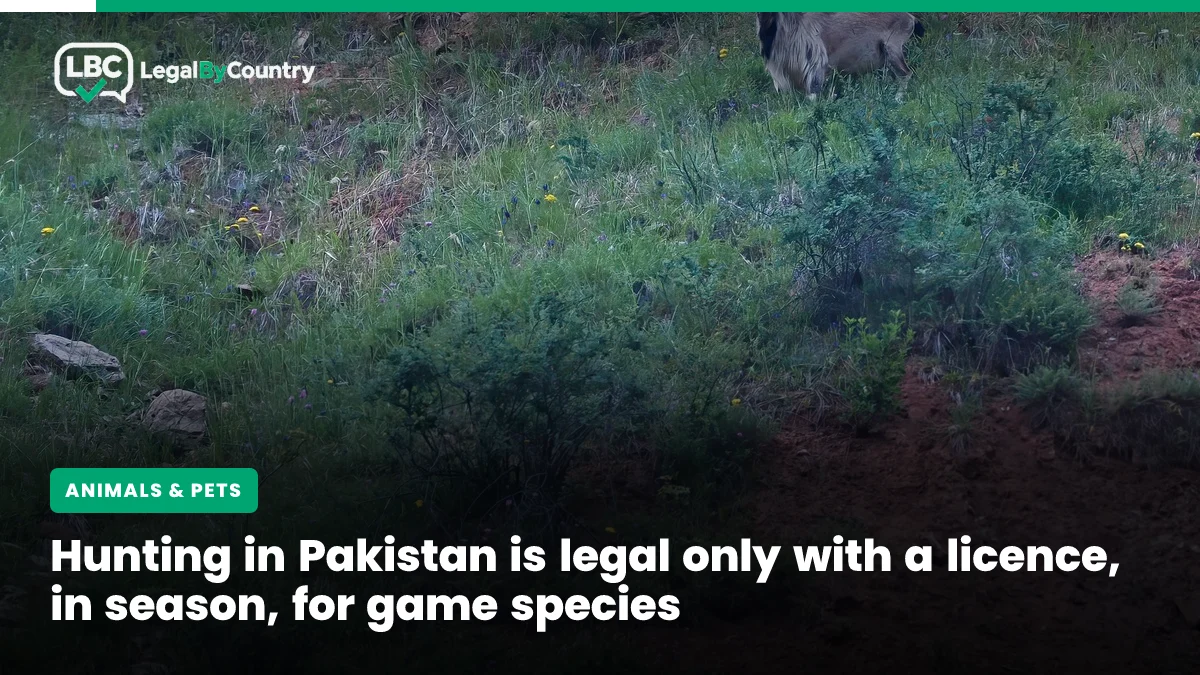
Short answer: Legal with a licence
Yes, but only with a provincial hunting licence or permit, during the notified season and for listed game species. Protected animals, national parks and sanctuaries are off limits under every provincial wildlife Act, and Punjab now jails illegal hunters for up to seven years.
- The law
Punjab Wildlife (Protection, Preservation, Conservation and Management) Act, 1974 (as amended 2025), ss. 9, 10, 18, 21
Sindh Wildlife Protection, Preservation, Conservation and Management Act, 2020, ss. 9, 14, 21, 43 to 46, Third Schedule
Khyber Pakhtunkhwa Wildlife and Biodiversity (Protection, Preservation, Conservation and Management) Act, 2015, ss. 9, 10, 44, 68, Fourth Schedule
Balochistan Wildlife (Protection, Preservation, Conservation and Management) Act, 2014, ss. 15, 16, 92, Schedule V
- Penalty
- In Punjab, hunting a protected animal carries five to seven years in prison, or a fine of Rs 100,000 to Rs 5 million, or both, and is non-bailable under section 21 of the Punjab Wildlife Act, 1974 as amended in 2025.
General information only, not legal advice. For help with your own matter, consult a qualified lawyer or legal consultant. Read the disclaimer
Hunting in Pakistan is legal only with a licence, in season and for game species
Before sunrise on a winter weekend, hunters wade into a Punjab jheel with shotguns and decoys while a wildlife ranger checks permits nearby. Is hunting legal in Pakistan? Yes, but only for listed species, in the right place and season, and with the right paper.
Every province has its own wildlife law, and all of them work the same basic way. Wild animals are sorted into lists. "Game animals" may be hunted under a licence or permit during a notified season. "Protected animals" may not be hunted at all. National parks and wildlife sanctuaries are closed to hunting, and game reserves open only under a special permit.
The main laws are the Punjab Wildlife (Protection, Preservation, Conservation and Management) Act, 1974, the Sindh Wildlife Protection, Preservation, Conservation and Management Act, 2020, the Khyber Pakhtunkhwa Wildlife and Biodiversity Act, 2015 and the Balochistan Wildlife Act, 2014. Islamabad has its own federal law. Our animal law guides for Pakistan cover pets, cruelty and other wildlife questions.
Each province decides what you may hunt and when
Wildlife is a provincial subject, so the province where you hunt sets the species list, the licence, the season and the penalty. A licence from one province does not cover another. Check the law and the season notification of the province you are standing in.
| Where | Main law | Who licenses | Key hunting rule |
|---|---|---|---|
| Punjab | Punjab Wildlife Act, 1974, amended in 2025 | Punjab Wildlife and Parks Department | Section 9: no hunting of protected animals, and game animals only "under a permit" |
| Sindh | Sindh Wildlife Act, 2020 | Sindh Wildlife Department | Section 21: no one may hunt, kill, trap or capture wildlife "unless permitted"; section 43(4) bans hunting in the breeding season |
| Khyber Pakhtunkhwa | KP Wildlife and Biodiversity Act, 2015 | KP Wildlife Department | Section 9(c): game animals only under a Big Game or Small Game Hunting Licence or Permit |
| Balochistan | Balochistan Wildlife Act, 2014 | Provincial wildlife department | Section 16: no hunting of protected animals, no hunting inside sanctuaries or national parks, and game only under a licence or permit |
| Islamabad | Islamabad Nature Conservation and Wildlife Management Act | Islamabad Wildlife Management Board | Hunting wild animals is prohibited, according to reports on the Act |
Gilgit-Baltistan and Azad Jammu and Kashmir have their own wildlife laws and departments. They run large trophy hunting programmes, covered below, but their rules sit outside this table.
A hunting licence covers game species only
A licence lets you hunt the animals your province lists as game, such as ducks, quail, partridges and hares. Big animals need more. In Khyber Pakhtunkhwa, a markhor or ibex needs a Big Game Hunting Permit on top of the Big Game Hunting Licence.
The licence types differ by province:
- Khyber Pakhtunkhwa issues Small Game and Big Game Hunting Licences and matching permits (section 44). Part IV of the First Schedule lists the animals that need a Big Game Hunting Permit as well: common leopard, wolf, rhesus monkey, Himalayan ibex, grey goral, markhor and urial.
- Balochistan uses big game and small game licences, special permits and a Trophy Hunting Permit for the big game in Part C of its Schedule I.
- Sindh gives the government "the sole prerogative to grant licenses in fee or gratis" (section 46). Its Second Schedule lets game be hunted only with a permit in your own hands, in areas open for hunting, during the open season and on the open days of the week.
- Punjab requires a permit for game animals and a special permit inside a game reserve. Since 28 January 2026, Punjab hunting licences and permits are applied for on the provincial e-Biz portal, Dunya News reported.
Fees change every season
Fees sit in rules and notifications, not the Acts, and change often. For the 2026 to 2027 season, Khyber Pakhtunkhwa set the annual Small Game Shooting Licence at Rs 5,000 and a Special Duck Hunting Fee of Rs 100 per gun per day, ARY News reported on 24 September 2026. We could not confirm the current Punjab, Sindh or Balochistan fees on an official site. The Punjab department's own FAQ says fees are paid at the State Bank after approval.
Seasons, days and bag limits are set by notification
Even with a licence, you may hunt only during the notified season, on the open days and up to the daily bag limit. Each department issues a fresh notification every year, and a hunt outside it counts as unlawful hunting, licence or not.
| Province and quarry | Season (as reported) | Days | Limit | Source, date |
|---|---|---|---|---|
| Punjab, waterfowl | 1 October 2026 to 31 March 2027 | Saturdays and Sundays | As set in the Act's First Schedule | ProPakistani, 1 October 2026 |
| Khyber Pakhtunkhwa, waterfowl | Until 31 December 2026 | Friday to Sunday | 5 ducks per gun per day | ARY News, 24 September 2026 |
| Punjab, quail (2025 to 2026 season) | 15 August to 15 April | Not stated | 50 per day | The Express Tribune, 23 August 2025 |
Khyber Pakhtunkhwa's 2026 notification also closes 53 named sites to hunting, including dams, lakes, river stretches and game reserves. Sindh's law adds a blanket rule: "No hunting shall be allowed during the breeding season" (section 43(4)). Get the current notification from your provincial department before every season.
Protected animals cannot be hunted at all
A protected animal is off limits whatever licence you hold. Each Act lists them in a schedule, and the lists include young animals and mothers of game species. Killing one is treated far more seriously than an ordinary licence breach.
- Females and young. Sindh's First Schedule and Khyber Pakhtunkhwa's Third Schedule protect all immature game animals and all females that are pregnant, suckling or with young. KP also protects every female markhor, ibex and grey goral.
- Named species. Sindh protects the Sindh wild goat, urial, chinkara and hog deer. KP's Third Schedule protects whole bird families, including herons, egrets, pelicans, storks and ibises.
- Bustards. Balochistan's Schedule III lists all bustards, including the houbara, as protected, with an exception for a limited number of birds.
Lists change by notification, so a bird that was game last year may be protected this year. The same schedules govern keeping wild birds at home, which our guide on keeping parrots and wild birds explains.
Parks and sanctuaries are closed, and game reserves need a special permit
Where you hunt matters as much as what you hunt. National parks and wildlife sanctuaries are closed to hunting in every province. Game reserves allow it only under a special permit that fixes the number of animals and the dates.
Sindh lists "hunting, shooting, killing, injuring, trapping, snaring and poisoning" as banned acts in protected areas (section 9(1)(a)). Its section 14 allows hunting in a game reserve only under a special permit from the Conservator Wildlife. Balochistan's section 16(c) bans hunting game in a strict nature reserve, wildlife sanctuary, national park, natural heritage site or biosphere core zone. In Punjab, the Wildlife and Parks Department has banned hunting in all protected areas, according to its 2026 season notice.
Private land is not a free zone either. Balochistan's section 15(2) bars hunting on private or community land without the owners' consent. Punjab and Sindh also let owners run private game reserves, and in Punjab an outsider may hunt there only with the owner's permission.
The way you hunt is regulated too
Each Act bans methods that are cruel or too efficient. Nets, snares, poison, explosives, automatic weapons and hunting from vehicles are prohibited across the provinces. A valid licence does not cover any of these methods unless an officer grants written permission.
Section 9 of the Punjab Act and section 9 of the KP Act set out the core list. The banned methods include:
- set guns, traps, snares, nets, baited hooks, explosives, poison and drugs;
- automatic weapons and weapons of a calibre used by the army or police;
- using any vehicle to chase or stampede game, and shooting game from a vehicle (Punjab adds within 200 yards of one);
- hunting big game with a shotgun or a .22 or smaller non-magnum rifle, since those are allowed only for birds and hares;
- hunting at night: Punjab allows only ducks, wild boar and vermin after sunset, while KP allows waterfowl before sunrise and live catching of cranes and quail after sunset;
- hiding near a water hole or salt lick, and, in KP, playback calls and decoys except for waterfowl, cranes and quail.
Hawks and dogs need their own special licence or permit (Punjab section 10, Sindh section 48, KP section 10). The gun itself is a separate matter. A hunting licence is not an arms licence, so your shotgun or rifle must also be licensed under your province's arms law, as our guide on owning a gun in Pakistan explains.
Trophy hunting is a legal, government-run programme
Trophy hunting of markhor, ibex and other mountain animals is legal under community quotas set by the authorities. Hunters, mostly foreign, buy permits at official auctions, and most of the money goes to the local communities that protect the herds.
Sindh's section 44 tells its department to run a trophy hunting programme "according to the quota as fixed by Management Authority," for foreigners and locals, on payment of prescribed fees. Khyber Pakhtunkhwa and Balochistan issue big game and trophy permits under their Acts. Exporting a trophy is a separate federal matter under the Pakistan Trade Control of Wild Fauna and Flora Act, 2012, which gives effect to CITES.
What permits have sold for
- In Gilgit-Baltistan, the top Astore markhor permit for the 2026 to 2027 season sold for $356,000 at an auction on 10 September 2026. Exportable Himalayan ibex permits went for $11,500 to $13,200. The season runs from 15 October 2026 to 10 April 2027 (Dawn, 11 September 2026).
- In Khyber Pakhtunkhwa, 11 non-exportable trophy permits sold for $553,300, and about 80% of permit revenue is spent on the hunting areas (Dawn, 18 January 2026).
The programme is also under dispute. In January 2026, the federal climate change ministry told provinces not to allocate quotas for non-exportable markhor and goral trophies until a legal opinion was obtained, and the KP department objected that wildlife is a provincial subject. Check the current position with the provincial department before applying.
Houbara bustard hunting is allowed only under special permits
Houbara hunting is not open to ordinary hunters. Permits go mainly to visiting Gulf dignitaries for falconry, through the Ministry of Foreign Affairs and the provincial wildlife department. For anyone else, hunting a houbara is an offence.
The Supreme Court banned houbara hunting on 19 August 2015 and cancelled all permits. On 22 January 2016, a five-member bench set that judgment aside by four votes to one, holding that the laws do not contemplate a permanent ban, Dawn reported. Sindh's section 45 now lets the government allot falconry areas, but never in a national park or sanctuary, on a dignitary's written request received directly or through the Ministry of Foreign Affairs. Under Sindh's Third Schedule, unlawfully hunting a houbara carries up to three months in jail and a fine of up to Rs 5,000 per bird.
Penalties now include prison, and Punjab's are the toughest
Illegal hunting can lead to jail, fines, an order to pay the animal's value, and the loss of your gun, vehicle and licence. In 2025, Punjab made its main hunting offences cognizable and non-bailable, with minimum terms. Other provinces still rely mostly on fines.
| Province | Offence | Penalty in the statute |
|---|---|---|
| Punjab | Hunting a protected animal, or by a water hole or salt lick (s. 9(ii), (x)) | 5 to 7 years, or a fine of Rs 100,000 to Rs 5 million, or both, plus confiscation (s. 21(1)(ii)) |
| Punjab | Most other breaches of s. 9, including hunting game without a permit | 2 to 5 years, or a fine of Rs 50,000 to Rs 1 million, or both, plus confiscation (s. 21(1)(i)) |
| Sindh | Hunting or killing a wild mammal without permission (s. 21) | Up to 5 years with a fine of up to Rs 250,000; bailable and compoundable |
| Sindh | Hunting game birds such as partridge, quail, houbara or waterfowl unlawfully | Up to 3 months with a fine of up to Rs 5,000 per bird |
| Khyber Pakhtunkhwa | Hunting a protected animal | Rs 10,000 or two weeks at least, up to Rs 45,000 or two years, or both, plus the animal's value (Fourth Schedule) |
| Khyber Pakhtunkhwa | Unlawful hunting of big game | Up to Rs 45,000 or three years, or both, plus value |
| Balochistan | Hunting a protected animal | Rs 20,000 or five weeks at least, up to Rs 50,000 or three months, or both, plus value (Schedule V) |
The Punjab figures come from the Punjab Wildlife (Amendment) Bill 2025, which the Provincial Assembly passed on 20 January 2025. The same amendment lets wildlife rangers register FIRs and sends cases to special courts. Repeat offenders face more in KP and Balochistan: a minimum of three months or a fine, confiscation of the gun and vehicle, and no licence for at least two years. Sindh bars compounding a second offence (section 28).
In Islamabad, a July 2025 case over a barking deer killed in Margalla Hills National Park was registered under the capital's wildlife Act, which carries up to Rs 1 million and one year in jail, according to Dawn. We could not read the official text of that Act to confirm the section.
Follow these steps to hunt within the law
The lawful route is short but has no shortcuts. Get the licence from the department, read the current season notice, and hunt only listed game in open areas with a licensed gun. Keep every document on you, because officers can demand them.
- Find out which province's law covers the ground you will hunt, and whether it is a national park, sanctuary, game reserve or private land.
- Make sure your firearm is licensed under your provincial arms law.
- Apply for the right hunting licence from the provincial wildlife department. In Punjab, that is through the e-Biz portal; elsewhere, ask the district wildlife office.
- Get any extra permit you need: a special permit for a game reserve, a hawk or dog licence, a big game or trophy permit, or the landowner's written consent.
- Read the season notification for open days, hours, closed sites and bag limits, and stay within them.
- Carry your licence, permit and arms licence while hunting, and show them when an officer asks.
- Keep only what you lawfully shot. Possessing or moving wild animals or trophies may need a certificate of lawful possession.
If a wild animal attacks, the provincial Acts allow killing it in genuine self-defence (Balochistan limits this to named dangerous species), but you must report it to the wildlife office, and the carcass belongs to the government. Our editorial policy explains how we check statutes like these.
Frequently asked questions
Do I need a licence to hunt ducks in Pakistan?
+
Yes. Every province requires a hunting licence or permit for game birds, including ducks. In Khyber Pakhtunkhwa, no waterfowl permit is issued without a valid Small Game Shooting Licence, and you must also stay within the season, open days and bag limit.
Can I hunt on my own farmland without a licence?
+
No. Owning the land does not replace the hunting licence, and the species, season and method rules still apply. The KP, Balochistan and Sindh Acts treat wild animals as government property, and in Balochistan others need the owner's consent to hunt on private land.
Is markhor hunting legal in Pakistan?
+
Only through the official trophy hunting programme. Permits are sold at government auctions under fixed quotas, mostly to foreign hunters, and in Gilgit-Baltistan the top 2026 to 2027 markhor permit sold for $356,000. Hunting a markhor any other way is a serious offence.
Who can hunt the houbara bustard in Pakistan?
+
Mainly visiting Gulf dignitaries holding special permits arranged through the Ministry of Foreign Affairs and the provincial wildlife department. The Supreme Court lifted its 2015 ban in January 2016. For ordinary hunters, killing a houbara is an offence.
Can I hunt at night with a torch?
+
Generally no. Punjab bans hunting after sunset and before sunrise except for ducks, wild boar and vermin, and Khyber Pakhtunkhwa bans hunting after sunset except live catching of cranes and quail. Check your province's Act and season notification.
Is killing a wild boar that damages crops legal?
+
Only with the right paperwork. In Khyber Pakhtunkhwa, wild boar is listed as vermin that may be hunted under a no objection certificate plus a hunting licence. Rules differ elsewhere, so ask your district wildlife office first, and never use poison or traps.
Does a hunting licence let me carry a gun?
+
No. A hunting licence comes from the wildlife department, while your shotgun or rifle needs a separate arms licence under your province's arms law. You need both, and display bans on arms still apply.
What happens if I hunt in a national park?
+
You commit an offence in every province, even with a hunting licence. In Sindh, hunting in a protected area carries up to five years in prison and a fine of up to Rs 250,000, and your gun and vehicle can be confiscated.
Sources
We compiled this guide from official sources: the law itself, government notifications and court records, checked against reporting of recent changes. It is for information only.
- Sindh Wildlife Protection, Preservation, Conservation and Management Act, 2020 (Sindh Act No. XXIII of 2020) · Sindh Code, Government of Sindh
- Khyber Pakhtunkhwa Wildlife and Biodiversity (Protection, Preservation, Conservation and Management) Act, 2015 (Act No. I of 2015) · Provincial Assembly of Khyber Pakhtunkhwa
- Balochistan Wildlife (Protection, Preservation, Conservation and Management) Act, 2014 · Government of Balochistan
- Punjab Wildlife (Protection, Preservation, Conservation and Management) Act, 1974 (consolidated text) · FAOLEX copy of the Punjab Laws text
- Punjab Wildlife (Protection, Preservation, Conservation and Management) (Amendment) Bill 2025 (Bill No. 06 of 2025) · Provincial Assembly of the Punjab
- Bill details: Punjab Wildlife (Amendment) Bill 2025, passed 20 January 2025 · Provincial Assembly of the Punjab
- Frequently asked questions · Forestry, Wildlife and Fisheries Department, Government of the Punjab
- Supreme Court lifts hunting ban on rare houbara bustard (22 January 2016) · Dawn
- Waterfowl hunting restricted to three days a week (24 September 2026) · ARY News
- Punjab Announces Waterfowl Hunting Season Dates (1 October 2026) · ProPakistani
- Hunting season opens with new wildlife laws (23 August 2025) · The Express Tribune
- Punjab Wildlife shifts online services to e-Biz portal (28 January 2026) · Dunya News
- GB auctions hunting permits (11 September 2026) · Dawn
- Federal curbs on non-exportable trophy permits in KP (18 January 2026) · Dawn
- Case registered over barking deer killed in Margalla Hills National Park (6 July 2025) · Dawn
Advocate, Supreme Court of Pakistan
Advocate of the Supreme Court of Pakistan and the Lahore High Court, former Assistant Advocate General Punjab and Assistant Attorney General for Pakistan, and adjunct professor of law in Lahore.
Full profile and credentials →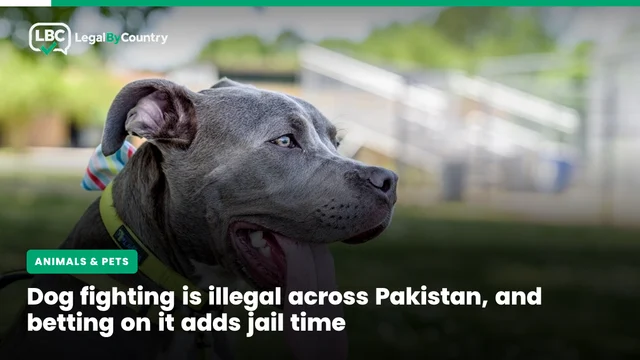
Is Dog Fighting Legal in Pakistan?
No. Section 6C of the Prevention of Cruelty to Animals Act, 1890 bans inciting or baiting animals to fight, and Khyber Pakhtunkhwa's Animal Welfare Act, 2024 bans fighting ventures. Betting on fights adds gambling charges carrying up to five years in Punjab.
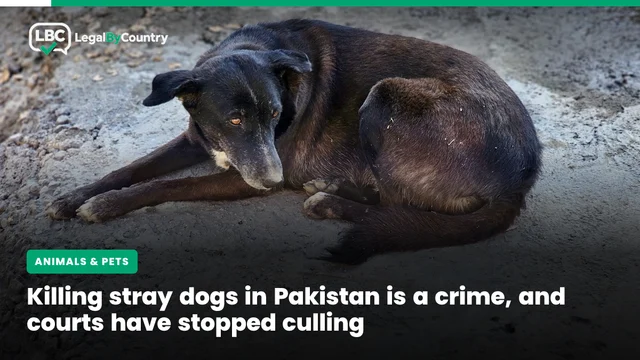
Is It Legal to Kill Stray Dogs in Pakistan?
No. Shooting, poisoning or beating a stray dog can be charged under sections 428 and 429 of the Pakistan Penal Code and provincial cruelty laws. High Courts have stopped municipal culling in Punjab and Islamabad, and only vets may euthanise rabid or incurable dogs.
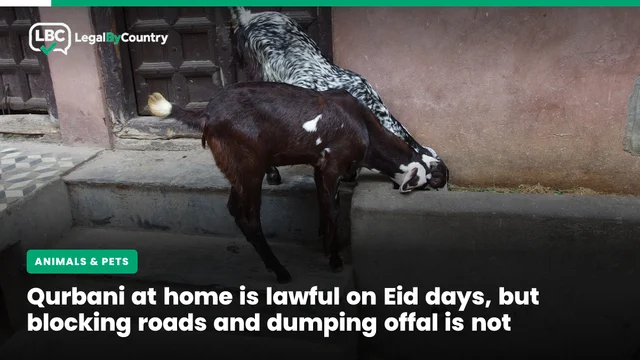
Is It Legal to Slaughter Animals in the Street During Eid in Pakistan?
Mostly yes, on Eid ul Adha and the two days after. Punjab's Animals Slaughter Control Act, 1963 and Balochistan's 2025 Act exempt qurbani from the slaughterhouse rule, but blocking roads, dumping offal or breaking a local Eid order can still bring fines.
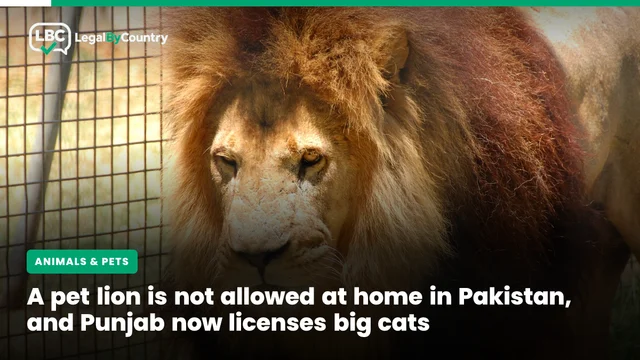
Is It Legal to Keep a Lion as a Pet in Pakistan?
No, not as a house pet. Punjab's Wildlife Act 1974 requires a section 10-B licence for any captive lion and bars big cats from homes. Other provinces demand a possession certificate, and Islamabad's 2023 law bans keeping wild animals in captivity.