

Is It Legal to Keep a Lion as a Pet in Pakistan?
No, not at home. See Punjab's 2025 big cat licence rules, the Lahore crackdown, penalties up to seven years and the rules in other provinces.

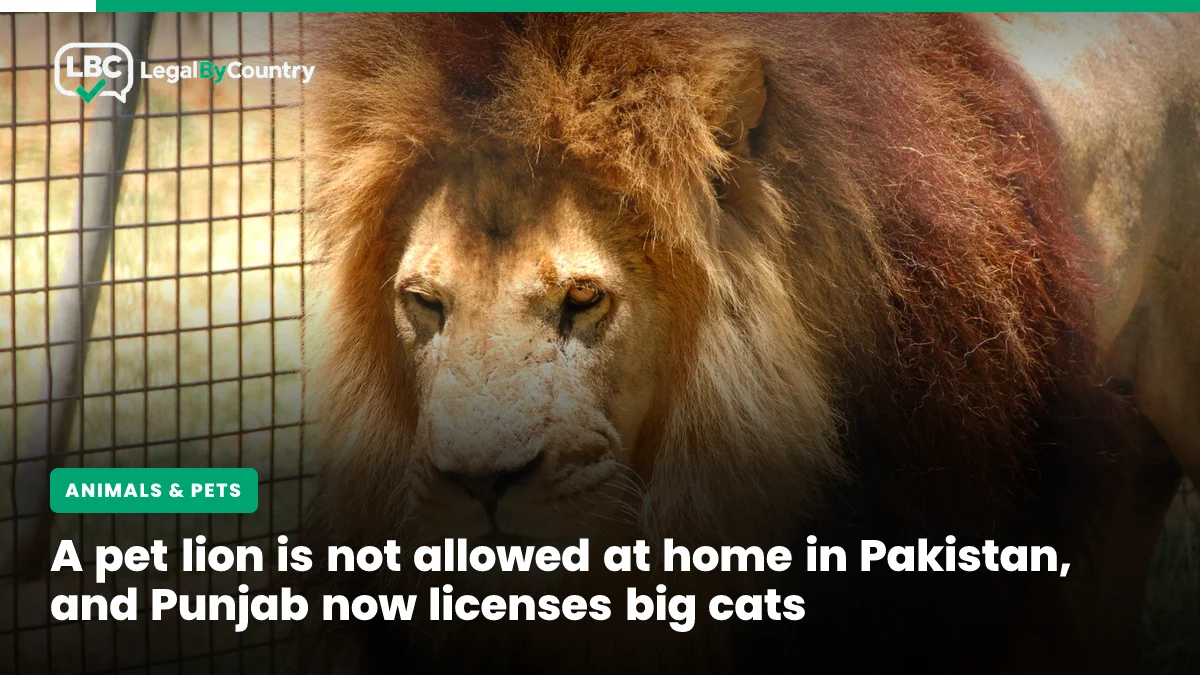
Short answer: Not as a house pet
No, not as a house pet. Punjab's Wildlife Act 1974 requires a section 10-B licence for any captive lion and bars big cats from homes. Other provinces demand a possession certificate, and Islamabad's 2023 law bans keeping wild animals in captivity.
- The law
Punjab Wildlife (Protection, Preservation, Conservation and Management) Act, 1974 (as amended 2025), ss. 10-B, 12, 13, 14, 21; Second Schedule
Punjab Wildlife (Amendment) Act 2025 (Act II of 2025), ss. 7, 9
Sindh Wildlife Protection, Preservation, Conservation and Management Act, 2020, ss. 49, 50
Khyber Pakhtunkhwa Wildlife and Biodiversity Act, 2015, ss. 13, 24
- Penalty
- In Punjab, importing or trading a big cat without a permit or licence carries five to seven years in prison or a fine of Rs 100,000 to Rs 5 million, or both, under section 21(1)(ii) of the Punjab Wildlife Act, 1974 as amended in 2025.
General information only, not legal advice. For help with your own matter, consult a qualified lawyer or legal consultant. Read the disclaimer
A lion cannot lawfully live in your house in Pakistan
On 3 July 2025, CCTV in Lahore's Shah Di Khoi caught an unlicensed lion leaping a wall and attacking a woman and two children. Is it legal to keep a lion as a pet in Pakistan? Not at home, and not without official papers.
Wildlife is a provincial subject, so each province and Islamabad has its own wildlife law. None of them treats a lion like a dog or a cat. Every one requires a certificate, licence or permit to hold a wild animal, Punjab now bars big cats from homes and residential areas, and the Islamabad law bans keeping wild animals in captivity altogether.
Lions are not native to Pakistan, so every lion here was imported or bred in captivity. That brings in a second layer: the federal law that controls trade in species protected by CITES, the international wildlife trade treaty. The animals and pets guides cover the wider rules on keeping and trading wildlife.
Punjab now treats a lion as a licensed captive animal
Since January 2025, Punjab law says no one may keep a lion, tiger, jaguar, puma or cheetah in captivity without a licence from the Director General, Wildlife and Parks. The licence fee is Rs 50,000 per animal, and homes do not qualify.
Three legal changes, all made in the space of a month, built this system:
- A licence requirement. The Punjab Wildlife (Protection, Preservation, Conservation and Management) (Amendment) Act 2025 (Act II of 2025, gazetted on 27 January 2025) added section 10-B to the Punjab Wildlife Act, 1974. No person may keep a wild animal listed in the First, Second or Fourth Schedule as a captive animal "except under a licence" from the Director General.
- Big cats listed by name. A notification of 30 January 2025 (No. SOP(WL)12-14/2019(P-I), gazetted 10 February 2025) added a "Felidae" group to the Second Schedule: lion, tiger, jaguar, puma and cheetah. Second Schedule animals need a certificate of lawful possession, and section 13 bars receiving one by gift or purchase without that certificate.
- A fee. A second notification of the same date amended rule 3 of the Punjab Wildlife Rules, 1974 to set a licence fee of Rs 50,000 per animal for each of the five species, issued by the Director General.
Homes and residential areas are off limits
The Punjab Wildlife and Parks Department's phasing out plan for big cats (March 2025) says plainly: "Big cats cannot be kept at residences or in residential areas." Owners who already had a big cat at home had to move it to a farm or farmhouse outside residential areas, meet the enclosure standards in the department's 2011 big cat guidelines, get a possession licence, and stop the animal breeding through neutering or contraception.
The same plan sets other conditions:
- Every big cat must be microchipped, at the owner's cost, and its number uploaded to the department's Wildlife PASS app within 3 months.
- Only registered breeding farms, private wildlife parks and safari parks that are open to the public for education may keep big cats long term.
- Breeders may sell only to registered parks and safaris, and only with the department's permission.
- No owner may take a big cat off the farm or park for public display, or let visitors into its enclosure, "even if these animals are fully trained and/or tamed."
The Chief Minister announced an end to private permission in January 2026
After two Lahore children were badly hurt by pet big cats in January 2026, Chief Minister Maryam Nawaz ordered on 26 January 2026 that the legal permission to keep big cats in Punjab be revoked, Dawn reported on 27 January 2026. On 2 March 2026, The Express Tribune reported that "no final notification has been issued," with 580 big cats registered and officials estimating more than 800 in private hands.
As of 16 November 2026, we have not found a gazetted notification or Act that carries out that order. On 20 September 2026, a Deputy Chief Wildlife Ranger told The Express Tribune that further amendments to tighten the rules had gone to the provincial cabinet. Until something is notified, the 2025 licence system is the law on paper, and the government's stated policy is that private keeping should end.
Punjab penalties now reach seven years and Rs 5 million
Section 21 of the Punjab Wildlife Act, as amended in 2025, sets two penalty tiers. Possession without a certificate can bring two to five years in prison, and illegal import or trade up to seven years. Both tiers are cognizable and non-bailable.
"Cognizable" means wildlife officers can arrest without a warrant. "Non-bailable" means bail is up to the court, not a right. The 2025 Act also gave wildlife rangers police powers of arrest and search, and set up special wildlife courts.
| Offence (Punjab, as of 16 November 2026) | Section breached | Prison | Fine |
|---|---|---|---|
| Keeping a wild animal without a certificate of lawful possession, or receiving a big cat without one | ss. 12, 13 | 2 to 5 years | Rs 50,000 to Rs 1 million, or both |
| Bringing a big cat into Punjab without an import permit, or trading in wild animals without a dealer's licence | ss. 14, 15 | 5 to 7 years | Rs 100,000 to Rs 5 million, or both |
| Breaking another rule with no specific penalty | s. 21(1)(iii) | Up to 10 months | Up to Rs 10,000, or both |
| Failing to guard against danger from an animal you keep (any province) | Pakistan Penal Code, s. 289 | Up to 6 months | Up to Rs 3,000, or both |
The confiscation of the animal, and of any vehicle or equipment used in the offence, comes on top of the prison term or fine. Section 289 of the Pakistan Penal Code, 1860 applies everywhere in Pakistan, and if a lion actually hurts someone, police can add the Penal Code's hurt offences. Officials quoted in July 2025 said unlicensed possession of a dangerous wild animal carries up to seven years and a Rs 5 million fine, which matches the higher tier.
Lahore's attacks turned the rules into raids
Punjab's crackdown follows a run of escapes and attacks, mostly in Lahore. Each incident pushed the government further, from a licence fee in early 2025 to raids in July 2025 and an announced end to private ownership in January 2026.
- 3 July 2025, Shah Di Khoi, Lahore. An unlicensed African lion escaped and injured a woman and two children. The owner was arrested and a case registered under the Punjab Wildlife Act, The Express Tribune reported on 4 July 2025.
- 7 July 2025. Authorities said 18 illegally kept lions had been confiscated across Punjab and 38 lion and tiger breeding farms raided, with 584 lions and tigers in homes and farms in the province, Dawn reported.
- 9 July 2025. The department announced sterilisation of privately held big cats and a ban on their trade, and said big cats were barred from urban areas and housing societies, The Express Tribune reported.
- January 2026, Sabzazar and Bhekewal, Lahore. An 8-year-old boy lost an arm to a pet lion, and a lioness being moved in an auto-rickshaw injured an 8-year-old girl. The government said it had seized 59 big cats and arrested 10 people, Dawn reported on 27 January 2026.
The crackdown has limits. The September 2026 Tribune report found that some seized animals were returned to owners under court orders, on condition they stay at registered breeding farms and out of urban areas, and that circuses were still showing lions at fairs.
Other provinces and Islamabad require papers, and Islamabad bans captivity
Outside Punjab, the rules are older and less specific to big cats, but none allows a lion without official paperwork. Sindh, Khyber Pakhtunkhwa and Balochistan require a certificate of lawful possession. Islamabad's 2023 law bans keeping wild animals in captivity altogether.
| Area | Main law | What it says about keeping a lion |
|---|---|---|
| Punjab | Punjab Wildlife Act, 1974, as amended 2025 | Licence under s. 10-B (Rs 50,000 per animal), no homes or residential areas, private permission announced revoked in January 2026 but not yet notified |
| Sindh | Sindh Wildlife Protection, Preservation, Conservation and Management Act, 2020 | Certificate of lawful possession for each animal (s. 49); captive bred animals kept for education, awareness or research (s. 50) |
| Khyber Pakhtunkhwa | KP Wildlife and Biodiversity Act, 2015 | Certificate or licence of possession for any live wild animal, including exotics (s. 13); the government may regulate captivity (s. 24) |
| Balochistan | Balochistan Wildlife Act, 2014 | All wild animals, captive or tame, are government property (s. 9); unlawfully held pets can be seized and confiscated (s. 25) |
| Islamabad | Islamabad Nature Conservation and Wildlife Management Act, 2023 | No one may keep wild animals in captivity (s. 16); existing animals had to be surrendered to the Board |
Sindh
Under the Sindh Act, unlawful possession is bailable, and its penalty schedule lists "Lion / Leopard" with up to three months in prison and a fine per animal. In March 2023, Sindh wildlife officials told Dawn that big cat permits carry 39 conditions, ban keeping them in residential areas, and that no new applications to import big cats were being accepted. When a pet lion escaped on Karachi's Sharea Faisal in August 2023, five people including the owner were booked under sections 21, 32, 49 and 50 of the Act, Dawn reported. In November 2025, the Sindh Chief Secretary ordered a draft ban on importing exotic species, Dawn reported, but we have not found it enacted.
Khyber Pakhtunkhwa and Balochistan
KP officials told Dawn in 2023 that the province's breeding facility rules allow birds and herbivores and discourage keeping carnivores. Balochistan's wildlife conservator said no permit had been issued in Quetta to keep big cats as pets. We could not open either province's rules ourselves, so check with the provincial wildlife department before relying on them.
Islamabad
Section 16 of the Islamabad Act says that, unless the Act or its rules allow it, no person shall "keep wild animals in captivity." Anyone holding a wild animal when the Act came into force had three months to surrender it to the Board, which may then seize it. Keeping a wild animal in breach of section 16 carries up to one year in prison, a fine under the Act's second schedule, or both.
Importing a lion needs federal CITES papers and provincial approval
Every lion in Pakistan came from abroad at some point, and imports run through the federal Ministry of Climate Change and Environmental Coordination, the country's CITES authority. You need a provincial recommendation, an export permit from the selling country and a federal import permit.
Section 6 of the Pakistan Trade Control of Wild Fauna and Flora Act, 2012 requires both a foreign export permit and a Pakistani import permit or no objection certificate for any CITES-listed specimen. The import permit is granted only if the recipient is "suitably equipped to house and care for it" and the animal is not to be used "primarily for commercial purposes." Breaking the Act carries one to two years in prison or a fine of Rs 500,000 to Rs 1 million.
The Ministry's instructions (dated January 2026) say applications go first to the provincial or territorial wildlife department, which forwards them to Islamabad. Commercial importers must also register with the Ministry each calendar year. A provincial import permit is needed too: section 14 of the Punjab Act bars bringing any exotic wild animal into Punjab without one.
The lawful route runs through licensed facilities, not homes
For a private person who wants a lion as a pet, no province offers a clear lawful route in 2026. The law allows big cats only in registered zoos, safari parks, wildlife parks and breeding farms, under licence and with strict housing standards.
If you already have a big cat, or you run a facility, these are the lawful steps in Punjab as the rules stand on 16 November 2026:
- Contact the Punjab Wildlife and Parks Department and declare the animal, if you have not done so already.
- Apply for the section 10-B licence and pay the Rs 50,000 per animal fee, keeping the receipt and your certificate of lawful possession together.
- Move the animal out of any home or residential area to premises that meet the department's enclosure standards.
- Microchip the animal and record its number on the Wildlife PASS app.
- Arrange neutering or contraception so the animal does not breed.
- If you cannot meet the standards, transfer the animal by sale or donation to a registered breeding farm, wildlife park or safari, with the department's permission.
Expect these steps to change once the January 2026 order is notified. Owners in other provinces should ask their provincial wildlife department in writing what certificate applies and keep the reply. Never buy a cub from a seller who cannot show the animal's import permit and certificate of lawful possession, because the buyer commits the offence too. Readers interested in other species can see the guides on keeping parrots and hunting, and how we check every source in our editorial policy.
Frequently asked questions
Can I keep a lion cub at home in Lahore?
+
No. The Punjab Wildlife and Parks Department's March 2025 plan says big cats cannot be kept at residences or in residential areas, and the Chief Minister ordered in January 2026 that private permission to keep big cats be revoked.
How much is the licence fee for a lion in Punjab?
+
Rs 50,000 per animal, under rule 3 of the Punjab Wildlife Rules, 1974 as amended on 30 January 2025. The same fee applies to tigers, jaguars, pumas and cheetahs. Paying it does not make keeping the animal at home lawful.
What is the punishment for keeping a lion without a licence in Punjab?
+
Up to five years in prison or a fine of up to Rs 1 million for possession without a certificate, and up to seven years or Rs 5 million for illegal import or trade, under section 21 of the Punjab Wildlife Act as amended in 2025. Both tiers are non-bailable.
Can I keep a lion on my farmhouse outside the city?
+
Only under licence and the department's enclosure standards, and that route may close. The 2025 plan let existing owners move big cats to farms outside residential areas, but the January 2026 order announced an end to private permission. Ask the department in writing first.
Is it legal to keep a lion in Karachi?
+
Not without a certificate of lawful possession under section 49 of the Sindh Wildlife Act, 2020. Sindh officials said in 2023 that big cat permits ban residential areas and that no new big cat import applications were being accepted.
Can I import a lion cub from another country?
+
Only with a CITES export permit from the selling country, a federal import permit from the Ministry of Climate Change and Environmental Coordination, and provincial approval. The 2012 Trade Control Act allows an import permit only if the recipient can properly house the animal.
Do the same rules apply to tigers, cheetahs and leopards?
+
Yes for tigers, cheetahs, jaguars and pumas, which Punjab listed with lions in January 2025. Leopards are native and already protected in Punjab's Third Schedule, and the department says keeping native big cats privately is illegal.
What should I do if a neighbour keeps a lion?
+
Report it to your provincial wildlife department or the police. In Punjab, the 2025 amendment added whistle-blower sections that protect the identity of people who report wildlife offences and allow a reward when an offender is punished.
Sources
We compiled this guide from official sources: the law itself, government notifications and court records, checked against reporting of recent changes. It is for information only.
- Punjab Wildlife (Protection, Preservation, Conservation and Management) Act, 1974 (consolidated, as amended to 2026) · Law and Parliamentary Affairs Department, Government of the Punjab (Punjab Code)
- Punjab Wildlife (Protection, Preservation, Conservation and Management) (Amendment) Act 2025 (Act II of 2025) · Law and Parliamentary Affairs Department, Government of the Punjab (Punjab Code)
- Notification No. SOP(WL)12-14/2019(P-I), 30 January 2025: big cats added to the Second Schedule (Gazette notification 28 of 2025) · Forestry, Wildlife and Fisheries Department, Government of the Punjab (Punjab Code)
- Notification No. SOP(WL)12-14/2019(P-I), 30 January 2025: Rs 50,000 licence fee per big cat in rule 3 (Gazette notification 29 of 2025) · Forestry, Wildlife and Fisheries Department, Government of the Punjab (Punjab Code)
- Guidelines and Phasing Out Plan for Big Cats (March 2025) · Punjab Wildlife and Parks Department
- Punjab Wildlife (Protection, Preservation, Conservation and Management) (Amendment) Bill 2025 (Bill No. 06 of 2025) · Provincial Assembly of the Punjab
- Sindh Wildlife Protection, Preservation, Conservation and Management Act, 2020 (Sindh Act No. XXIII of 2020) · Sindh Code, Government of Sindh
- Khyber Pakhtunkhwa Wildlife and Biodiversity (Protection, Preservation, Conservation and Management) Act, 2015 (Act No. I of 2015) · Provincial Assembly of Khyber Pakhtunkhwa
- Balochistan Wildlife Protection, Preservation, Conservation and Management Act, 2014 · Government of Balochistan
- Islamabad Nature Conservation and Wildlife Management Act, 2023 (bill as passed by the National Assembly) · National Assembly of Pakistan
- Pakistan Trade Control of Wild Fauna and Flora Act, 2012 (Act No. XIV of 2012) · FAOLEX copy of the federal Act
- Instructions for issuance of import / export documents for wildlife species · Ministry of Climate Change and Environmental Coordination
- Pakistan Penal Code, 1860 · Ministry of Law and Justice (Pakistan Code)
- Man held by wildlife authorities as illegal pet lion escapes in Lahore (4 July 2025) · The Express Tribune
- Punjab govt confiscates 18 big cats kept as pets in crackdown after lion attack in Lahore (7 July 2025) · Dawn
- Pet big cats to be sterilised, sale banned (9 July 2025) · The Express Tribune
- Punjab revokes permission to keep pet lions (27 January 2026) · Dawn
- Big cat policy faces uncertainty (2 March 2026) · The Express Tribune
- Big cats continue to appear at fairs despite tighter restrictions (20 September 2026) · The Express Tribune
- Do we have enough laws to protect wild, exotic animals? (6 March 2023) · Dawn
- Pet lion who prowled Karachi's Sharea Faisal moved to zoo; 5 including owner booked (30 August 2023) · Dawn
- Ban planned on import of exotic animals not native to Sindh (13 November 2025) · Dawn
Advocate, Supreme Court of Pakistan
Advocate of the Supreme Court of Pakistan and the Lahore High Court, former Assistant Advocate General Punjab and Assistant Attorney General for Pakistan, and adjunct professor of law in Lahore.
Full profile and credentials →
Is Hunting Legal in Pakistan?
Yes, but only with a provincial hunting licence or permit, during the notified season and for listed game species. Protected animals, national parks and sanctuaries are off limits under every provincial wildlife Act, and Punjab now jails illegal hunters for up to seven years.
Is Dog Fighting Legal in Pakistan?
No. Section 6C of the Prevention of Cruelty to Animals Act, 1890 bans inciting or baiting animals to fight, and Khyber Pakhtunkhwa's Animal Welfare Act, 2024 bans fighting ventures. Betting on fights adds gambling charges carrying up to five years in Punjab.
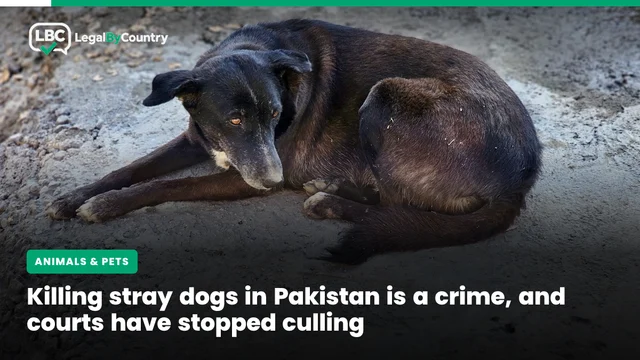
Is It Legal to Kill Stray Dogs in Pakistan?
No. Shooting, poisoning or beating a stray dog can be charged under sections 428 and 429 of the Pakistan Penal Code and provincial cruelty laws. High Courts have stopped municipal culling in Punjab and Islamabad, and only vets may euthanise rabid or incurable dogs.
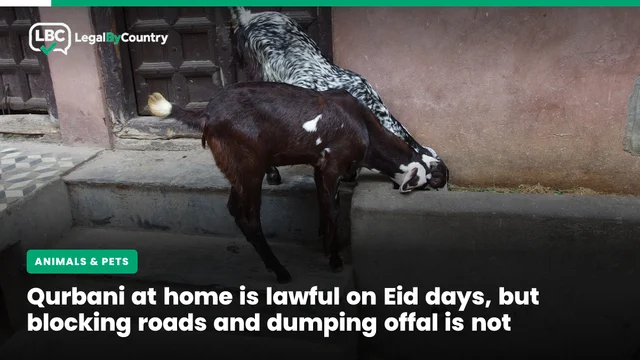
Is It Legal to Slaughter Animals in the Street During Eid in Pakistan?
Mostly yes, on Eid ul Adha and the two days after. Punjab's Animals Slaughter Control Act, 1963 and Balochistan's 2025 Act exempt qurbani from the slaughterhouse rule, but blocking roads, dumping offal or breaking a local Eid order can still bring fines.