

Can a Woman Get Khula Without Her Husband's Consent in Pakistan?
Yes. A Family Court can grant khula even if the husband refuses. See the case law, what dower is returned, timelines and the Union Council step.

Short answer: Yes, a court can grant it
Yes. Under the Family Courts Act, 1964 a Family Court can dissolve a marriage by khula once reconciliation fails, even if the husband refuses. The Supreme Court has upheld this since 1967, though the wife usually returns some or all of the dower.
- The law
Family Courts Act, 1964, ss. 5, 7(2), 10(4), 12A, 14(2), Schedule item 1
Punjab Family Courts (Amendment) Act 2015, ss. 8, 10, 17-A, 21-B as inserted
Dissolution of Muslim Marriages Act, 1939, ss. 2, 5
Muslim Family Laws Ordinance, 1961, ss. 7, 8
- Penalty
- Khula is a civil remedy, not an offence: the price is financial, as the federal proviso to section 10(4) of the Family Courts Act, 1964 tells the court to restore to the husband the haq mehr the wife received at marriage.
General information only, not legal advice. For help with your own matter, consult a qualified lawyer or legal consultant. Read the disclaimer
A family court can end the marriage even when the husband says no
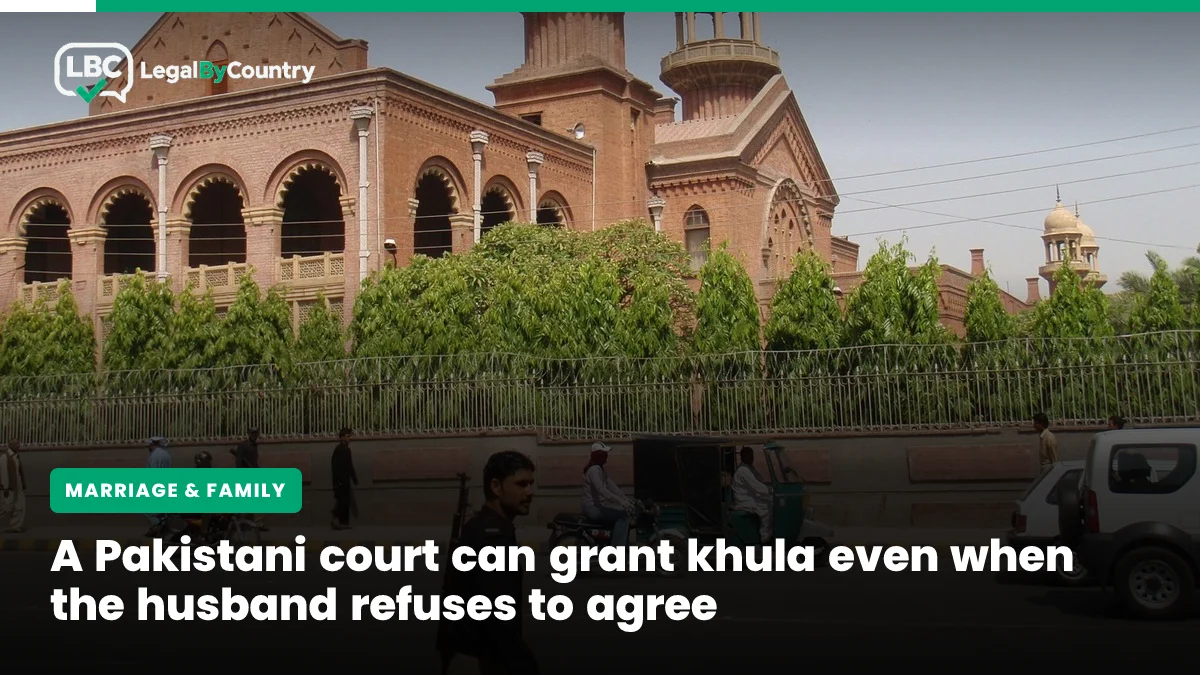
A woman files a suit at the family court, the husband turns up at the reconciliation hearing and says he will never divorce her. A khula without the husband's consent in Pakistan is still lawful: once reconciliation fails, the court itself dissolves the marriage.
The scene above plays out in family courts every working day, and the husband's refusal is usually the first thing a wife is told will stop her. Pakistani law says otherwise. The Family Courts Act, 1964 lists "Dissolution of marriage, including Khula" as the first item in its Schedule, which means a Family Court has exclusive power to hear it. The husband is a defendant in the case, not a gatekeeper.
Khula is the wife's route out of a marriage when she does not want to, or cannot, prove a fault such as cruelty. In return, she usually gives back the dower (haq mehr) or other benefits she received. The rest of this guide covers where the right comes from, what she may have to return, how long the case takes and what happens at the Union Council afterwards.
Courts have treated khula as the wife's right since 1967
The Supreme Court held in Khurshid Bibi v. Muhammad Amin, PLD 1967 SC 97, that a court can dissolve a marriage by khula even if the husband does not agree. The Federal Shariat Court has twice refused to declare that rule un-Islamic.
Before 1967, some courts followed the older view that khula needed the husband's agreement. The Khurshid Bibi judgment changed that, and a research paper published by the Federal Shariat Court notes that it "at present holds the field". The same paper records a later Supreme Court holding, Abdul Raheem v. Mst. Shahida Khan, PLD 1984 SC 329, that a person in authority, including a Qazi, "can order separation by Khula even if husband was not agreeable".
The Federal Shariat Court has upheld the rule
- Saleem Ahmad v. Government of Pakistan, PLD 2014 FSC 43: a Full Bench held that the Quranic verses relied on by challengers "do not specifically create a bar" on a court decreeing khula when reconciliation fails. The court asked why courts should not be able to decide khula "if a husband does not at all agree".
- Khurram Shehzad, Shariat Petition 11-I of 2022 (7 February 2023): a husband argued that section 10(4) of the Family Courts Act was un-Islamic because khula was granted without his consent. The court dismissed the petition and followed Saleem Ahmad.
- Haji Saif-ur-Rahman Shaheen, Shariat Petition 16-I of 2022 (judgment 6 October 2023): the court called khula "an absolute and a unique right" of women and said the right "cannot be denied by the court of law".
Federal Shariat Court decisions on whether a law matches Islamic injunctions bind every High Court and the courts below them under Article 203GG of the Constitution, a point the October 2023 judgment made expressly.
The Supreme Court repeated the point in 2025
In Dr. Seema Hanif Khan v. Waqas Khan (2025 SCP 392), a bench of Justice Ayesha A. Malik and Justice Naeem Akhtar Afghan described khula as an "independent and inalienable right" that does not depend on the husband's willingness to release his wife, The Express Tribune reported on 24 October 2025.
The Council of Islamic Ideology took the opposite view in February 2016 and called khula without the husband's consent un-Islamic, The Express Tribune reported on 19 February 2016. The Council only advises Parliament. Its opinion did not change the Family Courts Act, and the courts have not followed it.
Khula has to be the wife's own choice, not the court's
The husband cannot block khula, but a court cannot impose it either. Since 2025 the Supreme Court has set aside decrees where a family court turned a wife's fault-based divorce claim into khula without her clear consent, because that switch can cost her the dower.
A wife can ask for dissolution in two different ways. Under section 2 of the Dissolution of Muslim Marriages Act, 1939 she proves a ground, such as cruelty, two years without maintenance, or a second marriage without Arbitration Council permission. Section 5 of that Act says nothing in it affects her right to dower. Khula needs no proof of fault, but usually means giving something back.
- January 2026: a bench headed by Chief Justice Yahya Afridi held that family courts "should not, on their own motion and without the statement of the wife, convert the demand for divorce into khula", and awarded the wife her full unpaid dower of Rs 1.2 million, Dawn reported on 25 January 2026.
- May 2026: a three-member bench held that khula cannot be granted without the wife's clear, informed and unambiguous consent, and sent the case back for the family court to record her choice, ARY News reported on 24 May 2026.
- October 2026: a five-member bench held that failing to prove cruelty does not let a court choose khula on the wife's behalf, and recognised serious, lasting marital breakdown (shiqaq) as a possible ground under section 2(ix) of the 1939 Act, The Express Tribune reported on 8 October 2026.
| Route | Who starts it | Husband's consent needed? | Dower | Main law |
|---|---|---|---|---|
| Khula | Wife, through the Family Court | No | Usually returned or given up, as the court decides | Family Courts Act 1964, s. 10 |
| Dissolution on a proved ground | Wife, through the Family Court | No | Kept: s. 5 of the 1939 Act protects it | Dissolution of Muslim Marriages Act 1939, s. 2 |
| Talaq-e-tafweez (delegated divorce) | Wife, if the nikahnama gives her the right | No, already given in the nikahnama | Kept | Muslim Family Laws Ordinance 1961, s. 8 |
| Talaq | Husband | Not applicable | Payable in full | Muslim Family Laws Ordinance 1961, s. 7 |
If the husband married again without permission, the wife has her own ground under section 2(ii-a) of the 1939 Act, explained in our guide to second marriage without the first wife's permission. Abuse is a separate ground too, and our guide on whether domestic violence is a crime covers the criminal side.
What the wife gives back depends on where she lives
Outside Punjab, the federal text tells the court to restore to the husband the haq mehr received at marriage. Punjab's 2015 percentage formula was struck down by the Federal Shariat Court in 2022, so Punjab courts now decide the amount case by case.
In the federal text of section 10(4), as amended by Ordinance LV of 2002, the proviso says the Family Court, "if reconciliation fails, shall pass decree for dissolution of marriage forthwith and shall also restore to the husband the Haq Mehr received by the wife in consideration of marriage at the time of marriage". Section 9(1b) applies the same proviso when a wife claims khula in reply to her husband's suit for restitution of conjugal rights.
Punjab rewrote section 10 through the Punjab Family Courts (Amendment) Act 2015 (Act XI of 2015). Its new section 10(5) let the court direct the wife to surrender up to 50 percent of her deferred dower or up to 25 percent of her admitted prompt dower. On 17 February 2022 the Federal Shariat Court declared section 10(5) and (6) repugnant to Islamic injunctions in the case reported as PLD 2022 FSC 25, with effect from 1 May 2022, as the Court's own October 2023 judgment records. The Press Information Department announced the decision on 17 February 2022.
| Where | Rule on dower in khula | Source | As of |
|---|---|---|---|
| Islamabad, Sindh, Khyber Pakhtunkhwa, Balochistan | Court restores to the husband the haq mehr the wife received at the time of marriage | Family Courts Act 1964, s. 10(4) proviso (federal text, updated till 17 January 2025) | 16 November 2026 |
| Punjab, 2015 to 30 April 2022 | Up to 50% of deferred dower or up to 25% of admitted prompt dower surrendered | Punjab Family Courts (Amendment) Act 2015, s. 10(5) | No longer in force |
| Punjab, from 1 May 2022 | No fixed formula. If the wife offers back the entire dower she received, the court must grant khula after a chance to reconcile. Otherwise the court fixes the amount on the evidence and who caused the breakdown | Federal Shariat Court, PLD 2022 FSC 25, as explained in Shariat Petition 16-I of 2022 | 16 November 2026 |
Courts look at why the marriage broke down
Calling a decree khula does not automatically wipe out the wife's dower. In July 2026 Justice Mohsin Akhtar Kayani of the Lahore High Court held that where the husband's cruelty or failure to maintain caused the breakdown, "the wife retains her entitlement to dower and the husband cannot demand its return", Dunya News reported on 27 July 2026. The same ruling noted that the struck-down Punjab provisions have not been replaced by new legislation.
Personal belongings and gifts are a different matter from dower. The October 2025 Supreme Court judgment said gold and dower items should be returned to the wife unless there is a valid reason not to, and the Schedule to the Act lists "personal property and belongings of wife" as a separate family claim.
The law sets a six-month target for the whole case
Section 12A of the Family Courts Act tells the court to decide a case, including a suit for dissolution of marriage, within six months of filing. If it does not, either side may ask the High Court for directions. Real cases often take longer.
A khula suit usually ends at the pre-trial stage. Section 10 requires the court to try for a compromise first. Once reconciliation fails, the federal proviso says the decree is passed "forthwith", so a full trial with witnesses is often not needed when khula is the only relief claimed. In Punjab, the 2015 Act also tightened the early timetable.
| Step | Time limit in the Act | Section | As of |
|---|---|---|---|
| Summons sent to the husband (Punjab) | Within 2 days of filing; also by affixation and newspaper proclamation | s. 8(1)(b) and (c), as substituted in Punjab in 2015 | 16 November 2026 |
| First date for the husband to appear (Punjab) | Not more than 15 days ahead | s. 8(1)(a), Punjab | 16 November 2026 |
| Whole case decided | 6 months from filing | s. 12A | 16 November 2026 |
| Decree sent to the Union Council chairman (Punjab) | Not later than 3 days after the decree | s. 21-B, inserted in Punjab in 2015 | 16 November 2026 |
| Appeal decided, where one lies | 4 months | s. 14(4) | 16 November 2026 |
A husband who avoids the summons does not stall the case for ever: Punjab's section 8 allows service by post, courier, electronically, by affixation and by newspaper. Under section 14(2)(a), no appeal lies from a decree for dissolution of marriage except one based on clause (viii)(d) of the 1939 Act, so a khula decree is usually challenged, if at all, only through a writ petition in the High Court. The court fee for any suit or appeal under the Act is Rs 15 under section 19 (federal text, as of 16 November 2026).
The Union Council step finishes the divorce
A khula decree is not the last step. The Union Council chairman receives the decree, tries reconciliation through an Arbitration Council and, after the 90-day period that applies to talaq, issues the certificate a woman needs before remarrying or updating NADRA records.
Section 8 of the Muslim Family Laws Ordinance, 1961 says that where a party wishes to dissolve a marriage "otherwise than by talaq", section 7 applies "mutatis mutandis and so far as applicable". Section 7 requires notice to the chairman, an Arbitration Council within 30 days and a 90-day wait, extended to the end of a pregnancy. Punjab spells out the link: under section 21-B the chairman must "proceed as if he had received intimation of Talaq". Our guide to whether triple talaq is legal explains how that 90-day process works.
Khula ends the marriage as one irrevocable divorce. The Federal Shariat Court noted in February 2023 that the couple may later remarry each other by mutual consent, without an intervening marriage, and that the wife must observe iddat before marrying someone else.
Custody and maintenance are decided on their own
Khula settles the marriage, not the children. Custody, child maintenance and the wife's unpaid maintenance are separate claims in the same Family Court, and courts decide custody on the welfare of the child, not on who asked for the divorce.
- Custody: section 25 of the Family Courts Act makes the Family Court a District Court for the Guardians and Wards Act, 1890. Section 17 of that Act tells the court to be guided by "the welfare of the minor", having regard to age, sex and religion.
- Child maintenance: a father's duty to maintain his children does not end with khula. In Punjab, section 17-A requires the court to fix interim monthly maintenance at the husband's first appearance, and an amount fixed by decree rises by 10 percent a year if the court sets no other rate.
- Past maintenance: maintenance owed for the period of the marriage can be claimed in the same proceedings. The October 2025 Supreme Court judgment called it a statutory obligation that cannot be denied on a presumption of disobedience.
Under the proviso to section 7(2) of the Family Courts Act, a plaint for dissolution of marriage may include claims for dowry, maintenance, dower, personal property, custody of children and visitation, which saves a second round of hearings.
The lawful route to khula has seven steps
A wife files in the Family Court, attends the reconciliation hearing, states that she wants khula, and then follows the decree through the Union Council. A lawyer helps, and section 18 allows a woman who observes purdah to appear through an authorised agent.
- Gather the nikahnama, both CNICs, details of dower paid and unpaid, and the husband's current address.
- Decide, with advice, whether to claim khula or dissolution on a proved ground under the 1939 Act, because the choice affects the dower.
- File the plaint in the Family Court with a list of witnesses and documents, adding any claims for custody, maintenance or personal belongings. Section 5 of the Act gives the Family Court exclusive jurisdiction over these matters.
- Make sure the summons reaches the husband. If he avoids it, ask the court for substituted service.
- Attend the pre-trial hearing and reconciliation. If you choose khula, say so clearly on the record, as the Supreme Court now requires.
- Comply with any order on returning dower or benefits, and collect a certified copy of the decree.
- Make sure the decree reaches the Union Council chairman, complete the 90-day period and collect the divorce certificate before remarrying or updating NADRA.
Find more on marriage, divorce and custody in our family law guides.
Frequently asked questions
Can a husband stop his wife from getting khula?
+
No. Once reconciliation fails, the Family Court can dissolve the marriage by khula without his agreement. The Supreme Court has held this since Khurshid Bibi v. Muhammad Amin in 1967, and the Federal Shariat Court has refused to declare it un-Islamic.
Does a woman have to return the haq mehr in khula?
+
Usually some or all of it. Outside Punjab the federal text says the court restores the haq mehr she received at marriage. In Punjab the court decides the amount on the evidence, and courts have kept dower with the wife where the husband's cruelty caused the breakdown.
How long does khula take in Pakistan?
+
The Family Courts Act tells the court to decide the case within six months of filing, and a khula decree often comes at the pre-trial stage once reconciliation fails. After the decree, the Union Council process adds a 90-day period before the divorce certificate.
What if the husband does not appear in court?
+
The case can still go ahead. In Punjab the summons can be served by post, courier, electronically, by affixation and by newspaper proclamation, and the court can proceed if he stays away after proper service.
Can a court turn my divorce case into khula without asking me?
+
No. In 2026 the Supreme Court held several times that a family court cannot convert a fault-based dissolution suit into khula without the wife's clear and informed consent, because the switch can cost her the dower.
Can the husband appeal a khula decree?
+
Generally not. Section 14(2)(a) of the Family Courts Act bars appeals against a decree for dissolution of marriage, except one based on clause (viii)(d) of the 1939 Act. Husbands sometimes file writ petitions in the High Court instead.
Who gets custody of the children after khula?
+
Custody is decided separately, on the welfare of the child. The Family Court acts as a District Court under the Guardians and Wards Act, 1890, which tells it to weigh the child's age, sex, religion and welfare.
Can a couple remarry after khula?
+
Yes, by mutual consent. The Federal Shariat Court has noted that khula operates as a single irrevocable divorce, so the same couple can remarry without an intervening marriage, while the wife observes iddat before marrying anyone else.
Sources
We compiled this guide from official sources: the law itself, government notifications and court records, checked against reporting of recent changes. It is for information only.
- Family Courts Act, 1964 (updated till 17.1.2025) · Ministry of Law and Justice (Pakistan Code)
- Punjab Family Courts (Amendment) Act 2015 (Act XI of 2015), Gazette of the Punjab (Extraordinary), 18 March 2015 · Provincial Assembly of the Punjab
- Dissolution of Muslim Marriages Act, 1939 · Ministry of Law and Justice (Pakistan Code)
- Muslim Family Laws Ordinance, 1961 · Ministry of Law and Justice (Pakistan Code)
- Guardians and Wards Act, 1890 · Ministry of Law and Justice (Pakistan Code)
- Haji Saif-ur-Rahman Shaheen v. Islamic Republic of Pakistan, Shariat Petition No. 16/I of 2022 (judgment 6 October 2023) · Federal Shariat Court of Pakistan
- Khurram Shehzad v. Federation of Pakistan, Shariat Petition No. 11-I of 2022 (order 7 February 2023, following Saleem Ahmad, PLD 2014 FSC 43) · Federal Shariat Court of Pakistan
- Research paper: Dissolution of Muslim Marriage Act, 1939 (discussing Khurshid Bibi, PLD 1967 SC 97, and Abdul Raheem, PLD 1984 SC 329) · Federal Shariat Court of Pakistan
- PR No. 171: Federal Shariat Court judgment on Section 10(5) and (6) of the Family Courts Act, 1964 (17 February 2022) · Press Information Department, Government of Pakistan
- SC affirms women's right to khula, rules it independent of husband's consent (24 October 2025) · The Express Tribune
- Courts should not convert divorce cases into 'khula': SC (25 January 2026) · Dawn
- Consent of wife essential for Khula, Supreme Court rules (24 May 2026) · ARY News
- LHC rules women abused by husbands retain dower after divorce (27 July 2026) · Dunya News
- SC bars forced conversion of dissolution pleas into khula (8 October 2026) · The Express Tribune
- Husband's consent needed for Khula: CII (19 February 2016) · The Express Tribune
Advocate, Supreme Court of Pakistan
Advocate of the Supreme Court of Pakistan and the Lahore High Court, former Assistant Advocate General Punjab and Assistant Attorney General for Pakistan, and adjunct professor of law in Lahore.
Full profile and credentials →
Is Triple Talaq Legal in Pakistan?
Not as an instant divorce. Pronouncing triple talaq is not a crime, but section 7 of the Muslim Family Laws Ordinance, 1961 treats it like any talaq: written notice to the Union Council Chairman, then 90 days before it takes effect.
Is a Second Marriage Legal Without the First Wife's Permission in Pakistan?
No. Section 6 of the Muslim Family Laws Ordinance, 1961 requires the Arbitration Council's prior written permission. Marrying without it makes the whole dower payable at once and risks up to a year in jail, though courts usually treat the second nikah as valid.
Is Domestic Violence a Crime in Pakistan?
Yes. Hurting or threatening a family member is a crime under the Pakistan Penal Code everywhere. Islamabad, Sindh, Punjab, Khyber Pakhtunkhwa and Balochistan also have domestic violence laws giving survivors protection orders, and Islamabad, Sindh and KP punish some abuse directly.
Is Adoption Legal in Pakistan?
Not in the full legal sense for Muslims. Pakistan has no adoption statute, but a family court can appoint you a child's guardian under the Guardians and Wards Act, 1890. The child keeps their birth lineage and does not inherit automatically.