

Is Domestic Violence a Crime in Pakistan?
Yes. Abuse at home is a crime under the Penal Code, and every province has a protection law. See penalties, protection orders and helplines.

Short answer: A crime across Pakistan
Yes. Hurting or threatening a family member is a crime under the Pakistan Penal Code everywhere. Islamabad, Sindh, Punjab, Khyber Pakhtunkhwa and Balochistan also have domestic violence laws giving survivors protection orders, and Islamabad, Sindh and KP punish some abuse directly.
- The law
Domestic Violence (Prevention and Protection) Act, 2026 (Act X of 2026, Islamabad Capital Territory), ss. 3, 4, 5, 6, 8, 9, 12
Domestic Violence (Prevention and Protection) Act, 2013 (Sindh Act XX of 2013), ss. 5, 6, 7, 9, 11, 12, 15
Punjab Protection of Women against Violence Act 2016 (Act XVI of 2016), ss. 2, 4, 5, 7, 8, 9, 13, 14, 19, 20
Khyber Pakhtunkhwa Domestic Violence against Women (Prevention and Protection) Act, 2021 (Act III of 2021), ss. 2, 3, 12, 14, 15, 17
- Penalty
- Hurt at home is punished under the Penal Code, up to seven years for hurt that endangers life under section 337L(1), and section 3 of the KP Act of 2021 adds one to five years in prison for domestic violence against a woman.
General information only, not legal advice. For help with your own matter, consult a qualified lawyer or legal consultant. Read the disclaimer
Domestic violence is a crime in every part of Pakistan
A woman in Rawalpindi tells her sister the bruises came from a fall. Her sister knows better. Domestic violence is a crime in Pakistan: the Penal Code punishes hurt and threats at home everywhere, and every province now has its own protection law.
Two layers of law work together. The first is the Pakistan Penal Code, 1860, which has never made an exception for husbands, fathers or in-laws. Slapping, beating, burning or threatening a family member is the same offence it would be against a stranger.
The second layer is a set of domestic violence laws that give survivors something the Penal Code does not: a court order that keeps the abuser away, lets the survivor stay in the home and makes him pay for medical bills and lost income. Islamabad, Punjab, Sindh, Khyber Pakhtunkhwa and Balochistan each have one, and they differ in who they protect, which court hears the case and how fast it must decide.
A survivor does not need to show years of abuse. One act of hurt, or one serious threat, is enough for a police case, and most of these laws let a court act when violence is likely, not only after it happens.
The Penal Code already punishes most abuse at home
Every slap, punch, shove or threat inside a home is an offence under the Pakistan Penal Code. The police can register a First Information Report for hurt, assault and criminal intimidation whatever the relationship, and the punishment depends on the injury, not the family tie.
The table shows the sections police most often use when violence happens at home. The figures are the maximum prison terms in the Penal Code as published on Pakistan Code, checked on 16 November 2026.
| What happened | Penal Code section | Maximum punishment (as of 16 November 2026) |
|---|---|---|
| Assault or criminal force, such as a slap or a push | s. 352 | 3 months, or a fine up to Rs 1,500, or both |
| Assault on a woman intended to outrage her modesty | s. 354 | 2 years, or a fine, or both |
| A wound that bleeds (damiyah) | s. 337F(i) | 1 year plus daman (compensation) |
| A head or face injury without exposing bone (shajjah-i-khafifah) | s. 337A(i) | 2 years plus daman |
| Other hurt that endangers life or causes 20 days of severe pain | s. 337L(1) | 7 years plus daman |
| Threats to harm someone | s. 506 | 2 years; 7 years if the threat is to kill, cause grievous hurt or impute unchastity to a woman |
| Words, gestures or conduct that insult a woman's modesty or harass her | s. 509 | 3 years, or a fine up to Rs 500,000, or both |
More serious acts, such as acid attacks, burning, wrongful confinement and killing, carry far heavier sentences under their own sections. A medical examination soon after an injury matters, because the type of hurt recorded by the doctor decides which of these sections applies.
Each province and Islamabad has its own domestic violence law
Islamabad, Sindh, Punjab, Khyber Pakhtunkhwa and Balochistan have each passed a separate domestic violence law. They all offer protection orders, but they protect different people, send cases to different courts and set different time limits for a decision.
| Where you live | Law | Who it protects | Which court | Time limit for the court |
|---|---|---|---|---|
| Islamabad Capital Territory | Domestic Violence (Prevention and Protection) Act, 2026 (Act X of 2026) | Women, men, transgender persons, children, older and disabled people | Family Court with first class magistrate powers | First hearing within 7 days, decision within 90 days |
| Sindh | Domestic Violence (Prevention and Protection) Act, 2013 (Sindh Act XX of 2013) | Women, children and vulnerable persons | Judicial Magistrate of the first class | First hearing within 7 days, decision within 90 days |
| Punjab | Punjab Protection of Women against Violence Act 2016 (Act XVI of 2016) | Women only | Family Court | First hearing within 7 days, decision within 90 days "as nearly as possible" |
| Khyber Pakhtunkhwa | Domestic Violence against Women (Prevention and Protection) Act, 2021 (Act III of 2021) | Women only | Sessions or Additional Sessions Judge notified by the Peshawar High Court | Apply within 15 days of the incident, decision within 60 days |
| Balochistan | Domestic Violence (Prevention and Protection) Act, 2014 (Act VII of 2014) | Women, children, men, vulnerable persons and domestic workers | Sub Divisional Magistrate with first class powers | First hearing within 3 days, decision within 30 days |
Islamabad: the 2026 Act punishes abuse that is not already a Penal Code crime
Parliament passed the Domestic Violence (Prevention and Protection) Act, 2026 in a joint sitting, and the President assented on 26 January 2026. Section 3 covers physical, psychological and sexual abuse. Psychological abuse includes insults, stalking, threats of divorce or a second marriage on a baseless claim of insanity or infertility, false allegations against a woman's character and wilful abandonment.
Under section 4, abuse that is not already a Penal Code offence carries simple imprisonment of six months to three years, plus a fine of Rs 20,000 to Rs 100,000 paid to the survivor as compensation. Where the act is a Penal Code offence, such as hurt, the Penal Code punishment applies instead. Anyone who aids or abets the abuse faces the same punishment.
Sindh: the first province to pass a domestic violence law
The Sindh Act of 2013 lists Penal Code offences such as assault, hurt and wrongful confinement as domestic violence and adds new ones in section 6. Emotional and verbal abuse carries at least six months or compensation of at least Rs 10,000. Stalking carries at least one year or Rs 20,000, and sexual abuse at least two years or Rs 50,000.
Punjab: protection centres and GPS trackers
The Punjab Act of 2016 covers women only. It defines violence widely, including domestic, sexual, psychological and economic abuse, stalking and cybercrime. It does not create a new offence of domestic violence: the abuse itself is prosecuted under the Penal Code, and the Act adds protection, residence and monetary orders on top.
The Act also sets up Violence against Women Centres. Section 13 makes each one a single point for police reporting, registration of cases, medical examination, evidence collection, legal aid and counselling. The first centre opened in Multan, and the Act requires more through a phased programme, so ask the District Women Protection Officer which services operate in your district.
Khyber Pakhtunkhwa: one to five years in prison
Under section 3 of the KP Act of 2021, committing or abetting domestic violence against a woman is an offence punishable with one to five years in prison plus a fine. The Act defines violence as physical, psychological, emotional and economic abuse, and it routes complaints through a District Protection Committee in each district.
Balochistan: domestic workers are covered too
The Balochistan Act of 2014 protects anyone in a domestic relationship, including domestic help, and lists assault, criminal force, hurt, harassment, stalking, economic abuse and verbal abuse as domestic violence. The abuse is punished under the Penal Code, while the Act gives fast protection orders and penalises anyone who breaks them.
A protection order keeps the abuser away while the case runs
A protection order is a court order telling the abuser to stop the violence, stay away and stop contacting the survivor. Every one of the five laws allows one, and every one lets the court make an interim order before the full hearing.
Depending on the law, the court can order the abuser to:
- stop all violence and stop helping anyone else commit it;
- stay away from the survivor, her workplace and her children's school, and keep a set distance;
- stop calling, texting or messaging her in any form;
- leave the house where his violence puts her life or dignity in danger (Islamabad and Punjab);
- wear an ankle or wrist GPS tracker after grave violence, and surrender his firearms (Punjab, section 7);
- return her property, jewellery and documents;
- pay her medical costs, lost earnings and maintenance for her and the children.
A survivor cannot be thrown out of the shared home simply because the house is in the husband's or in-laws' name. Section 6 of the Islamabad Act gives her the right to live there "whether or not" she owns any share of it, and Sindh, Punjab and Balochistan protect her against eviction except in accordance with law. She can also choose a shelter instead.
In Punjab, a Women Protection Officer does not have to wait for the court in an emergency. Section 14(3)(d) lets the officer direct the abuser to leave the house for up to 48 hours to protect the woman's life, dignity or reputation.
Breaking a protection order is a separate offence
An abuser who ignores a protection order commits a fresh offence, on top of the violence itself. The penalties are set in each law, and Punjab and Balochistan punish repeat breaches more heavily than a first one.
| Law | Penalty for breaching an order (as of 16 November 2026) |
|---|---|
| Islamabad Act 2026, s. 12 | Imprisonment of one year and a fine of Rs 100,000 paid to the survivor. Cognizable, bailable and compoundable. |
| Sindh Act 2013, s. 15 | Up to one year, or a fine up to Rs 20,000, or both. Cognizable, bailable and compoundable. |
| Punjab Act 2016, s. 20 | Up to one year, or a fine of Rs 50,000 to Rs 200,000, or both. A repeat breach: one to two years and a fine of Rs 100,000 to Rs 500,000. |
| KP Act 2021, s. 17 | Up to one year, or a fine up to Rs 300,000, or both. |
| Balochistan Act 2014, s. 13 | Six months to one year and a fine of at least Rs 100,000. A repeat breach: one to two years and at least Rs 200,000. Cognizable, non-bailable and compoundable. |
"Cognizable" means the police can arrest without a warrant. Keep a copy of the order with you, because the court sends one to the local police station, and the police are expected to help enforce it.
Two laws also punish lying. Section 19 of the Punjab Act sets up to three months or a fine of Rs 50,000 to Rs 100,000 for a complaint the maker knows is false, and section 25 of the Balochistan Act sets up to six months or Rs 50,000. A true complaint made in good faith carries no risk.
Getting protection lawfully takes a few clear steps
A survivor can go to the police, to the court, or to the protection officer or committee set up under her provincial law. Doing more than one at once is normal: an FIR covers the crime, and a protection order covers her safety.
- Get safe first. In immediate danger, call the police on 15. Go to a relative's home, a shelter or, in Punjab, a Violence against Women Centre if one serves your district.
- Get a medical examination. Ask a government hospital for a medico-legal examination as soon as possible after any injury. Photograph injuries and keep prescriptions.
- Report the crime. Ask the police station to register an FIR for the Penal Code offence, such as hurt or criminal intimidation. Get a free copy of the FIR.
- Apply for a protection order. File a petition in the court named in your provincial law, yourself or through someone you authorise. In Islamabad the petition goes through a Protection Officer; in Punjab a Women Protection Officer can file it for you; in KP, file within 15 days of the incident.
- Ask for residence and money orders too. Request the right to stay in the home, the return of your belongings and payment of medical costs and maintenance in the same petition.
- Keep records. Save threatening messages, voice notes and the names of witnesses. Keep copies of every court order.
- Report every breach. If the abuser breaks the order, report it to the police and the court at once, because breach is a separate offence.
Free legal advice is available by phone before you file anything, and a lawyer is not required to make the first call. Questions about leaving the marriage, such as khula without the husband's consent, are separate from the protection case and can run alongside it. Our family law guides cover marriage, divorce and custody in more detail.
Helplines answer survivors free of charge
Pakistan has a national legal advice helpline and separate provincial women's helplines. The numbers below come from each government department's own website, checked on 16 November 2026. In immediate danger, call the police on 15 first.
| Helpline | Number | Run by |
|---|---|---|
| Police emergency | 15 | Provincial and Islamabad police |
| Human rights legal advice, nationwide | 1099 (toll free) | Ministry of Human Rights |
| Punjab Women's Toll-Free Helpline | 1043 (24 hours a day, 7 days a week) | Punjab Commission on the Status of Women |
| Sindh women's complaints helpline | 1094 | Women Development Department, Sindh |
| Bolo Helpline, Khyber Pakhtunkhwa | 0800-22227 (toll free) | Social Welfare, Special Education and Women Empowerment Department, KP |
The 1099 helpline gives free legal advice, counselling and referrals from anywhere in the country. The Punjab 1043 line is staffed by women call agents and legal advisers. KP's Bolo Helpline refers callers to counselling, legal aid, shelter, police protection and medical care. We could not confirm a dedicated provincial women's helpline for Balochistan on an official site, so survivors there should call 15 or 1099.
The law on paper is stronger than the help on the ground
Each law depends on officers, committees and shelters that governments have been slow to set up. A survivor may find that the protection officer named in the Act has not been appointed, so the police and the courts remain the most reliable route.
- Punjab: the 2016 Act came into force district by district. A December 2022 report said it had then been notified across the province after a Lahore High Court case, and it had earlier been notified only in Multan.
- Khyber Pakhtunkhwa: The Express Tribune reported on 23 October 2025 that, four years after the 2021 Act passed, the provincial government had yet to set up the district protection committees it requires.
- Islamabad: section 19 of the 2026 Act says protection officers are appointed after the federal government frames rules. We could not confirm that rules had been notified by 16 November 2026. The Islamabad High Court issued notices on a petition challenging the Act on 18 February 2026; the Act has not been suspended as far as we could find.
- KP definition of sexual abuse: the 2021 Act excludes "ordinary and natural relationships amongst husband and wife" from sexual abuse, which narrows what a wife can claim under that Act.
Gaps in the machinery do not change the core rule. Violence at home is a crime under the Penal Code in every district, and a court can order protection even where no committee meets. Threats used to control a spouse, such as threatening a second marriage without permission, are now abuse in their own right under the Islamabad and Sindh laws.
Frequently asked questions
Can a husband be arrested for beating his wife in Pakistan?
+
Yes. Beating a wife is hurt or criminal force under the Pakistan Penal Code, and police can register an FIR and arrest for these offences. Marriage is no defence, and the punishment depends on the injury recorded in the medical examination.
Is mental or emotional abuse a crime in Pakistan?
+
In some places, yes. The Islamabad Act of 2026 punishes psychological abuse that is not already a Penal Code offence with six months to three years, and the Sindh Act of 2013 sets at least six months or compensation for emotional and verbal abuse.
Can a wife be thrown out of her husband's house?
+
Not by force or without a lawful process. The Islamabad Act gives an aggrieved person the right to live in the shared household whether or not she owns it, and the Sindh, Punjab and Balochistan laws bar eviction except in accordance with law.
How quickly does a court decide a protection order?
+
It depends on where you live. Islamabad, Sindh and Punjab set a first hearing within 7 days and a decision within 90 days. Khyber Pakhtunkhwa sets 60 days, and Balochistan sets a first hearing within 3 days and a decision within 30 days.
Are men protected by domestic violence laws in Pakistan?
+
Yes in Islamabad and Balochistan, whose laws protect men as well as women, children and vulnerable people. The Punjab and Khyber Pakhtunkhwa laws protect women only, and Sindh covers women, children and vulnerable persons. The Penal Code protects everyone.
What happens if the abuser breaks a protection order?
+
He commits a separate offence. Each law sets its own penalty, up to one year in prison in most provinces, and Punjab and Balochistan punish repeat breaches with up to two years and higher fines. Report every breach to the police and the court.
What number do I call to report domestic violence in Pakistan?
+
Call the police on 15 in an emergency. For free legal advice, call the Ministry of Human Rights helpline on 1099. Punjab has the 1043 women's helpline, Sindh has 1094 and Khyber Pakhtunkhwa has the Bolo Helpline on 0800-22227.
Can I withdraw a domestic violence case later?
+
Some parts, yes. Breaching a protection order is compoundable under the Islamabad, Sindh and Balochistan laws, and you can ask the court to discharge an order. Whether a Penal Code hurt case can be settled depends on the section, so ask the court or a legal aid office.
Sources
We compiled this guide from official sources: the law itself, government notifications and court records, checked against reporting of recent changes. It is for information only.
- Domestic Violence (Prevention and Protection) Act, 2026 (Act No. X of 2026), Gazette of Pakistan, Extraordinary, 27 January 2026 · National Assembly Secretariat
- Domestic Violence (Prevention and Protection) Act, 2013 (Sindh Act No. XX of 2013) · Sindh Code, Government of Sindh
- Domestic Violence (Prevention and Protection) Act, 2013 and Rules, 2016 (amendments up to date) · Sindh Judicial Academy
- Punjab Protection of Women against Violence Act 2016 (Act XVI of 2016) · Law and Parliamentary Affairs Department, Government of the Punjab (Punjab Code)
- Khyber Pakhtunkhwa Domestic Violence against Women (Prevention and Protection) Act, 2021 (Act No. III of 2021) · KP Code, Government of Khyber Pakhtunkhwa
- Balochistan Domestic Violence (Prevention and Protection) Act, 2014 (Act VII of 2014) · Government of Balochistan
- Pakistan Penal Code, 1860 · Ministry of Law and Justice (Pakistan Code)
- Toll Free Helpline (1099) · Ministry of Human Rights, Government of Pakistan
- Helpline 1043 · Punjab Commission on the Status of Women
- Introduction (Helpline 1094) · Women Development Department, Government of Sindh
- Bolo Helpline 0800-22227 · Zakat, Ushr, Social Welfare, Special Education and Women Empowerment Department, Khyber Pakhtunkhwa
- IHC seeks govt response on plea challenging Domestic Violence Act (19 February 2026) · Dawn
- Four years on, K-P yet to enforce Domestic Violence Act 2021 (23 October 2025) · The Express Tribune
- Punjab Protection of Women Against Violence Act 2016 notified across Punjab (12 December 2022) · The Friday Times
Advocate, Supreme Court of Pakistan
Advocate of the Supreme Court of Pakistan and the Lahore High Court, former Assistant Advocate General Punjab and Assistant Attorney General for Pakistan, and adjunct professor of law in Lahore.
Full profile and credentials →
Can a Woman Get Khula Without Her Husband's Consent in Pakistan?
Yes. Under the Family Courts Act, 1964 a Family Court can dissolve a marriage by khula once reconciliation fails, even if the husband refuses. The Supreme Court has upheld this since 1967, though the wife usually returns some or all of the dower.
Is a Second Marriage Legal Without the First Wife's Permission in Pakistan?
No. Section 6 of the Muslim Family Laws Ordinance, 1961 requires the Arbitration Council's prior written permission. Marrying without it makes the whole dower payable at once and risks up to a year in jail, though courts usually treat the second nikah as valid.
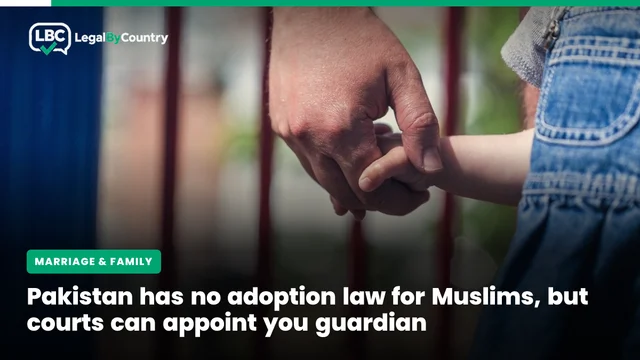
Is Adoption Legal in Pakistan?
Not in the full legal sense for Muslims. Pakistan has no adoption statute, but a family court can appoint you a child's guardian under the Guardians and Wards Act, 1890. The child keeps their birth lineage and does not inherit automatically.
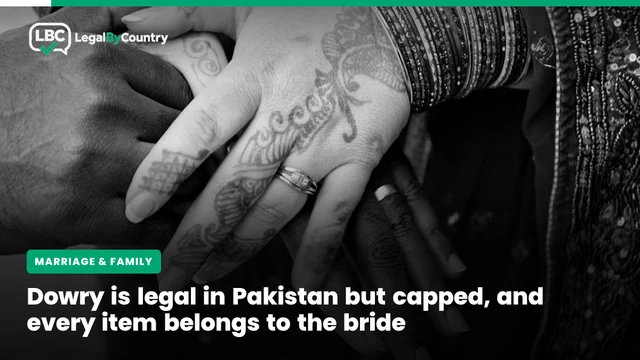
Is Dowry Legal in Pakistan?
Yes, but restricted. The Dowry and Bridal Gifts (Restriction) Act, 1976 caps dowry at Rs 5,000 and makes every article the bride's own property. Punjab bans displaying dowry, and Khyber Pakhtunkhwa punishes anyone on the groom's side who demands it.