

Is It Legal to Use a VPN in Pakistan?
Yes, using a VPN is not a crime, but PTA regulates them. See who must register, the licensed providers, the CII opinion and what is actually an offence.

Short answer: Not a crime, but regulated
Yes. No Pakistani law makes simply using a VPN an offence. PTA expects businesses and freelancers to register work VPNs free on its portal, licenses local VPN providers, and can disrupt unregistered traffic. Crimes committed through a VPN remain punishable under PECA 2016.
- The law
Prevention of Electronic Crimes Act, 2016 (as amended to 2025), ss. 11, 14, 20, 22, 26A, 27, 37, 43
Pakistan Telecommunication (Re-organization) Act, 1996, ss. 20, 31, 54
Constitution of the Islamic Republic of Pakistan, Arts. 229, 230
- Penalty
- Merely using a VPN carries no set penalty; crimes committed through one are punished under PECA, such as up to three years and a Rs 2 million fine for spreading fake information under section 26A, and providing an unlicensed telecom service carries up to three years or a Rs 10 million fine under section 31 of the 1996 Act.
General information only, not legal advice. For help with your own matter, consult a qualified lawyer or legal consultant. Read the disclaimer
Using a VPN in Pakistan is not a crime in itself
A freelancer in Lahore logs into her client's VPN before a morning call. So, is it legal to use a VPN in Pakistan? Yes. No statute makes using one an offence, but PTA regulates VPNs and expects commercial users to register.
We checked the federal statutes on Pakistan Code and PTA's own notices on 16 November 2026. Neither the Prevention of Electronic Crimes Act, 2016 (PECA) nor the Pakistan Telecommunication (Re-organization) Act, 1996 contains a section that punishes a person simply for connecting through a VPN.
That does not mean the state is relaxed about VPNs. Since 2024, PTA has run a registration system for businesses and freelancers, licensed local VPN companies, and blamed unregistered VPNs for network trouble. Connections that are not registered or licensed can be slowed or cut without notice. So the honest answer is "legal, but regulated", and the details depend on who you are and what you do through the connection. Our internet and phone guides for Pakistan cover the wider rules.
PTA's registration system is for businesses and freelancers
PTA runs a free online system where companies and freelancers register the VPNs they use for work. Registration whitelists your connection, which means PTA has a record of it and is meant to keep it working during disruptions. Ordinary personal users have no registration category.
How the system grew
- September 2024: PTA said VPNs were "not being blocked in Pakistan" and urged IT companies, software houses, freelancers and banks to register their IP addresses (Dawn, 10 September 2024).
- November 2024: PTA held a consultation on its "VPN registration framework" and moved registration to its own portal at ipregistration.pta.gov.pk (Dawn, 13 November 2024). PTA asked users to register by 30 November 2024.
- 16 November 2024: PTA's press release on the VPN registration process said registration is free, approvals usually take 8 to 10 hours, and more than 20,000 companies and freelancers had registered.
- December 2024: PTA added registration against a mobile number for freelancers without a fixed IP address (ProPakistani, 8 December 2024).
- January 2026: more than 30,000 entities and freelancers had registered since the portal opened (ProPakistani, 21 January 2026).
Who can register
PTA's November 2024 release names software houses, call centres, banks, embassies, members of the Pakistan Software Export Board and freelancers. Individuals who need a VPN "for commercial work" are told to apply as freelancers. A person who wants a VPN only for personal browsing does not fit any category.
What registration does and does not do
Registration protects a working connection. PTA's message since 2024 has been that registered users will not be affected "if a disruption occurs". Registration is not a permit you must hold before using a VPN, and no statute or notice we found sets a fine for failing to register.
Licensed local VPN companies are the newer route
Since 2025, PTA has licensed Pakistani companies to sell VPN services. Customers of a licensed provider do not need to register their own IP address or mobile number. Licensed providers must follow PTA's rules, which in a 2026 draft include identity checks and lawful interception.
On 18 April 2025, PTA announced it had granted three companies a "Class License for the Provision of Data Services" to offer VPNs, and advised all VPN providers "operating without a license" to get one (PTA press release). On 13 November 2025, PTA announced five licences under a reinstated CVAS-Data regime and said licensees could serve "individuals and organisations for legitimate and lawful purposes" (Dawn, 13 November 2025). By 21 January 2026, nine providers were licensed. PTA keeps a list of licensed VPN service providers on its website.
Reports disagree on one point. The same Dawn report says the licensed companies would serve only commercial clients, which would leave individual use "unlawful". PTA's own wording includes individuals. We found no notified rule settling this, so check the provider's terms and PTA's list before you buy.
The March 2026 draft licence
On 3 March 2026, PTA published a consultation paper on a draft class licence covering VPN services. The draft splits services into Corporate VPN and Public VPN, allows Public VPN for individuals, and would require licensees to:
- carry out CNIC or passport checks, and biometric checks where PTA requires them;
- keep records of VPN connections and deploy lawful interception systems;
- apply PTA's content-blocking lists and stop VPNs being used to reach blocked websites.
The paper is a consultation, not a final licence. As of 16 November 2026 we could not confirm that PTA has adopted it, so treat these terms as proposed.
No law names VPNs, and the Law Ministry said a ban had no legal basis
When the Interior Ministry asked PTA to block unregistered VPNs in November 2024, the Law Ministry advised that the government had "no legal standing to block VPNs". PTA then decided not to ban them after the 30 November deadline passed.
According to Dawn's report of 1 December 2024, the Law Ministry read PECA's power over unlawful online content as a power to block "content", not tools. That power now sits in section 37 of PECA, which lets the Authority remove or block access to information "in the interest of the glory of Islam or the integrity, security or defence of Pakistan", public order, decency or morality, contempt of court, or an offence under PECA. The section is about information, and it does not mention VPNs.
The 1996 Act gives the government wider network powers. Section 20 bars anyone from operating a telecom system or providing a telecom service without a PTA licence. Section 54 lets the Federal Government authorise interception "in the interest of national security", and after an emergency proclamation suspend a licensee's services. These powers explain why VPN traffic can be disrupted, but none of them makes a user's VPN connection an offence.
| Law or instrument | What it says that matters for VPNs | Status (checked 16 November 2026) |
|---|---|---|
| PECA 2016, s. 37 | Power to remove or block online information on listed grounds | In force; covers content, not tools, in the Law Ministry's 2024 reading |
| PECA (Amendment) Act 2025 | Created the Social Media Protection and Regulatory Authority and the s. 26A offence of spreading fake information | In force since January 2025; no VPN provision |
| Telecom Re-organization Act 1996, ss. 20 and 31 | Licence needed to provide a telecom service; offences carry up to three years or a fine up to Rs 10 million | In force; aimed at operators and providers |
| Telecom Re-organization Act 1996, s. 54 | Interception for national security; suspension of services in an emergency | In force |
| PTA registration portal | Free registration for companies and freelancers | Open |
| Draft class licence for VPN services | KYC, lawful interception, blocking lists for licensed providers | Consultation published 3 March 2026; final form not confirmed |
The Council of Islamic Ideology's VPN opinion has no legal force
In November 2024 the Council of Islamic Ideology called VPN use un-Islamic and asked the government to shut VPNs down. The Council is an advisory body. Its views can shape debate, but they do not create offences or bind courts, police or PTA.
Under Article 230 of the Constitution, the Council's job is to make recommendations and to advise Parliament, the assemblies, the President or a Governor. Only Parliament or a provincial assembly can turn a recommendation into law, and none has done so for VPNs.
The statement itself shifted within days. On 15 November 2024 the Council asked the government to shut down all VPNs, and its chairman, Dr Raghib Naeemi, said online theft is done through them (Dawn, 16 November 2024). On 18 November he clarified that misuse, not the technology, was the problem: "If you register the VPN, and do positive activity or even positive criticism, then there is no harm in it" (Dawn, 18 November 2024).
The X block and VPN slowdowns show how enforcement works in practice
Pakistan's VPN debate grew out of real blocks. The government cut access to X in February 2024, VPN use rose, and VPN connections were then slowed or disrupted at several points. The pattern has been network action against traffic, not arrests of ordinary users.
| Date | What happened | Source |
|---|---|---|
| 17 February 2024 | X blocked nationwide | Dawn |
| 18 August 2024 | IT state minister blamed heavy VPN use for slow internet and denied throttling | Business Recorder |
| 10 November 2024 | Nationwide VPN disruption; PTA called it a "technical glitch" and urged registration | Dawn |
| 1 December 2024 | PTA decides not to ban VPNs after Law Ministry advice | Dawn |
| 7 May 2025 | Access to X restored during the conflict with India | Dawn |
Courts also pushed back on the X block. On 17 April 2024 the Sindh High Court ordered the Interior Ministry to withdraw its 17 February 2024 letter telling PTA to block X (Digital Rights Monitor, 17 April 2024), but access stayed blocked until May 2025.
What you do through the VPN is what can be a crime
A VPN changes your data's route, not the law that applies to it. Under section 27 of PECA, an offence committed "through the use of an information system" is still an offence. Fraud, hate speech or fake news sent through a VPN stays punishable.
The offences most often linked to online activity are set out below, with the maximum penalties in the consolidated PECA text on Pakistan Code (checked 16 November 2026).
| Offence | Section | Maximum penalty |
|---|---|---|
| Spreading information you know is false and likely to cause fear, panic or unrest | PECA s. 26A | 3 years, fine up to Rs 2 million, or both |
| Hate speech advancing interfaith, sectarian or racial hatred | PECA s. 11 | 7 years, fine, or both |
| Electronic fraud for wrongful gain | PECA s. 14 | 2 years, fine up to Rs 10 million, or both |
| False information that harms a person's reputation or privacy | PECA s. 20 | 3 years, fine up to Rs 1 million, or both |
| Child sexual abuse material | PECA s. 22 | 14 to 20 years and a fine of at least Rs 1 million |
| Providing a telecom service without a licence | Re-organization Act ss. 20, 31 | 3 years, fine up to Rs 10 million, or both |
Section 43 of PECA makes the offences in sections 13, 14, 20, 22 and 26A, among others, cognizable, meaning the investigation agency can act without a court warrant, and non-bailable. Under section 31(5) of the 1996 Act, a court can take up an offence only on a written complaint from an officer authorised by PTA or the Frequency Allocation Board.
Viewing a blocked website through a VPN is a grey area. We found no section that makes simply viewing it a crime, but PTA's chairman told a Senate committee in late 2024 that individuals should not use VPNs to reach unauthorised websites. Sharing what you find can be an offence. The same logic applies to recording calls, which our guide on recording a phone call in Pakistan explains.
The lawful route is registration or a licensed provider
If you use a VPN for work, register it with PTA. The process is online and free, and PTA said in 2024 that approvals usually take 8 to 10 hours. If you are an individual, the safer option is a provider on PTA's licensed list.
For a company or freelancer, PTA's November 2024 release describes these steps:
- Get the IP address your VPN connects from. If you need a fixed IP, ask your internet service provider for one. Freelancers without a fixed IP can register a mobile number instead.
- Gather your CNIC, taxpayer status and company registration details, if you have a company.
- Freelancers: get a letter or email from your client or employer confirming the project.
- Create an account on PTA's VPN registration and IP whitelisting portal and fill in the form.
- Enter the IP address or mobile number, upload the supporting documents and submit.
- Keep the approval. If your IP, mobile number or client changes, register again.
PTA's helpline for registration questions is 0800-55055, as given in its November 2024 release. Check the portal for the current form before you apply, because PTA has changed the process several times since 2024. Our editorial policy explains how we check rules like these, and a lawyer can advise on your own situation.
Frequently asked questions
Can I be arrested just for using a VPN in Pakistan?
+
No law we could find makes simply using a VPN an offence, so there is no arrest power for that alone. Arrests follow offences committed through the VPN, such as fraud, hate speech or spreading fake information under PECA 2016.
Do ordinary people need to register a VPN with PTA?
+
No. PTA's registration portal has categories for companies and freelancers who use VPNs for work, not for personal browsing. Individuals who want a regulated option can use a provider on PTA's list of licensed VPN service providers.
How much does PTA VPN registration cost?
+
Nothing. PTA's press release of 16 November 2024 says VPN registration is free and approvals usually take 8 to 10 hours. If you need a fixed IP address, your internet service provider may charge for that separately.
Can a freelancer register a VPN without a fixed IP address?
+
Yes. Since December 2024, PTA has let freelancers register a VPN against a mobile number on its portal. You still need your CNIC and a letter or email from your client or employer confirming the project.
Is the Council of Islamic Ideology's VPN fatwa legally binding?
+
No. Under Article 230 of the Constitution, the Council only advises and recommends. Its November 2024 statement on VPNs did not become law, and its chairman later said registered VPNs used for positive purposes caused no harm.
Is it illegal to open a blocked website through a VPN?
+
We found no section that makes simply viewing a blocked site a crime, but PTA has said individuals should not use VPNs for this. Sharing unlawful content you find there can be an offence under PECA 2016.
Did PECA's 2025 amendment ban VPNs?
+
No. The Prevention of Electronic Crimes (Amendment) Act, 2025 created a new social media authority and the section 26A offence of spreading fake information, but it contains no provision on VPNs.
Can I sell VPN services in Pakistan without a licence?
+
No. Section 20 of the Pakistan Telecommunication (Re-organization) Act, 1996 bars providing a telecom service without a PTA licence, and section 31 sets up to three years in prison or a fine up to Rs 10 million.
Sources
We compiled this guide from official sources: the law itself, government notifications and court records, checked against reporting of recent changes. It is for information only.
- Prevention of Electronic Crimes Act, 2016 (consolidated with the Prevention of Electronic Crimes (Amendment) Act, 2025) · Ministry of Law and Justice (Pakistan Code)
- Pakistan Telecommunication (Re-organization) Act, 1996 · Ministry of Law and Justice (Pakistan Code)
- Constitution of the Islamic Republic of Pakistan · Ministry of Law and Justice (Pakistan Code)
- VPN Registration Process (press release, 16 November 2024) · Pakistan Telecommunication Authority
- PTA Grants License to VPN Service Providers Under Class License (press release, 18 April 2025) · Pakistan Telecommunication Authority
- List of Licensed VPN Service Providers · Pakistan Telecommunication Authority
- Consultation paper on draft Class License for Intranet Data Communication and VPN Services (3 March 2026) · Pakistan Telecommunication Authority
- VPN Registration and IP Whitelisting System · Pakistan Telecommunication Authority
- PTA decides not to ban VPNs over 'lack of legal grounds' (1 December 2024) · Dawn
- PTA commences licencing of VPN service providers under CVAS regime (13 November 2025) · Dawn
- PTA introduces new registration portal for VPN users (13 November 2024) · Dawn
- PTA clarifies VPNs not being blocked in the country (10 September 2024) · Dawn
- PTA speaks on 'technical glitch', insists on VPN registration (12 November 2024) · Dawn
- Council of Islamic Ideology asks govt to block technologies 'affecting social values' (16 November 2024) · Dawn
- CII chief says VPNs un-Islamic if used against national security, for character assassination (18 November 2024) · Dawn
- Pakistani users able to access X after brief disruption amid global outage (24 May 2025) · Dawn
- IT minister denies reports govt throttling internet speed (18 August 2024) · Business Recorder
- PTA Allows Freelancers to Register VPNs With Phone Numbers (8 December 2024) · ProPakistani
- PTA licenses 9 local VPN providers, over 30,000 users already registered (21 January 2026) · ProPakistani
- Sindh High Court orders Interior Ministry to revoke X suspension letter (17 April 2024) · Digital Rights Monitor

Advocate, Supreme Court of Pakistan
Advocate of the Supreme Court of Pakistan and the Lahore High Court, former Assistant Advocate General Punjab and Assistant Attorney General for Pakistan, and adjunct professor of law in Lahore.
Full profile and credentials →
Is It Legal to Record a Phone Call in Pakistan?
It depends. No statute bans recording a call you are part of, but PECA 2016 punishes interception with dishonest intention, and the Supreme Court said in 2026 that secret recording for illegal purposes is criminal. Sharing a recording to harm someone is clearly illegal.

Is Cryptocurrency Legal in Pakistan?
Yes, owning, buying and selling crypto for yourself is legal, but it is not legal tender. Under the Virtual Assets Act, 2026, any exchange or crypto service needs a PVARA licence, and running one without a licence is a crime.

Is It Legal to Fly a Drone in Pakistan?
Only in limited cases. Since February 2026, a federal directive and provincial section 144 orders have banned outdoor drone flying without written permission. The Pakistan Civil Aviation Act, 2023 also treats drones as aircraft, requiring registration and allowing seizure.
Is Starlink Legal in Pakistan?
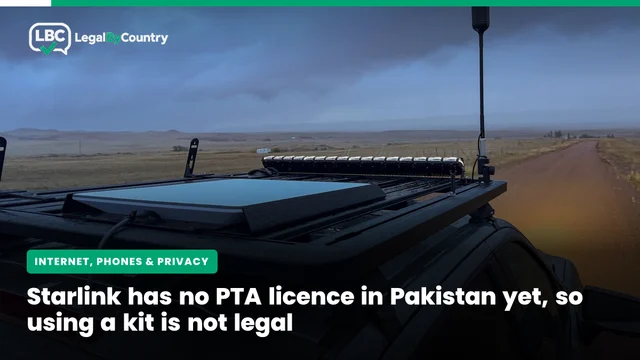
No, not yet. As of November 2026, Starlink has no PTA licence and only a provisional PSARB registration. Using an imported kit can be an offence under section 31 of the Telecom Act, 1996, carrying up to three years or Rs 10 million.