

Is It Legal to Record a Phone Call in Pakistan?
It depends. Recording your own call is not banned outright, but secret recording, tapping and sharing to harm can be crimes under PECA. See the rules.

Short answer: Depends on consent and use
It depends. No statute bans recording a call you are part of, but PECA 2016 punishes interception with dishonest intention, and the Supreme Court said in 2026 that secret recording for illegal purposes is criminal. Sharing a recording to harm someone is clearly illegal.
- The law
Prevention of Electronic Crimes Act, 2016 (as amended to 2025), ss. 19, 20, 21, 24, 43
Constitution of the Islamic Republic of Pakistan, Art. 14
Qanun-e-Shahadat Order, 1984, Arts. 46-A, 78-A, 164
Investigation for Fair Trial Act, 2013, ss. 9, 34, 35
- Penalty
- Intercepting a call with dishonest intention carries up to two years or a Rs 500,000 fine under section 19 of PECA, and sharing sexual recordings to harm or blackmail carries up to five years and a Rs 5 million fine under section 21.
General information only, not legal advice. For help with your own matter, consult a qualified lawyer or legal consultant. Read the disclaimer
Recording your own call is not banned outright, but using it can be a crime
A tenant in Rawalpindi taps record on a call with a landlord who keeps changing what he promised about the deposit. Most people asking whether it is legal to record a phone call in Pakistan are like her: on the call themselves, and wanting proof.
The honest answer is that it depends on what you do and why. No federal statute we could find says, in plain words, that a person on a call may record it, and none says they may not. What the law does punish is intercepting calls you are not part of, recording or sharing with a dishonest or harmful purpose, and publishing recordings to blackmail, harass or shame someone.
The main law is the Prevention of Electronic Crimes Act, 2016 (PECA), as amended by the Criminal Laws (Amendment) Act, 2023 and the Prevention of Electronic Crimes (Amendment) Act, 2025. The Constitution, the Pakistan Penal Code and the evidence law also matter, and the courts have become noticeably stricter about secret recordings since March 2026.
PECA punishes interception with dishonest intention, not every recording
Section 19 of PECA makes unauthorised interception a crime only when it is done "with dishonest intention" and by technical means. The penalty is up to two years in prison, a fine of up to Rs 500,000, or both, as of November 2026.
Section 19 covers the interception of "any transmission that is not intended to be and is not open to the public" from or within an information system. Section 2 defines "dishonest intention" as an intention "to cause injury, wrongful gain or wrongful loss or harm to any person or to create hatred or incitement to violence."
Two points follow from the wording:
- Intention is part of the offence. Recording a call so you remember what was agreed is a different act from recording it to trap, threaten or embarrass someone.
- The section is about interception. A person who taps another person's line, or plants an app on someone else's phone, plainly intercepts a transmission meant for others. Whether a person who is already on the call "intercepts" it has not been settled in any judgment we could find, so do not treat your own presence on the call as a safe harbour.
Section 19 is non-cognizable, bailable and compoundable under section 43, which means police cannot arrest without a warrant and the parties can settle the case. Those labels describe procedure. A conviction can still follow.
The Constitution protects dignity and privacy, and the courts read that widely
Article 14 of the Constitution says "the dignity of man and, subject to law, the privacy of home, shall be inviolable." The Supreme Court has used that promise against phone tapping by the state, and in 2026 against secret recordings made by private people.
The text of Article 14 mentions the home, but the courts have not read it that narrowly. In Mohtarma Benazir Bhutto v. President of Pakistan (PLD 1998 SC 388), the Supreme Court held that phone tapping and eavesdropping violated the right to privacy and injured personal dignity, as summarised in a Business Recorder analysis of 28 April 2023.
The March 2026 ruling on secret recordings
In March 2026, a three-member Supreme Court bench, in a judgment written by Justice Muhammad Hashim Khan Kakar, upheld an acquittal in a bribery case built mainly on a clandestine audio recording. The Express Tribune reported on 10 March 2026 that the court said:
- secretly recording a private conversation without consent, with the intention of using it for extortion or other illegal purposes, is criminal conduct;
- secretly recording a citizen's private talk and then using it in court violates Article 14;
- a complainant who turns to unlawful surveillance becomes an offender, and a person whose secret recording is leaked is a victim;
- a recording without a verified source or identifiable owner cannot be admitted as evidence in a criminal case.
The court also warned against a "surveillance theatre where the end justifies the means." We have relied on dated press reports of this judgment because we could not open the judgment itself on the Supreme Court website. Some reports link the ruling to "section 23" of PECA, but section 23 of the current Act deals with malicious code, so we have not repeated that reference.
A recording can be evidence, but only if it clears strict tests
Courts can let a call recording in, but the Qanun-e-Shahadat Order, 1984 leaves that to the judge, and the Supreme Court has set 21 conditions for proving audio and video. A secret recording made to trap someone is the weakest kind.
Article 164 of the Qanun-e-Shahadat Order, 1984 used to let a court allow evidence that had become available "because of modern devices or techniques." The Criminal Laws (Amendment) Act, 2023 replaced it. The current text says that, depending on the case, the court may allow evidence "recorded by the Court through the modern devices or techniques including video call, viber, skype, imo, whatsapp," and video conference. Articles 46-A and 78-A deal separately with electronic documents.
The 21 conditions in Ishtiaq Ahmed Mirza
In Ishtiaq Ahmed Mirza v. Federation of Pakistan (PLD 2019 SC 675), the case about the video of accountability judge Arshad Malik, the Supreme Court listed 21 requirements for proving an audio tape or video. The Sindh High Court quoted the full list in Khanzadi v. The State (Criminal Appeal No. 722 of 2019). The main ones are:
- the recording must be proved genuine and not tampered with or doctored;
- it must be the actual record of the conversation as it happened;
- the person who made it must appear in court and produce it personally;
- it must be played in court and be clearly audible, and the voices must be identified;
- safe custody from recording to trial must be proved, and the source and date of acquiring it disclosed;
- the transcript must be prepared under independent supervision;
- the person recording should not be someone who made the recording "for the purpose of laying a trap to procure evidence";
- a recording produced late in a case "may be looked at with suspicion," and a formal application is needed to put it on record.
The court also said a forensic report by the Punjab Forensic Science Agency on an audio tape is admissible in evidence. In June 2025, in the Noor Mukadam murder case, the Supreme Court accepted authenticated footage as primary evidence, Dawn reported on 11 June 2025. Read together, these rulings mean a properly kept, forensically checked recording can carry weight, while a secret trap recording with gaps in its history usually will not.
Sharing a recording to harm someone is where most people break the law
Publishing or sending a recording to blackmail, harass, shame or falsely accuse someone can fall under several PECA and Penal Code offences at once. Some carry five years in prison, and the 2025 amendment made the dignity offence arrestable without a warrant.
- Dignity (PECA s. 20). Publicly showing or sending information you know to be false that intimidates or harms a person's reputation or privacy. The 2025 amendment moved section 20 into the list of cognizable, non-bailable, non-compoundable offences in section 43.
- Modesty (PECA s. 21). Sharing sexually explicit images or videos of a person, or intimidating someone with them, to harm, take revenge or blackmail. Sexual content recorded without consent sits here.
- Cyber stalking (PECA s. 24). Using electronic means, with intent to coerce, intimidate or harass, to monitor a person's messages and communications, to spy on them, or to distribute a photo or video of them without consent in a harmful way.
- Extortion (PPC ss. 383 and 384). Threatening to release a recording unless someone pays or hands something over.
- Defamation (PPC ss. 499 and 500). Spreading a recording, or a misleading edit of one, to damage someone's reputation.
- Intruding on a woman's privacy (PPC s. 509). Section 509 covers anyone who, intending to insult a woman's modesty, "intrudes upon the privacy of such woman."
Under sections 20, 21 and 24 of PECA, the person harmed can also ask the regulator to remove or block the material. Section 50A says the Pakistan Telecommunication Authority keeps doing that work until the new Social Media Protection and Regulatory Authority is set up. Courts can also order compensation to a victim under section 45.
Penalties for recording and sharing offences
The table below shows the maximum penalty for each offence most likely to apply, taken from the consolidated texts on Pakistan Code. Figures are as of 16 November 2026, and courts usually impose less than the maximum.
| What happened | Law and section | Maximum penalty (as of 16 Nov 2026) | Arrest without warrant? |
|---|---|---|---|
| Intercepting a call or transmission with dishonest intention | PECA s. 19 | 2 years, Rs 500,000 fine, or both | No |
| Intercepting or disclosing the contents of telecom messages | Pakistan Telecommunication (Re-organization) Act, 1996, s. 31(1)(g) | 3 years, Rs 10 million fine, or both | Court acts on a written complaint from a PTA-authorised officer |
| Surveillance or interception outside the Fair Trial Act | Investigation for Fair Trial Act, 2013, s. 35 | 3 years and a fine | Not stated in the Act |
| Spreading false material that harms reputation or privacy | PECA s. 20 | 3 years, Rs 1 million fine, or both | Yes, since January 2025 |
| Sharing or threatening with sexual images or video | PECA s. 21 | 5 years, Rs 5 million fine, or both (7 years if the victim is a minor) | Yes |
| Monitoring or spying on someone to harass them | PECA s. 24 | 3 years, Rs 1 million fine, or both (5 years if the victim is a minor) | No |
| Threatening to release a recording for money | PPC s. 384 | 3 years, a fine, or both | Check with the police or a lawyer |
| Defamation using a recording | PPC s. 500 | 2 years, a fine, or both (5 years for the originator) | Check with the police or a lawyer |
Sources: Pakistan Telecommunication (Re-organization) Act, 1996, Investigation for Fair Trial Act, 2013 and the Pakistan Penal Code, 1860 on Pakistan Code, plus PECA as linked above.
Listening in on other people's calls is illegal unless a High Court judge allows it
Recording a call you are not part of is the clearest offence in this area. Private people have no lawful way to tap a phone, and even intelligence agencies and police need a High Court judge's warrant under the Investigation for Fair Trial Act, 2013.
The Fair Trial Act lets only listed applicants (the ISI, the three services intelligence agencies, the Intelligence Bureau and the police) seek a warrant. They need the Interior Minister's permission first, then a warrant from a High Court judge in chambers. Section 34 punishes misuse of intercepted material with up to five years in prison or a fine of up to Rs 10 million, and section 35 punishes any interception outside the Act.
Section 54 of the Telecom Act also lets the Federal Government authorise interception "in the interest of national security." In July 2024 the government issued SRO 1005(I)/2024, which gave legal cover to phone tapping of suspects and was widely reported as authorising the ISI, Dawn reported on 10 July 2024. In May 2024, Justice Babar Sattar of the Islamabad High Court had restrained telecom companies from recording calls and data for surveillance, in the audio leaks case brought by Bushra Bibi and Najamus Saqib, Business Recorder reported on 30 May 2024. How these powers fit together is still contested in court.
For a private person, none of this opens a door. Putting spyware on a spouse's phone, forwarding someone's calls to your own number, or buying "call recordings" of another person is outside every one of these routes.
Businesses should tell callers before recording
No Pakistani statute we found sets out a general rule for business call recording, and the Personal Data Protection Bill is still not law. The safe practice is to tell callers at the start, keep recordings secure, and use them only for the stated purpose.
Banks, telecom companies and call centres in Pakistan commonly play a message saying calls may be recorded. That notice matters for two reasons. A caller who hears it and stays on the line is not being recorded in secret, which takes the call outside the facts of the March 2026 ruling. And a recording made as routine business practice, by staff whose job includes recording, fits the Supreme Court's test for evidence far better than a trap recording does.
Data protection is the gap. As of August 2026, the federal Personal Data Protection Bill was still a draft, The Express Tribune reported on 24 August 2026. Until it passes, PECA, the Penal Code and sector rules set by regulators for the firms they supervise do the work. Regulated businesses should check their own regulator's rules.
Employers who record staff calls should put it in writing in the contract or a policy. A secret recording of an employee, used to embarrass or pressure them, can raise the same PECA and Penal Code issues as any other.
The lawful way to record a call in Pakistan
The safest route is simple: say you are recording, get a clear yes, keep the file private, and take it to the proper authority rather than the internet. Those steps keep you outside the offences above and give the recording its best chance in court.
- Tell the other person at the start. Say "I am recording this call" and wait for a clear yes on the recording itself. If they refuse, end the call or take notes instead.
- Record only calls you are part of. Never record, forward or access anyone else's calls or messages.
- Keep the original file untouched. Do not edit, trim or convert it. Note the date, time, phone number and the device you used.
- Store it securely and share it with no one. Posting it on social media or a WhatsApp group is where most legal trouble starts.
- Take it to the right place. If the call involved threats, blackmail or harassment, report it to the National Cyber Crime Investigation Agency (NCCIA), which took over from the FIA Cyber Crime Wing in April 2025 under section 29 of PECA, or to your local police.
- Let a lawyer put it before a court. In a court case, your lawyer files a formal application to bring the recording on record and arranges a forensic report if needed.
If you are the person who was recorded and the recording is being used against you, you can complain to the NCCIA, apply for removal of the material, and seek compensation. Other guides on phones and privacy are on our internet, phones and privacy page, and our editorial policy explains how we check the law behind each guide.
Frequently asked questions
Can I record a call without telling the other person in Pakistan?
+
We would not advise it. No statute expressly allows or bans a participant recording, but PECA punishes interception with dishonest intention, and the Supreme Court said in March 2026 that secret recording for illegal purposes is criminal and violates Article 14. Telling the other person first is the safe route.
Is a recorded phone call valid evidence in a Pakistani court?
+
Sometimes. Under the Qanun-e-Shahadat Order, 1984 the court decides, and Ishtiaq Ahmed Mirza v. Federation of Pakistan (PLD 2019 SC 675) sets 21 conditions, including proof the recording is genuine, that the maker produces it, and safe custody. Trap recordings are treated with suspicion.
Is it illegal to share someone's call recording on WhatsApp or social media?
+
It can be. Sharing to harm, harass, blackmail or defame can fall under PECA sections 20, 21 and 24 and the Penal Code offences of extortion and defamation. Spreading false material that harms someone's reputation or privacy has been arrestable without a warrant since January 2025.
Can I record my husband's or wife's calls?
+
No, not calls you are not part of. Intercepting someone else's calls or messages, or installing spyware on their phone, can be unauthorised interception under section 19 of PECA and cyber stalking under section 24, as well as a breach of their Article 14 privacy.
Can a company record customer calls in Pakistan?
+
Yes, in practice, if callers are told. No general statute governs business recording and the Personal Data Protection Bill was still a draft as of August 2026, so firms should announce recording, keep files secure, use them only for the stated purpose and follow their regulator's rules.
Can the government tap my phone?
+
Only through a legal route. The Investigation for Fair Trial Act, 2013 requires the Interior Minister's permission and a High Court judge's warrant, and section 54 of the Telecom Act lets the Federal Government authorise interception for national security. The limits of these powers are still being argued in court.
What should I do if someone is blackmailing me with a recording?
+
Do not pay or delete anything. Keep the messages and the number, then report it to the National Cyber Crime Investigation Agency or your local police. Using sexual material to blackmail is punishable under section 21 of PECA, and you can ask for the material to be removed.
Is recording a call with the police or a government officer allowed?
+
The same rules apply as for any call. Tell the officer you are recording, keep the original file untouched and do not post it to shame anyone. In March 2026 the Supreme Court upheld an acquittal in a bribery case built on a secret audio recording.
Sources
We compiled this guide from official sources: the law itself, government notifications and court records, checked against reporting of recent changes. It is for information only.
- Prevention of Electronic Crimes Act, 2016 (consolidated, including amendments to 2025) · Ministry of Law and Justice (Pakistan Code)
- Prevention of Electronic Crimes (Amendment) Act, 2025 (Act No. II of 2025), Gazette of Pakistan, 29 January 2025 · National Assembly of Pakistan
- Criminal Laws (Amendment) Act, 2023 (Act No. XXXVII of 2023), Gazette of Pakistan, July 2023 · Pakistan Telecommunication Authority
- Constitution of the Islamic Republic of Pakistan · Ministry of Law and Justice (Pakistan Code)
- Qanun-e-Shahadat Order, 1984 · Ministry of Law and Justice (Pakistan Code)
- Investigation for Fair Trial Act, 2013 · Ministry of Law and Justice (Pakistan Code)
- Pakistan Telecommunication (Re-organization) Act, 1996 · Ministry of Law and Justice (Pakistan Code)
- Pakistan Penal Code, 1860 · Ministry of Law and Justice (Pakistan Code)
- Khanzadi v. The State (Criminal Appeal No. 722 of 2019), quoting Ishtiaq Ahmed Mirza v. Federation of Pakistan, PLD 2019 SC 675 · High Court of Sindh
- Secret recording of private talks illegal: SC (10 March 2026) · The Express Tribune
- Supreme Court issues detailed verdict in Noor Mukadam murder case (11 June 2025) · Dawn
- Situationer: how audio leaks led to permission to intercept (10 July 2024) · Dawn
- Surveillance purposes: IHC asks telcos not to record calls, data (30 May 2024) · Business Recorder
- Analysis citing Mohtarma Benazir Bhutto v. President of Pakistan, PLD 1998 SC 388 (28 April 2023) · Business Recorder
- Pakistan can no longer wait for personal data protection law (24 August 2026) · The Express Tribune

Advocate, Supreme Court of Pakistan
Advocate of the Supreme Court of Pakistan and the Lahore High Court, former Assistant Advocate General Punjab and Assistant Attorney General for Pakistan, and adjunct professor of law in Lahore.
Full profile and credentials →
Is It Legal to Use a VPN in Pakistan?
Yes. No Pakistani law makes simply using a VPN an offence. PTA expects businesses and freelancers to register work VPNs free on its portal, licenses local VPN providers, and can disrupt unregistered traffic. Crimes committed through a VPN remain punishable under PECA 2016.

Is Cryptocurrency Legal in Pakistan?
Yes, owning, buying and selling crypto for yourself is legal, but it is not legal tender. Under the Virtual Assets Act, 2026, any exchange or crypto service needs a PVARA licence, and running one without a licence is a crime.
Is It Legal to Fly a Drone in Pakistan?
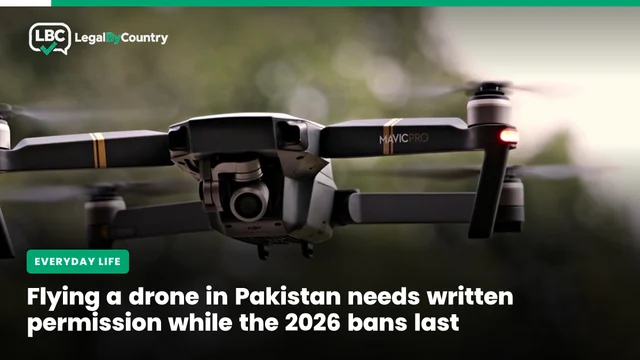
Only in limited cases. Since February 2026, a federal directive and provincial section 144 orders have banned outdoor drone flying without written permission. The Pakistan Civil Aviation Act, 2023 also treats drones as aircraft, requiring registration and allowing seizure.
Is Starlink Legal in Pakistan?
No, not yet. As of November 2026, Starlink has no PTA licence and only a provisional PSARB registration. Using an imported kit can be an offence under section 31 of the Telecom Act, 1996, carrying up to three years or Rs 10 million.