

Is It Legal to Install CCTV at Home in Pakistan?
Yes, home CCTV is legal and needs no permit. See the privacy limits on neighbours, audio and sharing footage, and when businesses must install it.

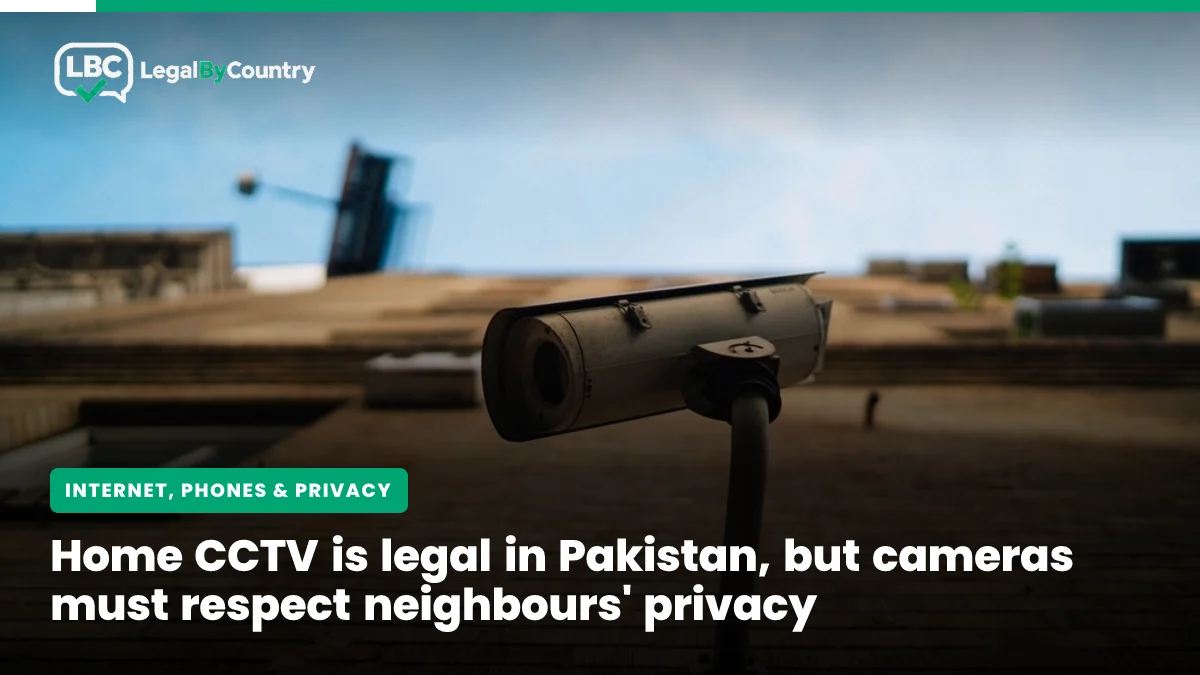
Short answer: Legal, within privacy limits
Yes. No Pakistani law bans home CCTV or requires a permit. Article 14 of the Constitution still protects your neighbours' privacy, and PECA 2016 and the Penal Code punish spying, hidden cameras in private rooms and sharing footage to harm or blackmail someone.
- The law
Constitution of the Islamic Republic of Pakistan, Art. 14
Prevention of Electronic Crimes Act, 2016 (as amended to 2025), ss. 19, 20, 21, 24
Pakistan Penal Code, 1860, ss. 500, 509
Punjab Security of Vulnerable Establishments Act 2015, ss. 2(h), 6, 7, 11, 13, 14
- Penalty
- Installing a home camera carries no penalty, but sharing intimate footage to harm or blackmail carries up to five years and a Rs 5 million fine under section 21 of PECA, and intruding on a woman's privacy up to three years under section 509 of the Penal Code.
General information only, not legal advice. For help with your own matter, consult a qualified lawyer or legal consultant. Read the disclaimer
Home CCTV is legal in Pakistan, and no permit is needed
Drive down almost any street in Lahore, Karachi or Peshawar and you will see white cameras over gates and doorbells. So is it legal to install CCTV at home in Pakistan? Yes. No law bans it, and you need no licence, police permit or registration.
What the law controls is how you use the cameras. Where they point, what they record, whether they pick up sound and what you do with the footage can all cross a legal line. Most legal trouble with home CCTV starts after the recording, not at the installation.
Pakistan also has no general data protection law yet. The Personal Data Protection Bill was still a draft as of August 2026, according to The Express Tribune. So the rules for a homeowner come from the Constitution, the criminal law and the courts, not from one CCTV statute.
Privacy limits come from the Constitution and the criminal law
Article 14 of the Constitution protects dignity and "the privacy of home", and the Prevention of Electronic Crimes Act, 2016 (PECA) punishes misuse of images and video. A camera covering your own gate is fine. A camera used to spy, shame or blackmail is not.
Article 14 protects your neighbours too
Article 14(1) of the Constitution says "the dignity of man and, subject to law, the privacy of home, shall be inviolable." The same right that protects your house protects the house next door. In March 2026 a three-member Supreme Court bench said secretly recording a private conversation breaches this guarantee, as reported by The Express Tribune on 10 March 2026.
PECA punishes misuse of images, not ordinary cameras
The Prevention of Electronic Crimes Act, 2016 (as amended to 2025) does not regulate CCTV as such. Three of its offences matter once footage leaves your recorder:
- Section 24 (cyber stalking): using an information system to "watch or spy upon a person" in a way that causes fear or serious distress, or to take a photo or video of someone and display or distribute it without consent in a way that harms them. Up to three years or a fine up to Rs 1 million.
- Section 21 (modesty): publicly showing or sending a video of a person in sexually explicit conduct, or using one to intimidate or blackmail. Up to five years or a fine up to Rs 5 million, and up to seven years where the victim is a minor.
- Section 20 (dignity): publicly showing false information that harms a person's reputation or privacy. Up to three years or a fine up to Rs 1 million.
Victims under all three sections can apply to the Social Media Protection and Regulatory Authority to have the material removed or blocked.
Cameras in private rooms can be a Penal Code offence
Section 509 of the Pakistan Penal Code punishes anyone who, intending to insult the modesty of a woman, "intrudes upon the privacy of such woman", with up to three years or a fine up to Rs 500,000. Its explanation says this can happen in homes. A hidden camera in a bathroom, a changing area or a domestic worker's or tenant's room carries exactly that risk.
| What you do with a home camera | Legal position (as of 16 November 2026) | Law |
|---|---|---|
| Cover your own gate, door, driveway or garden | Legal, no permit needed | No law requires one |
| Catch a strip of the public street while covering your gate | Generally accepted, keep it to what you need | Art. 14 Constitution |
| Aim a camera into a neighbour's house, roof or courtyard | High risk: privacy breach, possible harassment complaint | Art. 14; PECA s. 24; PPC s. 509 |
| Hide a camera in a bathroom or someone's bedroom | Likely a crime | PPC s. 509 (up to 3 years) |
| Post footage to shame or harm someone | Can be a crime | PECA ss. 20, 24; PPC s. 500 |
| Use intimate footage to blackmail | Crime | PECA s. 21 (up to 5 years, Rs 5 million) |
| Hand footage of a crime to the police | Legal and encouraged | Qanun-e-Shahadat Order, 1984 |
Pointing a camera at your neighbour is where disputes start
No Pakistani statute sets an angle or distance for home cameras. The safe rule is simple: cover your own property and the approach to it, and keep cameras off your neighbour's windows, roof, courtyard and private spaces. Aiming into their home invites a complaint.
In Pakistani homes the roof and the inner courtyard are often where women of the house move without purdah. A camera that looks down into a neighbour's sehn or onto their roof is the most common trigger for a fight, a police complaint or a case. Depending on what was recorded and why, a complaint could rest on Article 14, cyber stalking under section 24 of PECA or section 509 of the Penal Code.
A camera over your gate will often catch part of the street and the front of the house opposite. That is usually unavoidable and is not, by itself, an offence. What changes the picture is intent and use: zooming in on one person, tracking their movements, or sharing clips of them.
If your neighbour objects, the practical answer is to show them what the camera sees. Many systems let you mask part of the frame so a window or doorway is blacked out in the recording. Doing that early usually settles the matter.
Recording sound is riskier than recording video
Many home cameras record audio by default. No statute expressly bans this, but the Supreme Court said in March 2026 that covertly recording private conversations for an illegal purpose is criminal and breaches Article 14. Turn audio off where people talk privately.
Video of your gate shows who came and went. Audio captures what people said, including family members, guests, drivers and domestic staff who may not know a microphone is listening. That is far closer to the secret recording the Supreme Court condemned.
Section 19 of PECA punishes "unauthorized interception" with dishonest intention, with up to two years or a fine up to Rs 500,000. Its wording targets intercepting transmissions from an information system, such as calls or messages, so it is not clear it covers a microphone in a room. Our guide on recording phone calls in Pakistan covers that offence in detail.
The simplest lawful approach is to switch audio off on indoor cameras, or keep it only where everyone knows it is on, such as a video doorbell at the gate.
Sharing footage online can turn a victim into an accused
Posting a clip of a thief or a rude neighbour feels harmless, but it can expose you to PECA and defamation complaints if the person is wrongly identified or the post harms them. Give footage of a crime to the police instead of social media.
Section 24(1)(d) of PECA covers taking a video of someone and displaying or distributing it "without his consent in a manner that harms a person." Section 20 covers false information that harms a person's reputation or privacy. Section 500 of the Penal Code punishes defamation with up to two years' simple imprisonment, a fine, or both.
Being right about the theft is not a full defence if the caption names the wrong man, or the clip shows a woman, a child or a family who had nothing to do with it. Blur bystanders if a clip must be shared, and leave identification to the police. The neighbouring question of posting photos of people is covered in our guide on posting someone's photo without permission.
Businesses and institutions can be required to install CCTV
Homes are not covered, but shops, banks, hospitals, schools, hotels, petrol pumps, wedding halls and places of worship can be. Each province has a "vulnerable establishments" law that lets officials require security arrangements, expressly including CCTV, and punish managers who ignore them.
Punjab
The Punjab Security of Vulnerable Establishments Act 2015 (XIV of 2015) defines "security arrangements" in section 2(h) to include "installation and proper functioning of closed circuit television cameras". A Security Advisory Committee in each sub-division recommends places for notification, inspects them quarterly and gives written advice. The manager must follow that advice (sections 6 and 7), and section 13 requires the manager to hand evidence from those systems to the police.
A manager who ignores a warning, a sealing direction or a request for evidence faces up to six months in prison and a fine of Rs 50,000 to Rs 100,000 under section 14. The Committee can also seal the premises until the advice is followed (section 11). The Act repealed the older Punjab Shops and Establishments (Security) Act, 1999.
Sindh, Khyber Pakhtunkhwa and Balochistan
The other provinces have similar laws, each listing CCTV as a security arrangement:
| Province or territory | Law | Penalty for non-compliance (as of 16 November 2026) |
|---|---|---|
| Punjab | Punjab Security of Vulnerable Establishments Act 2015, s. 14 | Up to 6 months and a fine of Rs 50,000 to Rs 100,000; sealing |
| Sindh | Sindh Security of Vulnerable Establishments Act, 2015 (Act XXIX of 2015), s. 14 | Up to 6 months and a fine of at least Rs 45,000 |
| Khyber Pakhtunkhwa | KP Sensitive and Vulnerable Establishments and Places (Security) Act, 2015, s. 12 | Up to 1 year or a fine up to Rs 40,000, or both; sealing for continuing breach |
| Balochistan | Balochistan Security of Vulnerable Establishment Act, 2024 (Act V of 2024) | Up to 6 months and a fine of Rs 50,000 to Rs 100,000 |
| Islamabad Capital Territory | No equivalent statute found; directions are issued administratively | Depends on the order issued |
Sources: Sindh Act XXIX of 2015, KP Act III of 2015 and Balochistan Act V of 2024.
Islamabad
We found no Islamabad law that matches the provincial acts. CCTV requirements for businesses in the capital have come through administrative directions instead, so ask the ICT administration or your police station what applies to your premises. Separately, in September 2026 the President promulgated an ordinance protecting Islamabad's Safe City cameras, with reported fines of up to Rs 2 million for damaging them, according to ProPakistani on 26 September 2026. That ordinance protects government cameras. It does not regulate home CCTV.
A home office, clinic or shop run from a house can fall under these laws once it is notified, so check with your district administration if you run a business from home.
CCTV footage can be evidence if it is handled properly
Pakistani courts accept CCTV footage, and the Supreme Court has said authenticated footage can stand as primary evidence on its own. Whether it helps your case depends on proving it is genuine, unedited and came from a working system you control.
Article 46-A of the Qanun-e-Shahadat Order, 1984 makes records "generated, received or recorded by an automated information system while it is in working order" relevant facts. In its June 2025 detailed judgment in the Noor Mukadam case, the Supreme Court said footage can be admitted under the "silent witness" theory, meaning it proves what it shows without an eyewitness, "provided it is properly authenticated", as Dawn reported on 11 June 2025.
The flip side matters too. In March 2026 the Supreme Court said a recording without a verified source or identifiable owner cannot be treated as admissible evidence in criminal proceedings. Footage you cannot vouch for, or that was obtained by spying, may help nobody.
A lawful home CCTV setup takes six steps
Most home systems are lawful from day one. These steps keep yours on the right side of the law and make your footage useful if you ever need it in a police case or in court.
- Point cameras at your own property. Cover gates, doors, the driveway and boundary walls. Keep them off neighbours' windows, roofs and courtyards, and use privacy masking where the view cannot be avoided.
- Tell the people who live and work in the house. Family, tenants and domestic staff should know where cameras are. A small sign at the gate does the same for visitors.
- Keep cameras out of private spaces. No cameras in bathrooms, changing areas, or a worker's or tenant's room.
- Turn audio off indoors. Keep sound recording only where everyone knows about it, such as a video doorbell.
- Secure the recorder and the app. Change default passwords and limit who can view footage. Leaked feeds are a common source of blackmail material.
- Preserve, do not post. If something happens, keep the original recording unedited, note the date and time, and give a copy to the police when you report it.
If you also run a dashcam, the vehicle rules are covered in our guide on whether dashcams are legal in Pakistan. More guides on phones, privacy and the internet sit on our online and privacy guides page.
Frequently asked questions
Do I need permission from the police to install CCTV at home in Pakistan?
+
No. No federal or provincial law requires a licence, permit or registration for cameras on your own house. Permission questions arise only for businesses notified under the provincial vulnerable establishments laws, which can be told to install and maintain CCTV.
Can my neighbour's CCTV camera point at my house?
+
Not into your private spaces. Article 14 of the Constitution protects the privacy of your home, and watching or spying on someone in a way that causes distress can be cyber stalking under section 24 of PECA. Ask your neighbour to move or mask the camera first, then complain to the police if needed.
Can I put a camera in my maid's or driver's room?
+
No. A camera in a worker's or tenant's private room, or in a bathroom, risks a charge under section 509 of the Penal Code, which punishes intruding on a woman's privacy with up to three years in prison or a fine up to Rs 500,000. Keep cameras to shared and outdoor areas.
Is it legal for home CCTV to record audio?
+
No law expressly bans it, but it is riskier than video. The Supreme Court said in March 2026 that covertly recording private conversations for an illegal purpose is criminal and breaches Article 14. Switch audio off indoors and keep it only where everyone knows it is on.
Can I post CCTV footage of a thief on Facebook?
+
You can, but it is risky. If the post wrongly identifies someone or harms a bystander, it can lead to complaints under PECA sections 20 and 24 or defamation under section 500 of the Penal Code. Giving the footage to the police is the safer route.
Is CCTV footage accepted as evidence in Pakistani courts?
+
Yes, if it is authenticated. Article 46-A of the Qanun-e-Shahadat Order makes records from a working automated system relevant, and the Supreme Court said in June 2025 that properly authenticated footage can stand as primary evidence. Keep the original file unedited.
Do shops have to install CCTV cameras in Pakistan?
+
Notified ones can be required to. Under the Punjab Security of Vulnerable Establishments Act 2015 and similar laws in Sindh, Khyber Pakhtunkhwa and Balochistan, officials can direct shops, banks, hospitals and other notified places to install CCTV, with fines and sealing for non-compliance.
Must I give my CCTV footage to the police?
+
Managers of notified vulnerable establishments in Punjab must, under section 13 of the 2015 Act, and refusing can bring up to six months in prison. Homeowners have no equivalent statutory duty, but sharing footage of a crime with the police is lawful and usually helps the case.
Sources
We compiled this guide from official sources: the law itself, government notifications and court records, checked against reporting of recent changes. It is for information only.
- Constitution of the Islamic Republic of Pakistan · Ministry of Law and Justice (Pakistan Code)
- Prevention of Electronic Crimes Act, 2016 (consolidated, including amendments to 2025) · Ministry of Law and Justice (Pakistan Code)
- Pakistan Penal Code, 1860 · Ministry of Law and Justice (Pakistan Code)
- Qanun-e-Shahadat Order, 1984 · Ministry of Law and Justice (Pakistan Code)
- Punjab Security of Vulnerable Establishments Act 2015 (XIV of 2015) · Law and Parliamentary Affairs Department, Government of the Punjab (Punjab Code)
- Sindh Security of Vulnerable Establishments Act, 2015 (Sindh Act No. XXIX of 2015) · Sindh Code, Government of Sindh
- Khyber Pakhtunkhwa Sensitive and Vulnerable Establishments and Places (Security) Act, 2015 (Act No. III of 2015) · Provincial Assembly of Khyber Pakhtunkhwa
- Balochistan Security of Vulnerable Establishment Act, 2024 (Act No. V of 2024) · Provincial Assembly of Balochistan
- Punjab Security of Vulnerable Establishments Bill 2015 (Bill No. 1 of 2015): bill details · Provincial Assembly of the Punjab
- Secret recording of private talks illegal: SC (10 March 2026) · The Express Tribune
- Supreme Court issues detailed verdict in Noor Mukadam murder case (11 June 2025) · Dawn
- Islamabad Safe City cameras to get legal protection under new ordinance (26 September 2026) · ProPakistani
- Pakistan can no longer wait for personal data protection law (24 August 2026) · The Express Tribune
- LHC appoints amicus curiae in plea against secret filming (17 December 2021) · Dawn

Advocate, Supreme Court of Pakistan
Advocate of the Supreme Court of Pakistan and the Lahore High Court, former Assistant Advocate General Punjab and Assistant Attorney General for Pakistan, and adjunct professor of law in Lahore.
Full profile and credentials →
Is It Legal to Record a Phone Call in Pakistan?
It depends. No statute bans recording a call you are part of, but PECA 2016 punishes interception with dishonest intention, and the Supreme Court said in 2026 that secret recording for illegal purposes is criminal. Sharing a recording to harm someone is clearly illegal.
Is It Legal to Post Someone's Photo Without Permission in Pakistan?
It depends. No law requires consent for every photo, but sharing someone's picture without consent to harass or harm them is cyber stalking under PECA section 24, and posting sexual, morphed or falsely captioned images is a more serious crime under sections 21 and 20.
Is Starlink Legal in Pakistan?
No, not yet. As of November 2026, Starlink has no PTA licence and only a provisional PSARB registration. Using an imported kit can be an offence under section 31 of the Telecom Act, 1996, carrying up to three years or Rs 10 million.
Is Sharing Fake News a Crime in Pakistan?
Yes, when you know or have reason to believe it is false. Section 26A of PECA 2016, added in January 2025, punishes spreading false information online that is likely to cause fear, panic or unrest with up to three years in prison.