

Is It Legal to Carry a Knife in Pakistan?
Kitchen, work and small knives are legal, but daggers, swords, flick-knives and 4-inch blades need a licence. See the rules, bans and penalties.

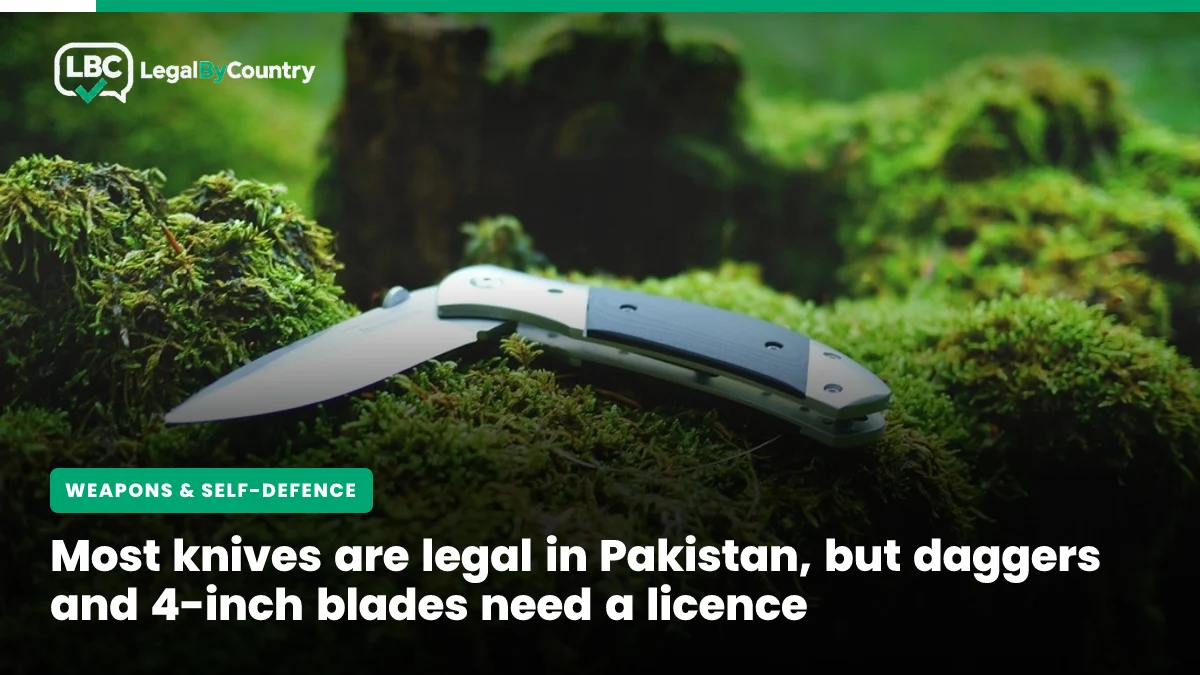
Short answer: Depends on the blade
Mostly yes. Kitchen knives, work knives and small blades are legal, but the Pakistan Arms Ordinance, 1965 and provincial arms laws treat daggers, swords, flick-knives and knives with blades of four inches or more as arms needing a licence.
- The law
Pakistan Arms Ordinance, 1965, ss. 3(b)(iii), 8, 9, 11-B, 13
Punjab Arms Ordinance, 1965 (as amended to 2025), ss. 3, 8, 9, 13, 14A
Sindh Arms Act, 2013, ss. 2(c), 2(d), 3, 23
Khyber Pakhtunkhwa Arms Act, 2013, ss. 3, 8, 9, 15
- Penalty
- Going armed with or possessing a dagger, sword, flick-knife or other blade that counts as an arm without a licence carries up to seven years in jail, a fine, or both under section 13 of the Pakistan Arms Ordinance, 1965.
General information only, not legal advice. For help with your own matter, consult a qualified lawyer or legal consultant. Read the disclaimer
Most everyday knives are legal, but bigger blades count as arms
A butcher walks to work on Eid morning with three long knives wrapped in cloth. A teenager keeps a spring-loaded knife in his pocket because it looks cool. Only one of them is breaking Pakistan's arms law, and blade length and purpose explain why.
So, is it legal to carry a knife in Pakistan? For most kitchen, work and small pocket knives, yes. The Pakistan Arms Ordinance, 1965 and the arms laws of Punjab, Khyber Pakhtunkhwa and Balochistan treat daggers, swords, flick-knives and knives with blades of four inches or more as "arms". Arms need a licence.
Two other things can turn a lawful knife into a problem: a Section 144 order that bans carrying weapons in public for a set period, and what you actually do with the knife. Both are covered below.
The arms laws name knives, daggers and swords in black and white
The federal Ordinance and three provincial laws use the same list. "Arms" includes swords, sword-sticks, daggers, bayonets, flick-knives of any size and knives with blades of four inches or more. Kitchen knives and knives used in good faith for work are excluded.
Section 3(b)(iii) of the federal Ordinance, as substituted in 1969, reads: "air pistols, bayonets, swords, sword-sticks, daggers, knives with blades of four inches or more (but not kitchen knives or knives used in good faith for the carrying on of a profession), and flick-knives irrespective of the blade". The next clause adds knuckle-dusters, spears, spear-heads, bows and arrows.
The same words appear in the Punjab Arms Ordinance, 1965, the Khyber Pakhtunkhwa Arms Act, 2013 and the Balochistan Arms Act, 2022. The federal Ordinance still governs Islamabad.
What a flick-knife means
All four laws define a flick-knife as one whose blade opens automatically when you press a button, spring or other device in the handle. The definition also covers knives whose blade drops out by gravity or a flick of the wrist and then locks in place. Blade length does not matter for these: any flick-knife is an arm.
Sindh words it differently
The Sindh Arms Act, 2013 has no four-inch rule. Section 2(c) defines arms as articles "designed as weapons of offence or defence", naming "swords, bayonets, and other lethal weapon", and excludes "articles designed solely for domestic or agricultural purposes". A kitchen knife or a farmer's sickle stays outside. A dagger or a combat knife is likely inside, whatever its length.
Sindh's licensing rule in section 3 speaks of firearms. A 2023 amendment rewrote the definition of "firearms" so that it "includes arms", which may pull swords and daggers into the same licence rule. We could not find a court ruling on that point, so treat a blade bought as a weapon in Sindh as needing a licence.
Your knife's status depends on its blade and its purpose
A small folding knife, a kitchen knife and a working tool carried for your trade are not "arms" under the federal, Punjab, KP and Balochistan laws. A dagger, a sword, a flick-knife or a long non-kitchen blade is, and needs a licence.
| Item | Federal, Punjab, KP, Balochistan | Sindh |
|---|---|---|
| Kitchen knife (any length) | Not an arm | Not an arm (domestic article) |
| Knife used in good faith for your trade, such as a butcher's or a tailor's | Not an arm | Not an arm if designed for domestic or agricultural use. Other trade blades are unclear. |
| Folding or fixed knife with a blade under four inches | Not an arm | Depends on whether it is designed as a weapon |
| Non-kitchen knife with a blade of four inches or more | Arm: licence needed | Arm if designed as a weapon |
| Flick-knife or spring knife, any size | Arm: licence needed | Not named. Likely an arm as a weapon of offence. |
| Dagger, sword, sword-stick, bayonet | Arm: licence needed | Arm (swords and bayonets named) |
| Knuckle-duster, spear, bow and arrows | Arm: licence needed | Not named. Likely an arm as a weapon of offence. |
Status as of 16 November 2026, from the texts linked on this page.
Courts look closely at length and pattern
Judges have held prosecutors to the exact words. In Shaukat Ali v. The State (1991 MLD 516), the Lahore High Court acquitted a man because no witness proved the blade was over four inches. The FIR and recovery memo alone were not enough.
In Ali Asghar v. The State (2011 P Cr. L J 641), the same court acquitted a man caught with a chhuri whose blade measured 5.5 inches. The judge found it was the "ordinarily kitchen knive/chhuri normally used in every house", so it fell inside the kitchen-knife exclusion. Both rulings turned on their facts, so they are not a licence to carry long blades.
Going armed with a blade that counts as an arm needs a licence
Section 8 of the federal, Punjab, KP and Balochistan laws bans "going armed" with any arm except under a licence, and section 9 bans possession without one. If your blade is an arm, carrying it without a licence is an offence.
Police, magistrates and other empowered officers can disarm anyone going armed without a licence, under section 8(2) of the federal Ordinance and its provincial copies. The provincial Home Department, through the licensing authority named in its arms rules, issues licences for arms.
We could not confirm on any official site that provinces currently issue licences for daggers or swords in practice. The best-known example is religious. In December 2021, Daily Pakistan reported that the Peshawar High Court allowed Sikhs to carry the kirpan in public in Khyber Pakhtunkhwa, on condition that they hold a renewable licence.
Swords at home and on the wall
Section 9 covers possession, not just carrying, so keeping a sword or dagger at home without a licence is also covered. Sindh's section 40 excludes weapons that are obsolete, of antiquarian significance or so damaged they cannot work, though that clause is written around firearms. If you own a family sword or a decorative dagger, ask your district licensing office whether it needs a licence.
A Section 144 order can ban even a kitchen knife in public
Provincial governments and district officers regularly ban carrying weapons in public for days or weeks. Some of these orders go wider than the arms laws and cover knives, daggers, sticks and "any article which can be used as a weapon of offence".
Section 144 of the Code of Criminal Procedure, 1898 lets the authorities order the public to abstain from an act to prevent danger, a riot or an affray. Section 11-B of the arms laws separately lets governments ban carrying or displaying arms at gatherings, processions, fairs, courts and schools.
- Punjab, Muharram 2026. A Home Department order dated 10 June 2026 banned carrying bamboo sticks, knives, daggers, spears and "any article which can be used as a weapon of offence" in public places during Muharram 1 to 10, unless a competent authority had permitted it, The Express Tribune reported on 17 June 2026.
- Sindh, October 2026. On 1 October 2026 the Government of Sindh banned the display of arms across the province for one month under Section 144(6), and told police to register cases under section 188 of the Penal Code.
During an order like the Punjab Muharram ban, the kitchen-knife exclusion does not help you, because the order bans the article itself in public. Breaking it is an offence under section 188 of the Pakistan Penal Code. Where the disobedience risks human life or safety or a riot, the maximum is six months in jail, a fine of up to Rs 3,000, or both. Carrying an arm in breach of a section 11-B order is also punished under the arms laws themselves.
Orders are often renewed or replaced, especially around Muharram, elections, protests and large events. Check local news and your district administration before carrying any blade in public on those days.
Kitchen and work knives are protected only while used for that purpose
The exclusion covers kitchen knives and knives "used in good faith for the carrying on of a profession". Good faith is the key phrase: a butcher heading to a job qualifies, but the same knife carried to a fight does not.
Examples that usually fall inside the exclusion:
- A qasai carrying knives to slaughter animals on Eid ul Adha.
- A chef or cook carrying knives to a kitchen or catering job.
- A farmer with a sickle, or a gardener with pruning blades, under the Sindh agricultural exclusion and the federal profession exclusion.
- A carpenter, electrician or upholsterer with the cutting tools of the trade.
- A new kitchen knife carried home from the market in its packaging.
Police decide on the spot and courts decide later. Carry work knives wrapped or boxed, with your tools, on the way to or from work, and be ready to explain why you have them. A kitchen knife tucked into a waistband at night is much harder to explain.
Self-defence is not a lawful reason to carry a blade
None of the arms laws lists self-defence as an excuse for going armed. If your knife counts as an arm, carrying it "for protection" without a licence is still an offence. If it is an ordinary knife, carrying it as a weapon invites trouble.
The kitchen and profession exclusions are about purpose. A knife carried mainly to fight with is hard to call a kitchen knife or a work tool. Sindh's definition goes further and counts any article "designed as" a weapon of offence or defence.
The Penal Code then deals with use. Joining an unlawful assembly armed with "anything which, used as a weapon of offence, is likely to cause death" carries up to two years under section 144 PPC, and rioting while so armed carries up to three years under section 148. Injuring someone with a knife brings the hurt and murder sections into play. The law on defending yourself is in sections 96 to 106 PPC, which our guide on killing in self-defence explains. If you want a legal personal safety option, read our guide on whether pepper spray is legal.
Penalties for unlicensed blades can reach seven years
Going armed with, or possessing, a blade that counts as an arm without a licence is a criminal offence. Under the federal, KP and Balochistan laws the maximum is seven years in jail, a fine, or both. Punjab's newer penalty section is written around guns.
| Jurisdiction | Section | Penalty for going armed or possessing without a licence |
|---|---|---|
| Islamabad (federal) | Pakistan Arms Ordinance, s. 13(d), (e) | Up to 7 years, or fine, or both. The 3-year minimum in the proviso applies to listed guns and explosives, not knives. |
| Punjab | Punjab Arms Ordinance, s. 13 | Offence is non-bailable and cognizable. Section 13(2), rewritten in 2025, sets minimum terms for prohibited and non-prohibited bore weapons, and the text does not say how they apply to blades. |
| Sindh | Sindh Arms Act, ss. 3, 23(1)(a) | Up to 14 years and fine for firearms without a licence. Whether this reaches swords and daggers after the 2023 amendment is untested. |
| Khyber Pakhtunkhwa | KP Arms Act, s. 15 | Up to 7 years, or fine, or both. |
| Balochistan | Balochistan Arms Act, s. 15 | Up to 7 years, or a fine of up to two lakh rupees, or both. |
Penalties as of 16 November 2026. Courts can also confiscate the weapon. Our guide on owning a gun in Pakistan covers the firearm side of these laws in detail.
Reported cases show what happens in practice. In Bilal Hussain v. The State (1982 SCMR 1141), the Supreme Court left in place a one-year sentence under the Arms Ordinance for possessing the knife used in a stabbing, on top of the sentence for the attack itself.
Carrying a blade lawfully takes a few simple checks
Most people never need a licence: they carry small knives, kitchen knives and work tools for ordinary reasons. If you want to keep or carry anything bigger, follow these steps before you leave the house.
- Measure the blade. Under the federal, Punjab, KP and Balochistan laws, four inches or more on a non-kitchen knife makes it an arm.
- Check the type. Flick-knives, daggers, swords, sword-sticks, bayonets and knuckle-dusters are arms whatever their size.
- Ask whether your purpose is genuine kitchen or trade use. If not, assume the exclusion will not protect you.
- For anything that counts as an arm, ask your provincial Home Department or district licensing office whether a licence is available and apply only through official channels.
- Check for a Section 144 order in your district, especially around Muharram, elections, protests and big events.
- Carry work knives wrapped or boxed, out of sight, and never carry any blade into a court, school, rally or procession.
Frequently asked questions
What knife length is illegal in Pakistan?
+
A blade of four inches or more makes a non-kitchen knife an arm under the federal, Punjab, KP and Balochistan laws, so it needs a licence. Kitchen knives and genuine work knives are excluded at any length. Sindh's law has no length rule and looks at whether the item is designed as a weapon.
Is it legal to carry a pocket knife in Pakistan?
+
Usually yes, if the blade is under four inches and it is not a flick-knife or spring knife. Flick-knives count as arms whatever their size. Even a small knife can be banned in public while a Section 144 order covering knives is in force.
Do I need a licence for a sword or dagger at home?
+
Under the letter of the arms laws, yes. Swords and daggers are listed as arms, and section 9 bans possessing arms without a licence. Ask your district licensing office about family or decorative pieces, because we could not confirm current licensing practice for edged weapons.
Can a butcher carry knives on Eid in Pakistan?
+
Yes, in general. Knives used in good faith for a profession, and kitchen knives, are excluded from the definition of arms. Carry them wrapped, on the way to or from the work, and check whether any Section 144 order in your district bans knives in public.
Can I carry a knife for self-defence in Pakistan?
+
No, self-defence is not a lawful excuse under the arms laws. If the knife counts as an arm, carrying it without a licence is an offence, and carrying an ordinary knife as a weapon undermines the kitchen and work exclusions.
What is the punishment for carrying a dagger without a licence?
+
Up to seven years in jail, a fine, or both under section 13 of the Pakistan Arms Ordinance, 1965, with similar terms in KP and Balochistan. Punjab treats the offence as non-bailable, and Sindh's Act may apply its stricter firearm penalty.
Can Sikhs carry a kirpan in Pakistan?
+
In Khyber Pakhtunkhwa, yes, with a licence. In December 2021 the Peshawar High Court allowed Sikhs to carry the kirpan in public on condition of a renewable licence, according to press reports. Other provinces have no equivalent ruling we could find.
Are knives banned during Muharram in Pakistan?
+
Often, yes, in public places. Punjab's Muharram 2026 order under Section 144 banned carrying knives, daggers, spears, sticks and any article usable as a weapon in public during Muharram 1 to 10, unless permitted. Other provinces and districts issue similar orders.
Sources
We compiled this guide from official sources: the law itself, government notifications and court records, checked against reporting of recent changes. It is for information only.
- Pakistan Arms Ordinance, 1965 (updated till 23.9.2021) · Ministry of Law and Justice (Pakistan Code)
- Punjab Arms Ordinance, 1965 (as amended by the Punjab Arms (Amendment) Act 2025) · Law and Parliamentary Affairs Department, Government of the Punjab (Punjab Code)
- Sindh Arms Act, 2013 (Sindh Act No. V of 2013, consolidated) · Sindh Code, Government of Sindh
- Khyber Pakhtunkhwa Arms Act, 2013 (Act No. XXIII of 2013) · Provincial Assembly of Khyber Pakhtunkhwa
- Balochistan Arms Act, 2022 (Act No. XVIII of 2022) · Provincial Assembly of Balochistan
- Code of Criminal Procedure, 1898 · Ministry of Law and Justice (Pakistan Code)
- Pakistan Penal Code, 1860 · Ministry of Law and Justice (Pakistan Code)
- Order: ban on display of arms throughout Sindh under Section 144(6) Cr.P.C. (1 October 2026) · Home Department, Government of Sindh
- Shaukat Ali v. The State, 1991 MLD 516 (Lahore High Court, 21 November 1990) · Pakistan Case Law (law report text)
- Ali Asghar v. The State, 2011 P Cr. L J 641 (Lahore High Court, 1 December 2010) · Pakistan Case Law (law report text)
- Bilal Hussain v. The State, 1982 SCMR 1141 (Supreme Court of Pakistan, 31 January 1982) · Pakistan Case Law (law report text)
- Punjab imposes section 144 across province for Muharram (17 June 2026) · The Express Tribune
- Pakistani Sikhs partially welcome court ruling on kirpan (25 December 2021) · Daily Pakistan
Advocate, Supreme Court of Pakistan
Advocate of the Supreme Court of Pakistan and the Lahore High Court, former Assistant Advocate General Punjab and Assistant Attorney General for Pakistan, and adjunct professor of law in Lahore.
Full profile and credentials →
Is Dog Fighting Legal in Pakistan?
No. Section 6C of the Prevention of Cruelty to Animals Act, 1890 bans inciting or baiting animals to fight, and Khyber Pakhtunkhwa's Animal Welfare Act, 2024 bans fighting ventures. Betting on fights adds gambling charges carrying up to five years in Punjab.
Is It Legal Not to Carry Your CNIC in Pakistan?
Yes. The NADRA Ordinance, 2000 requires you to register and apply for a CNIC within 90 days of turning 18, but no law we found makes carrying it at all times compulsory. Flights, SIMs, banks and hotels still need it.
Is It Legal to Buy Property on a File in Pakistan?
Yes, if the scheme is approved and the file genuine, but a file is only a contract with the developer. Section 54 of the Transfer of Property Act, 1882 requires a registered deed for ownership. Lahore banned file trading in LDA schemes in July 2026.
Is It Legal to Evict a Tenant Without Notice in Pakistan?
No. A landlord can only evict through the Rent Tribunal in Punjab or the Rent Controller in Sindh, Islamabad and KP. Changing locks or removing belongings can be a crime under the Illegal Dispossession Act, 2005, punishable with up to ten years.