

Is Court Marriage Legal in Pakistan?
Yes. Court marriage is a registered nikah between consenting adults. See the age by province, documents, registration rules and protection from harassment.

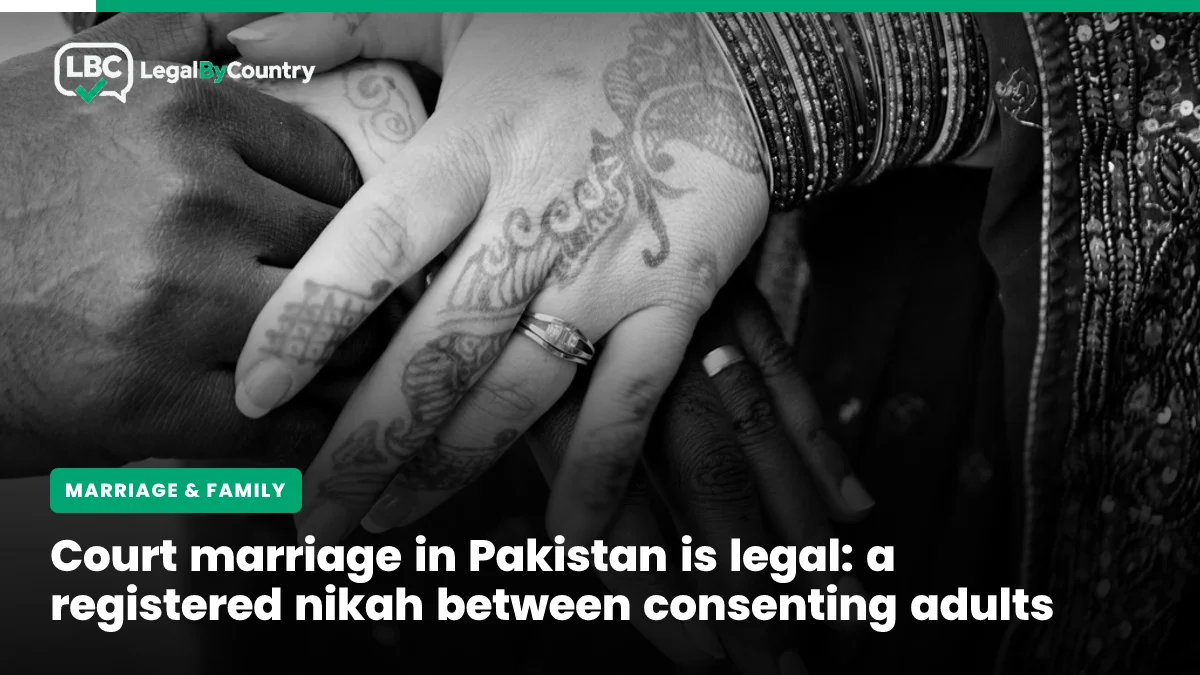
Short answer: Legal for consenting adults
Yes. A court marriage is an ordinary nikah between two consenting adults, registered with a licensed Nikah Registrar under section 5 of the Muslim Family Laws Ordinance, 1961. Both must meet their province's minimum age, which is 18 everywhere except Khyber Pakhtunkhwa.
- The law
Muslim Family Laws Ordinance, 1961, ss. 5, 6
Muslim Family Laws Ordinance, 1961 (Punjab, as amended 2015), s. 5(2A), 5(4)
Islamabad Capital Territory Child Marriage Restraint Act, 2025, ss. 2, 3
- Penalty
- Forcing a woman to marry carries three to seven years and a Rs 500,000 fine under section 498B of the Pakistan Penal Code, and failing to report a nikah for registration in Punjab carries up to three months and a Rs 100,000 fine under section 5(4).
General information only, not legal advice. For help with your own matter, consult a qualified lawyer or legal consultant. Read the disclaimer
Court marriage is legal because it is a registered nikah
Yes, court marriage is legal in Pakistan. For Muslims it is not a separate kind of marriage. It is an ordinary nikah between two consenting adults, usually performed near the courts, recorded on a nikahnama and registered under the Muslim Family Laws Ordinance, 1961.
Stand outside the district courts in Lahore, Karachi or Rawalpindi on any weekday and you will see the same row of offices: stamp-paper vendors, oath commissioners, and boards advertising "court marriage" in Urdu and English. A couple walks in with their ID cards, signs an affidavit, sits through a nikah with two witnesses, and walks out with a nikahnama. No judge hears the case. No court passes an order.
That is why the phrase confuses people. No Pakistani statute uses the words "court marriage". The label describes where the nikah happens and the paperwork around it, usually when the couple's families are not part of the arrangement. What makes the marriage lawful is the same for every Muslim couple in the country: a valid nikah, free consent of two adults, and registration with a licensed Nikah Registrar. Our marriage and family law guides cover the questions that sit around it.
Registration under the 1961 Ordinance is compulsory
Section 5 of the Muslim Family Laws Ordinance, 1961 says every marriage solemnized under Muslim law "shall be registered". The Union Council licenses Nikah Registrars, and anyone who performs a nikah without being the Registrar must report it to one.
The text of section 5 of the Ordinance sets out four working rules:
- Every Muslim marriage must be registered (section 5(1)).
- The Union Council grants licences to Nikah Registrars (section 5(2)).
- A nikah not performed by the Registrar must be reported to him by the person who performed it (section 5(3)).
- The nikahnama form, the registers and the fees are set by rules, and anyone can inspect the record or get a copy at the Union Council (sections 5(5) and 5(6)).
The penalty falls on whoever fails to report
In the federal text, which applies in Islamabad, failing to report a nikah to the Registrar carries simple imprisonment of up to three months, a fine of up to Rs 1,000, or both. Punjab rewrote section 5 through the Punjab Muslim Family Laws (Amendment) Act, 2015. The Punjab version of the Ordinance raises that penalty to up to three months and a Rs 100,000 fine, and adds a new duty: the Registrar or nikah khawan must fill every column of the nikahnama accurately, on pain of up to one month and a Rs 25,000 fine.
Notice who the penalty targets. Section 5 punishes the person who performed the nikah and failed to report it. The Ordinance does not say an unregistered nikah is void. Even so, an unregistered marriage is hard to prove when a family files a case or a wife claims her dower, so register it on the day.
Both of you must be adults who freely agree
A nikah needs the free consent of both the man and the woman. Nobody can give that consent for an adult. Forcing a woman into marriage is a crime under section 498B of the Pakistan Penal Code, with three to seven years in prison.
The Pakistan Penal Code backs this up in three places. Section 498B punishes anyone who "coerces or in any manner whatsoever compels a woman to enter into marriage" with three to seven years and a fine of Rs 500,000. Section 365B punishes kidnapping or abducting a woman to compel her to marry against her will with imprisonment for life. Section 496 punishes going through a marriage ceremony fraudulently, knowing it is not a lawful marriage, with up to seven years.
Consent also means you must be legally free to marry. If either of you is already married, the earlier marriage matters. A woman needs proof that her earlier marriage has ended. A man who already has a wife needs written permission from the Arbitration Council under section 6 of the Ordinance before a second marriage, and the Registrar is barred from registering one without it. We cover that in our guide on second marriage without the first wife's permission.
The minimum age depends on where the nikah takes place
In Islamabad, Punjab, Sindh and Balochistan, both the bride and groom must be at least 18. Khyber Pakhtunkhwa still applies the Child Marriage Restraint Act, 1929, which sets 18 for males and 16 for females.
| Where | Law in force (as of 16 November 2026) | Minimum age | Registrar rule |
|---|---|---|---|
| Islamabad Capital Territory | ICT Child Marriage Restraint Act, 2025 | 18 for both | Must not register if either party is under 18; must check both CNICs (s. 3) |
| Punjab | Punjab Child Marriage Restraint Act, 2026 (Gazette, 11 May 2026) | 18 for both | Must not register a child marriage (s. 3) |
| Sindh | Sindh Child Marriages Restraint Act, 2013 | 18 for both | Anyone who facilitates a child marriage faces two to three years (s. 4) |
| Balochistan | Balochistan Child Marriages Restraint Act, 2025 | 18 for both | Nikah khawan, Registrar and UC Secretary must keep both CNICs (s. 5) |
| Khyber Pakhtunkhwa | Child Marriage Restraint Act, 1929 | 18 for males, 16 for females | Solemnizing a child marriage is an offence (s. 5) |
The Islamabad, Punjab and Balochistan laws make the CNIC the practical test of age. A nikah office near the courts that is asked to marry someone without a CNIC, or with a date of birth under 18, should refuse. Penalties under the new provincial laws run to years in prison, not the one month of the 1929 Act. Our guide on whether child marriage is illegal sets those out province by province.
The wali question is separate from the legality of the procedure
Many court marriages happen because a woman's father or family will not agree. Whether a nikah without the wali's consent is valid is a question of Muslim personal law and case law, not of the court-marriage procedure, and it deserves its own answer.
Pakistan's superior courts have dealt with this question directly, most famously in a 2004 Supreme Court judgment. We explain what the courts have held, and what they have not, in our guide on whether a marriage without the father's consent is valid. For this guide the point is narrower: the 1961 Ordinance and the provincial age laws do not list a wali's signature as a condition of registration.
You will need identity documents, witnesses and a nikahnama
Expect to bring original CNICs for both of you, two adult witnesses with their CNICs, and proof that any earlier marriage has ended. Most court-marriage offices also prepare a sworn affidavit of free will, though no statute requires one.
- CNICs. The Islamabad Act (section 3(2)) and the Balochistan Act (section 5) expressly require the Registrar to check NADRA-issued identity documents showing both dates of birth.
- Two witnesses. The nikahnama form has columns for witnesses, and Registrars ask for their CNICs.
- Proof of status. A divorce certificate, khula decree or death certificate if either party was married before, and Arbitration Council permission if the husband already has a wife.
- Affidavit of free will. A statement on stamp paper, attested by an oath commissioner, saying each of you is an adult marrying by choice. Courts often see it as useful evidence of consent, but it does not replace the nikah or the registration.
- Photographs. Many offices ask for passport-size photos; the number varies.
After registration you can ask the Union Council for a computerised marriage registration certificate. The Faisalabad district government's own help page, for example, asks for the registered nikahnama and the CNICs of the husband, wife and their parents, and lists a fee of Rs 300 (as of 16 November 2026). Fees and lists differ between districts, so confirm with your Union Council.
The lawful route follows a fixed order
The safe sequence is simple: check that you are both eligible, gather documents, perform the nikah before a licensed Registrar or report it to one, then collect the registered nikahnama and the Union Council certificate.
- Confirm you are both at least the legal age for your province and that neither of you is married, or that a husband has Arbitration Council permission.
- Collect original CNICs, two adult witnesses with CNICs, and any divorce or death certificate.
- If you choose to, sign affidavits of free will before an oath commissioner.
- Have the nikah performed with both of you present, saying your consent yourselves, and the dower (haq mehr) written in the nikahnama.
- Read every column of the nikahnama before signing, including the column on delegated right of divorce, and make sure nothing is left blank or struck out without your agreement.
- Make sure the nikah is entered in the Nikah Registrar's register for the ward, and take your copies of the nikahnama.
- Apply to the Union Council for the computerised marriage registration certificate, then update your marital status with NADRA if you need it for a passport, visa or family registration.
Avoid any office that offers to backdate a nikahnama, change a date of birth or skip the CNIC check. Those shortcuts create the very evidence that sinks a couple later, and the person who signs a false entry can face prosecution.
Courts can protect couples from harassment
When a family objects, the usual response is an abduction case or pressure through the police. The law gives adult couples three main remedies: a complaint to the Justice of the Peace, a habeas corpus petition, and a constitutional petition in the High Court.
The three remedies
- Justice of the Peace. Under section 22A(6) of the Code of Criminal Procedure, 1898, an ex-officio Justice of the Peace (in practice a Sessions or Additional Sessions Judge) can direct the police on complaints of "neglect, failure or excess", including harassment or a refusal to register a case.
- Habeas corpus. Section 491 of the Code lets the High Court order that a person "illegally or improperly detained in public or private custody" be produced and set free. Section 491(1A) lets the High Court give this power to Sessions Judges. Couples use it when a spouse is held by relatives.
- Article 199 petition. Under Article 199 of the Constitution, the High Court can direct the police and other officials to act lawfully. Couples file these "protection petitions" asking the court to stop harassment by the police or family.
When a family files an abduction case
Families sometimes register a first information report under section 365B, claiming the woman was abducted. If she is an adult who married by choice, her own statement before a magistrate or the High Court is usually decisive, and the registered nikahnama and CNICs back it up. The case still has to be answered in court, so keep originals and copies of every document safe. Remember too that the law cuts both ways: a woman taken or married against her will has the protection of sections 365B and 498B, whoever arranged it.
Everything above concerns Muslim marriages, which the 1961 Ordinance governs. Christians marry under the Christian Marriage Act, 1872, and Hindus under their own personal laws, with separate rules for interfaith couples.
Frequently asked questions
Is court marriage different from a normal nikah in Pakistan?
+
No. For Muslims, a court marriage is an ordinary nikah performed near the courts, usually with an affidavit of free will. No judge decides it, and it must be registered with a Nikah Registrar like any other nikah.
What is the minimum age for court marriage in Pakistan?
+
Eighteen for both parties in Islamabad, Punjab, Sindh and Balochistan, as of 16 November 2026. Khyber Pakhtunkhwa still applies the Child Marriage Restraint Act, 1929, which sets 18 for males and 16 for females.
Do we need our parents' permission for a court marriage?
+
The registration law does not list parental permission as a condition for adults. Whether a nikah without the wali is valid is a question of Muslim personal law and case law, which we explain in a separate guide.
Is an affidavit legally required for court marriage?
+
No statute requires one. The affidavit of free will is a common practice that gives evidence of consent and age, but the marriage depends on a valid nikah and its registration, not on the affidavit.
What happens if a nikah is not registered?
+
The person who performed it can be punished for failing to report it under section 5 of the 1961 Ordinance. The Ordinance does not declare the marriage void, but an unregistered nikah is much harder to prove in court.
Can my family file an abduction case after a court marriage?
+
They can file one, but an adult woman who married by choice can say so before a magistrate or the High Court. Couples facing harassment can also apply to the Justice of the Peace or file a protection petition.
Can a married man have a court marriage without his wife's permission?
+
No lawful second marriage can be registered without written permission from the Arbitration Council under section 6 of the Muslim Family Laws Ordinance. The Registrar is barred from registering it otherwise.
How do we get a marriage certificate after court marriage?
+
Apply to your Union Council with the registered nikahnama and CNICs for a computerised marriage registration certificate. Faisalabad lists a Rs 300 fee as of 16 November 2026; check your own Union Council.
Sources
We compiled this guide from official sources: the law itself, government notifications and court records, checked against reporting of recent changes. It is for information only.
- Muslim Family Laws Ordinance, 1961 (Ordinance VIII of 1961) · Ministry of Law and Justice (Pakistan Code)
- Muslim Family Laws Ordinance, 1961, as amended by the Punjab Muslim Family Laws (Amendment) Act, 2015 · Law and Parliamentary Affairs Department, Government of the Punjab (Punjab Code)
- Islamabad Capital Territory Child Marriage Restraint Act, 2025 (Act No. XI of 2025) · Ministry of Law and Justice (Pakistan Code)
- The Punjab Child Marriage Restraint Act 2026 (Punjab Gazette Extraordinary, 11 May 2026) · Local Government and Community Development Department, Government of the Punjab
- Sindh Child Marriages Restraint Act, 2013 (Sindh Act No. XV of 2014) · Prosecution Department, Government of Sindh
- Balochistan Child Marriages Restraint Act, 2025 (Baln. Act No. XXXIII of 2025) · Prosecution Department, Government of Balochistan
- Child Marriage Restraint Act, 1929 · Ministry of Law and Justice (Pakistan Code)
- Pakistan Penal Code, 1860 · Ministry of Law and Justice (Pakistan Code)
- Code of Criminal Procedure, 1898 · Ministry of Law and Justice (Pakistan Code)
- Constitution of the Islamic Republic of Pakistan, 1973 · Ministry of Law and Justice (Pakistan Code)
- Frequently Asked Questions: marriage registration certificate · District Government Faisalabad, Government of the Punjab
- Punjab Assembly passes bill setting minimum marriage age at 18 for both males and females (27 April 2026) · Dawn

Advocate, Supreme Court of Pakistan
Advocate of the Supreme Court of Pakistan and the Lahore High Court, former Assistant Advocate General Punjab and Assistant Attorney General for Pakistan, and adjunct professor of law in Lahore.
Full profile and credentials →
Is Child Marriage Illegal in Pakistan?
Yes. Child marriage is a crime everywhere in Pakistan. Islamabad, Punjab, Sindh and Balochistan set 18 for both sexes and jail the adult groom, parents and organisers for two to three years. Khyber Pakhtunkhwa's 1929 Act still sets 16 for girls.
Is a Second Marriage Legal Without the First Wife's Permission in Pakistan?
No. Section 6 of the Muslim Family Laws Ordinance, 1961 requires the Arbitration Council's prior written permission. Marrying without it makes the whole dower payable at once and risks up to a year in jail, though courts usually treat the second nikah as valid.
Is Adoption Legal in Pakistan?
Not in the full legal sense for Muslims. Pakistan has no adoption statute, but a family court can appoint you a child's guardian under the Guardians and Wards Act, 1890. The child keeps their birth lineage and does not inherit automatically.
Is Domestic Violence a Crime in Pakistan?
Yes. Hurting or threatening a family member is a crime under the Pakistan Penal Code everywhere. Islamabad, Sindh, Punjab, Khyber Pakhtunkhwa and Balochistan also have domestic violence laws giving survivors protection orders, and Islamabad, Sindh and KP punish some abuse directly.