

Is It Legal to Buy Dollars in the Open Market in Pakistan?
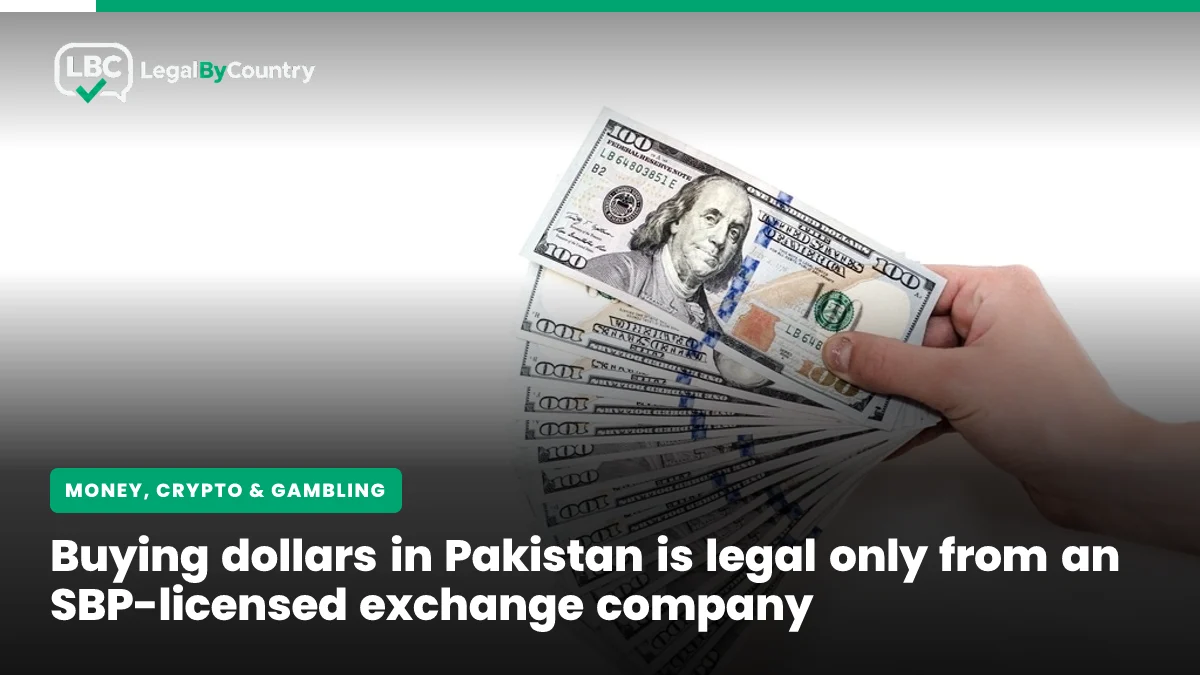
Yes, from an SBP-authorised exchange company. See the CNIC and biometric rules, the USD 10,000 daily cap and why the grey market can mean jail.
Short answer: Legal at licensed exchange companies
Yes, if you buy from an exchange company or bank authorised by the State Bank of Pakistan. Section 4 of the Foreign Exchange Regulation Act, 1947 bars dealing with anyone else, and SBP rules cap purchases at USD 10,000 a day.
- The law
Foreign Exchange Regulation Act, 1947, ss. 3AA, 4, 23, 23A
Protection of Economic Reforms Act, 1992, ss. 4, 5
SBP Regulatory Framework for Exchange Companies, Ch. 7, paras 2, 3, 5
- Penalty
- Buying or selling foreign currency outside an authorised dealer or exchange company breaches section 4(1) of the Foreign Exchange Regulation Act, 1947 and carries up to five years' rigorous imprisonment, a fine, or both, plus confiscation, under section 23(1).
General information only, not legal advice. For help with your own matter, consult a qualified lawyer or legal consultant. Read the disclaimer
Buying dollars in Pakistan's open market is legal at a licensed exchange company
Walk into an exchange company in Saddar and the cashier asks for your CNIC, then scans your thumb. Buying dollars in the open market in Pakistan is legal when the seller is authorised by the State Bank of Pakistan (SBP) and you follow its rules.
In everyday Pakistani usage, the "open market" means the counters of exchange companies, as opposed to the interbank market where banks trade with each other. That market is lawful. The illegal one is the grey market or kerb market: unlicensed dealers, shopkeepers and "money changers" who buy and sell dollars without SBP authorisation.
The law behind this is the Foreign Exchange Regulation Act, 1947 (FERA). Section 4(1) says that, except with SBP permission, no person other than an authorised dealer may buy, borrow, sell, lend or exchange foreign exchange with anyone who is not an authorised dealer. Section 3AA lets the SBP authorise exchange companies to deal in foreign currency notes, coins, travellers' cheques and transfers. Buy from one of them and you are inside the law. Buy from anyone else and you are outside it.
Only SBP-authorised exchange companies and banks can sell you foreign currency
Lawful sellers are banks authorised to deal in foreign exchange and exchange companies authorised under section 3AA of FERA. A shop, a friend's contact or a man outside the market who "can arrange dollars" is not authorised, however good his rate looks.
Exchange companies serve customers mainly through three kinds of outlet under the SBP's Regulatory Framework for Exchange Companies (RFEC): branches, currency exchange booths and payment booths. Each outlet must display a signboard showing its type and must hold an SBP authorisation letter. Every transaction has to be entered in the company's central computer system in real time, and you must get a system-generated receipt. A handwritten slip is a warning sign, because the RFEC treats any deal not recorded in that system as an "out of books" transaction.
How to check that a dealer is licensed
- Look the company and the outlet address up in the SBP's list of exchange company outlets. The version we checked was last updated on 13 October 2026 and lists 1,491 outlets.
- Expect the counter to ask for your original CNIC and, above the threshold, a fingerprint scan. A dealer who asks for nothing is not following SBP rules.
- Insist on a printed receipt carrying the company name, the amount, the rate and your identity document number.
The SBP sets identity checks, purpose rules and limits on every purchase
Paragraph 5 of Chapter 7 of the RFEC, last revised on 14 November 2025, sets the rules for selling foreign currency to individuals. Each rule starts at a fixed dollar amount, and the daily and yearly caps count all exchange companies together.
| Amount you buy (USD or equivalent) | What the exchange company must do | Rule (as of 16 November 2026) |
|---|---|---|
| Any amount | See your original CNIC, NICOP, POC or passport and keep a copy | RFEC Ch. 7, para 5(b) |
| 500 or more | Verify Pakistani nationals biometrically through NADRA and keep the record | RFEC Ch. 7, para 5(c) |
| 1,000 or more | Record the purpose and your source of funds, and take supporting documents | RFEC Ch. 7, para 5(e) |
| 2,000 or more | Take your rupee payment by bank transfer or cheque from your own personal account, not cash | RFEC Ch. 7, para 5(f) |
| Any amount going into your foreign currency account | Account-to-account only: rupees from your account, dollars credited to your FCY account | RFEC Ch. 7, para 5(g), added by EPD Circular Letter No. 10 of 2025 |
| Per person per day | Maximum 10,000 from all exchange companies combined | RFEC Ch. 7, para 5(h)(i) |
| Per person per calendar year | Maximum 100,000 from all exchange companies combined | RFEC Ch. 7, para 5(h)(ii) |
The daily and yearly caps include cash, account transfers and outward remittances. At every purchase you sign an undertaking that you have not already reached either limit and will not cross it with this deal. The company must also record each sale against an SBP purpose code, such as travel, education or health.
Biometric and face checks
If NADRA cannot verify your fingerprints because of a disability, an injury, mehndi on your hands or a system outage, the RFEC lets the company accept an original online Verisys slip from NADRA instead. ProPakistani reported on 11 December 2025 that the SBP had told exchange companies to add facial recognition to NADRA biometric checks from 1 January 2026. We could not find that instruction in a public SBP circular, so expect a face scan at some counters and fingerprints at all of them.
Purpose limits on top of the caps
The RFEC also tells exchange companies to follow "purpose specific limits under the applicable regulations". In January 2024, Profit reported lower caps for travel purchases. We could not find a current SBP circular that publishes purpose-wise figures, so ask the exchange company what it can sell for your purpose before you go with a large amount.
Dollars bought for a purpose must be used for that purpose
Tell an exchange company you are buying dollars for travel, fees or treatment, and the law expects you to spend them on that. Section 4(3) of FERA says currency bought for a purpose that cannot be used for it must be sold back without delay.
The same idea appears in the Protection of Economic Reforms Act, 1992. Section 4(1) gives every citizen the freedom to "bring, hold, sell, transfer and take out" foreign exchange. But section 4(2)(f), inserted by the Finance Act, 2018, says that freedom does not cover foreign exchange bought from an authorised dealer, money changer or exchange company in Pakistan for a stated purpose. In plain terms, buying dollars for "travel" and then sitting on them as savings is not what the law protects.
Honesty at the counter matters for a second reason. The purpose you declare and the documents you hand over are part of the transaction record, which the SBP and the Financial Monitoring Unit can later examine.
Keeping foreign currency is legal, and a bank account is the safest place for it
Pakistani citizens may hold foreign currency under section 4(1) of the Protection of Economic Reforms Act, 1992, and may open foreign currency accounts with banks. The limits fall on how you buy, how much cash you move and how you deposit it.
- Foreign currency accounts. Residents can open FCY accounts with authorised banks under Chapter 6 of the SBP's Foreign Exchange Manual. Since the November 2025 circular, dollars you buy from an exchange company to put in that account must move account to account.
- Cash deposits need a filer. A proviso added to section 5(4) of the Protection of Economic Reforms Act by the Finance Act, 2018 says no cash may be deposited in a resident citizen's foreign currency account unless the account holder is a filer under the Income Tax Ordinance, 2001.
- Moving cash. Section 4(2)(g) of the same Act takes cross-border or inland movement of foreign currency cash above USD 10,000 out of the general freedom, subject to SBP limits. The travel rules have their own guide: how much cash you can carry out of Pakistan.
- Dollars at home. Keeping a modest amount of lawfully bought currency at home is not an offence in itself, but it carries theft risk and questions about where the money came from. Our guide on keeping cash at home covers that side.
The grey market is a FERA offence for the dealer and the buyer
Section 4(1) of FERA binds both sides of a deal, so buying dollars from an unlicensed dealer breaks the law as well as selling them. Section 23 punishes a contravention with rigorous imprisonment of up to five years, a fine, or both, plus confiscation.
Section 23 makes these offences cognizable, meaning police or the investigating agency can arrest without a warrant, and non-bailable. The Sessions judge of the area sits as the FERA Tribunal and tries the case. Normally a case starts on a written complaint from a person the SBP authorises, but a proviso added in 2020 removes that step where a person not authorised under sections 3, 3A or 3AA is "found involved in illegal foreign exchange business". The court can also order the currency itself confiscated.
| Point | What FERA says | Section |
|---|---|---|
| Who may deal | Only authorised dealers, or others with SBP permission | s. 4(1) |
| Maximum sentence | Rigorous imprisonment up to 5 years, or fine, or both | s. 23(1) |
| Confiscation | Currency, gold, silver or other property involved can be confiscated | s. 23(1) |
| Arrest and bail | Cognizable and non-bailable | s. 23(2) |
| Court | Sessions judge as Tribunal, to finish within 6 months (extendable by 6) | ss. 23(3B), 23A |
Figures are from the Pakistan Code text of FERA updated to 14 October 2021, as amended by Act X of 2020. We checked it on 16 November 2026.
Enforcement is active
The Federal Investigation Agency's Commercial Banking Circles run raids on unlicensed dealers. Profit reported on 12 January 2026 that FIA Karachi had arrested a man running an unlicensed money-changing business in PECHS and seized USD 16,000. Grey market deals often sit next to hundi and hawala, the informal transfer systems covered in our guide on whether hundi and hawala are legal.
The practical risks for buyers
- No receipt, so no proof you paid or what rate you were given.
- Counterfeit notes, with no one to complain to.
- Seizure of the currency if the dealer is raided while you are there.
- Exposure in a later investigation if your money moved through a network the FIA is pursuing.
Exchange companies must also follow the law when they buy from you
Selling your dollars back for rupees is also lawful at an authorised exchange company. Under paragraph 3 of Chapter 7 of the RFEC, the company keeps a copy of your CNIC or passport when you sell USD 2,500 or more.
The same paragraph allows only "ready" value date deals, meaning same-day settlement. Exchange companies are also free under section 4(2) of FERA to set their own buying and selling rates, unless the SBP directs otherwise. That is why rates differ a little from one counter to the next and from the interbank rate.
Follow these steps to buy dollars lawfully
The lawful route takes a few minutes at the counter once your documents and bank account are in order. Plan ahead for larger amounts, because anything from USD 2,000 must be paid from your own bank account and needs a purpose and paperwork.
- Pick an exchange company outlet that appears on the SBP's published list, or use your bank if you only need dollars in your foreign currency account.
- Take your original CNIC (or NICOP, POC or passport). Pakistani nationals buying USD 500 or more will be fingerprinted through NADRA.
- Decide your purpose and carry proof for USD 1,000 or more: a ticket and visa for travel, a fee voucher for education, a hospital estimate for treatment.
- For USD 2,000 or more, arrange payment by bank transfer or cheque from your personal account. Cash rupees will be refused at that level.
- If the dollars are going into your foreign currency account, ask for an account-to-account transfer instead of cash.
- Sign the undertaking that you are within USD 10,000 for the day and USD 100,000 for the year across all exchange companies.
- Collect the system-generated receipt and keep it. If you later cannot use the currency for the stated purpose, sell it back to an authorised dealer.
If something at the counter feels wrong, such as no receipt, no ID check or a rate far from the posted board, walk away and report it to the SBP. Our money and finance guides cover the neighbouring questions, from forex trading to foreign bank accounts.
Frequently asked questions
How many dollars can I buy in Pakistan in one day?
+
Up to USD 10,000 per person per day, counting all exchange companies together. The SBP's Regulatory Framework for Exchange Companies also caps purchases at USD 100,000 per calendar year, and you sign an undertaking at each purchase that you are within both limits.
Do I need a CNIC to buy dollars?
+
Yes, for any amount. The exchange company must see your original CNIC, NICOP, POC or passport and keep a copy. From USD 500 upwards, Pakistani nationals are also verified biometrically through NADRA.
Can I pay cash rupees for dollars?
+
Only below USD 2,000. For USD 2,000 or more, the exchange company must receive the rupees by bank transfer or cheque from your own personal account, and note the bank and reference on the receipt.
Is it illegal to buy dollars from a money changer in the market?
+
Yes, if that dealer is not authorised by the SBP. Section 4(1) of the Foreign Exchange Regulation Act, 1947 bars dealing with anyone other than an authorised dealer, and section 23 punishes breaches with up to five years in prison, a fine, or both.
Can I keep dollars at home in Pakistan?
+
Holding foreign currency is generally allowed under section 4(1) of the Protection of Economic Reforms Act, 1992. Dollars bought for a stated purpose such as travel should be used for it or sold back, under section 4(3) of FERA.
Can I deposit dollars in cash into my foreign currency account?
+
Only if you are a filer. A proviso to section 5(4) of the Protection of Economic Reforms Act, 1992, added in 2018, bars cash deposits into a resident citizen's foreign currency account unless the holder is a filer under the Income Tax Ordinance, 2001.
Why do exchange companies ask the purpose of buying dollars?
+
SBP rules require them to. For USD 1,000 or more they must record the purpose and your source of funds and take supporting documents, and every sale is logged against an SBP purpose code such as travel, education or health.
How can I check if an exchange company is licensed?
+
Search the SBP's published list of exchange company outlets, which gives each company, address, outlet type and city. The version we checked was updated on 13 October 2026. A licensed counter checks your ID and issues a system-generated receipt.
Sources
We compiled this guide from official sources: the law itself, government notifications and court records, checked against reporting of recent changes. It is for information only.
- Foreign Exchange Regulation Act, 1947 (updated till 14.10.2021) · Ministry of Law and Justice (Pakistan Code)
- Protection of Economic Reforms Act, 1992 (Act XII of 1992, as amended by the Finance Act, 2018) · State Bank of Pakistan
- Regulatory Framework for Exchange Companies · Exchange Policy Department, State Bank of Pakistan
- EPD Circular Letter No. 10 of 2025: Amendment in Instructions Related to Sale of Foreign Currencies to Individuals (14 November 2025) · State Bank of Pakistan
- EPD Circular Letter No. 05 of 2026: Instructions regarding Foreign Currency Accounts and Non-resident Rupee Accounts (24 March 2026) · State Bank of Pakistan
- Exchange Companies: Network Position of Exchange Companies (as on 13 October 2026) · State Bank of Pakistan
- Public Now Has to Go Through Facial Scans for Purchase and Sale of Foreign Currency (11 December 2025) · ProPakistani
- FIA arrests suspect in illegal currency exchange crackdown in Karachi, seizes $16,000 (12 January 2026) · Profit (Pakistan Today)
- SBP enforces new measures to control US dollar transactions (19 January 2024) · Profit (Pakistan Today)
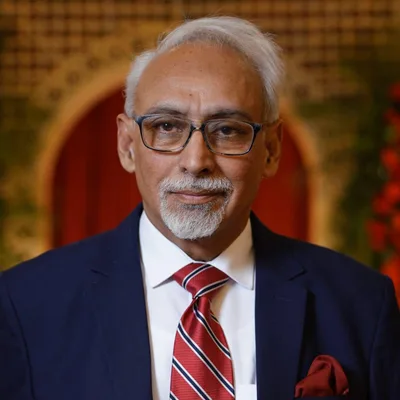
Advocate, Supreme Court of Pakistan
Advocate of the Supreme Court of Pakistan and the Lahore High Court, former Assistant Advocate General Punjab and Assistant Attorney General for Pakistan, and adjunct professor of law in Lahore.
Full profile and credentials →
Is Hundi or Hawala Legal in Pakistan?
No. Moving money through an unlicensed hundi or hawala dealer breaks sections 4 and 5 of the Foreign Exchange Regulation Act, 1947, punishable with up to five years in prison. Crime-linked transfers can add money laundering charges carrying up to ten years.
How Much Cash Can You Legally Carry Out of Pakistan?
Only within fixed limits. Under rule 7A of the Baggage Rules, 2006 and FERA 1947, adults may take USD 5,000 per trip and USD 30,000 a year, minors half that, plus Rs 10,000. All foreign currency must be declared at departure.

Is Forex Trading Legal in Pakistan?
Only through regulated local channels. Currency futures on PMEX through an SECP-licensed broker are lawful, but the State Bank says residents buying from offshore forex or CFD apps, or sending them money, breaks sections 4(1) and 5(1) of FERA, 1947.
Are Prize Bonds Still Legal in Pakistan?
Yes. Rs 100, Rs 200, Rs 750 and Rs 1,500 bearer bonds and registered Premium Prize Bonds remain valid. The Rs 7,500, Rs 15,000, Rs 25,000 and Rs 40,000 bearer bonds were withdrawn, and the last date to encash them was 31 December 2024.